
Large Vision-Language Models Get Lost in Attention
Abstract
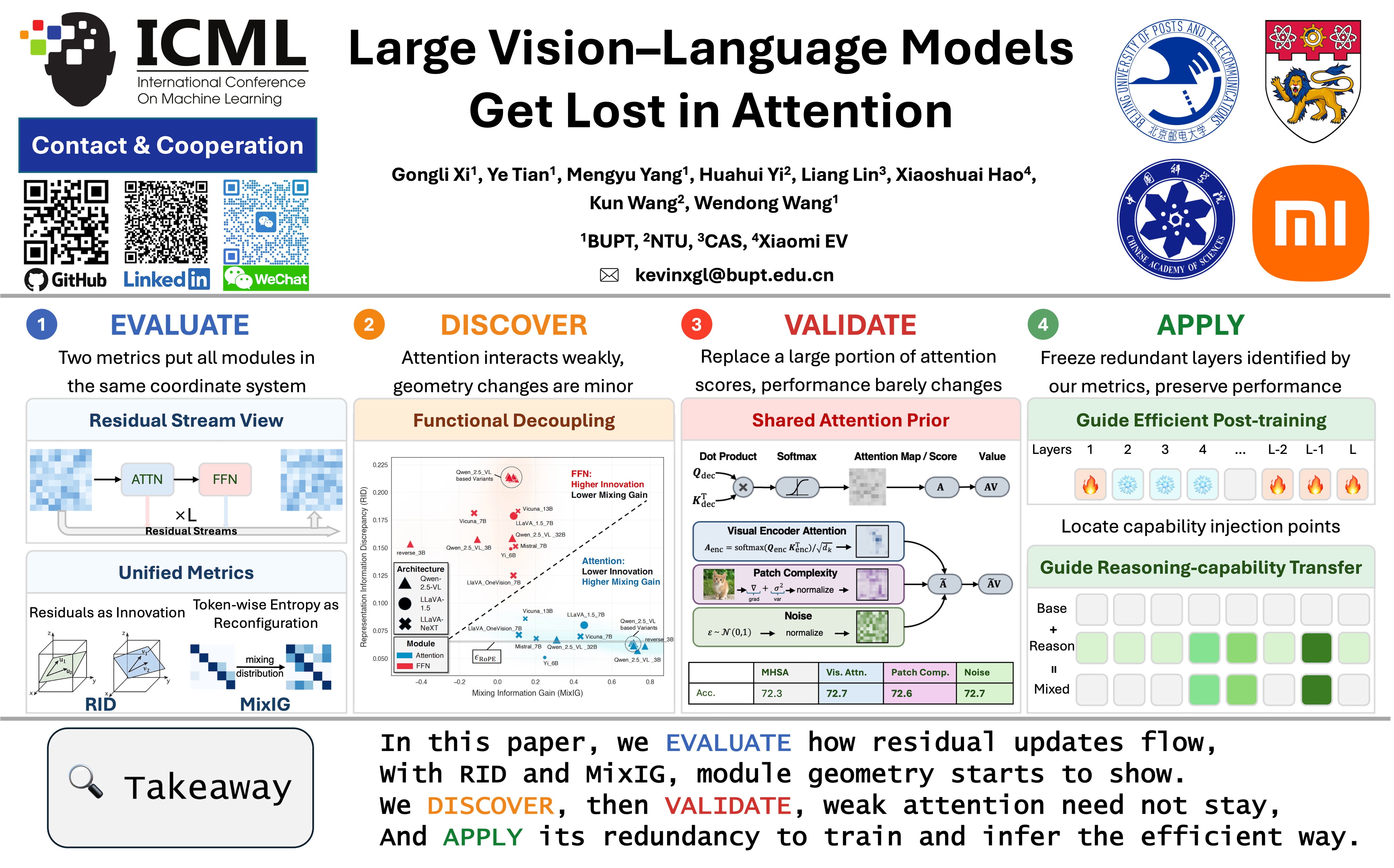
Despite the rapid evolution of training paradigms, the decoder backbone of large vision--language models (LVLMs) remains fundamentally rooted in the residual-connection Transformer architecture. Therefore, deciphering the distinct roles of internal modules is critical for understanding model mechanics and guiding architectural optimization. While prior statistical approaches have provided valuable attribution-based insights, they often lack a unified theoretical basis. To bridge this gap, we propose a unified framework grounded in information theory and geometry to quantify the geometric and entropic nature of residual updates. Applying this unified framework reveals a fundamental functional decoupling: Attention acts as a subspace-preserving operator focused on reconfiguration, whereas FFNs serve as subspace-expanding operators driving semantic innovation. Strikingly, further experiments demonstrate that replacing learned attention weights with predefined values (e.g., Gaussian noise) yields comparable or even superior performance across a majority of datasets relative to vanilla models. These results expose severe misallocation and redundancy in current mechanisms, suggesting that state-of-the-art LVLMs effectively ``get lost in attention'' rather than efficiently leveraging visual context.
Lay Summary
Large vision-language models can answer questions about images, but it is still unclear how they actually use visual information inside the model. In particular, modern models spend a large amount of computation on attention, the mechanism that decides which parts of the input should interact with each other. We study this question by measuring how different parts of the model change its internal representations. Our analysis shows a clear division of labor: attention mainly rearranges information that is already present, while feed-forward layers introduce more new semantic information. We further find that visual attention is often poorly allocated, meaning that the model may focus its interactions away from the image regions that are most relevant to the question. Surprisingly, replacing some learned attention scores with simple predefined patterns, or even noise in selected layers, often preserves or improves performance across several vision-language benchmarks. These findings suggest that current vision-language models may spend substantial computation on redundant attention operations. Our work provides a new way to diagnose this inefficiency and may help guide the design of more reliable and efficient multimodal models.