
DyCon: Dynamic Reasoning Control via Evolving Difficulty Modeling
Abstract
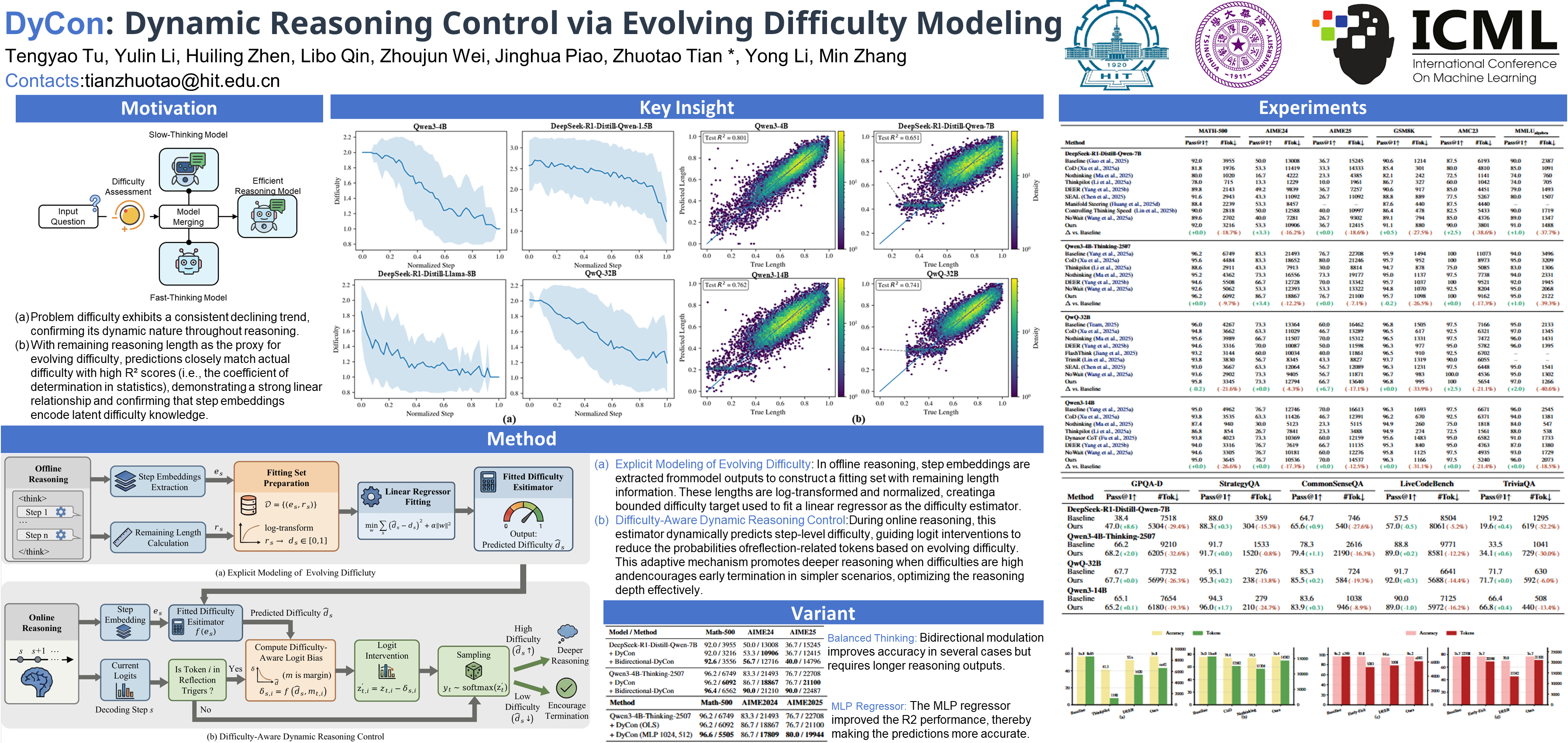
Recent advances in Large Reasoning Models (LRMs) demonstrate remarkable performance improvements by iteratively reflecting, exploring, and executing complex tasks, yet suffer from inefficiencies due to redundant reasoning, known as ``overthinking''. Existing methods to mitigate this issue either rely on static difficulty estimates or require task-specific training, and thus fail to adapt to the dynamic complexity during reasoning. In this work, we empirically show that the problem difficulty evolves dynamically throughout the reasoning process and is linearly encoded in the LRM’s step-level embeddings. Building on this insight, we propose DyCon, a training-free framework that leverages latent step-level representations to explicitly model the evolving task difficulty, enabling the dynamic control of reasoning depth to mitigate the overthinking issue. Extensive experiments conducted on four models ranging from 4B to 32B, and across twelve benchmarks in math reasoning, general question answering, and coding tasks demonstrate that DyCon significantly enhances reasoning efficiency by reducing redundant steps without sacrificing accuracy or generalization. Project page and code are available at https://github.com/yu-lin-li/DyCon.
Lay Summary
Large AI models can solve difficult problems by reasoning step by step, but they often spend too much time producing unnecessary reasoning before giving an answer. This makes them slower and more expensive to use. A key challenge is that the amount of reasoning needed is not fixed: a problem may become easier or harder as the model works through it. In this paper, we show that this changing difficulty can be estimated from the model’s internal signals during reasoning. Based on this finding, we introduce DyCon, a method that dynamically controls how long the model continues reasoning without requiring additional training. DyCon helps the model reduce redundant reasoning while keeping its problem-solving accuracy. We evaluate DyCon on multiple large reasoning models and a wide range of math, question answering, and coding tasks. The results show that DyCon can make reasoning models more efficient while preserving their general ability to solve difficult problems.