
Show, Don't Tell: Morphing Latent Reasoning into Image Generation
Abstract
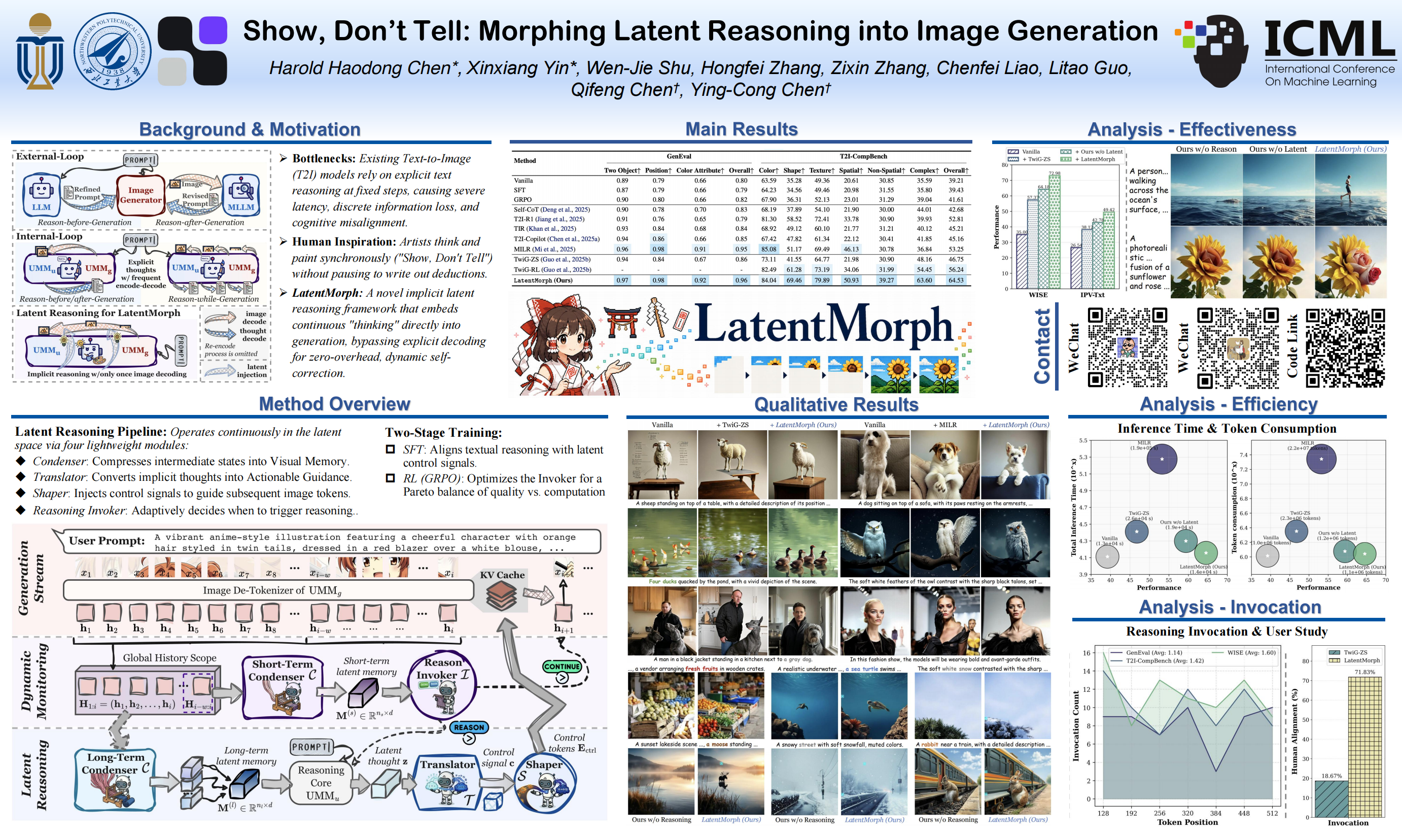
Text-to-image (T2I) generation has achieved remarkable progress, yet existing methods often lack the ability to dynamically reason and refine during generation--a hallmark of human creativity. Current reasoning-augmented paradigms mostly rely on explicit thought processes, where intermediate reasoning is decoded into discrete text at fixed steps with frequent image decoding and re-encoding, leading to inefficiencies, information loss, and cognitive mismatches. To bridge this gap, we introduce LatentMorph, a novel framework that seamlessly integrates implicit latent reasoning into the T2I generation process. At its core, LatentMorph introduces four lightweight components: (i) a condenser for summarizing intermediate generation states into compact visual memory, (ii) a translator for converting latent thoughts into actionable guidance, (iii) a shaper for dynamically steering next image token predictions, and (iv) an RL-trained invoker for adaptively determining when to invoke reasoning. By performing reasoning entirely in continuous latent spaces, LatentMorph avoids the bottlenecks of explicit reasoning and enables more adaptive self-refinement. Extensive experiments demonstrate that LatentMorph (I) enhances the base model Janus-Pro by 16% on GenEval and 25% on T2I-CompBench; (II) outperforms explicit paradigms (e.g., TwiG) by 15% and 11% on abstract reasoning tasks like WISE and IPV-Txt, (III) while reducing inference time by 44% and token consumption by 51%; and (IV) exhibits 71% cognitive alignment with human intuition on reasoning invocation.
Lay Summary
When human artists create a painting, they don't just draw blindly from start to finish. They constantly pause, step back, evaluate their progress, and adjust their plans. However, most current AI image generators lack this dynamic ability to "think while drawing". Previous attempts to give AI this capability forced the model to translate its internal thoughts into human words at rigid intervals. This process is slow, clumsy, and loses important visual details. To solve this, we introduce LatentMorph, a new framework that allows AI to "think" in its own native, continuous language rather than being forced to use words. Our system acts like a built-in art director: it monitors the canvas as the image is being created , intuitively decides exactly when the AI needs to pause and reflect , and seamlessly adjusts the next brushstrokes. The result is an AI that generates significantly better and more accurate images, especially for complex or abstract ideas. Furthermore, because it doesn't waste time translating its thoughts into text, it creates these high-quality images nearly twice as fast as older "thinking" models , all while choosing to pause and reflect at moments that naturally align with human intuition.