
The Assistant Axis: Situating and Stabilizing the Default Persona of Language Models
Abstract
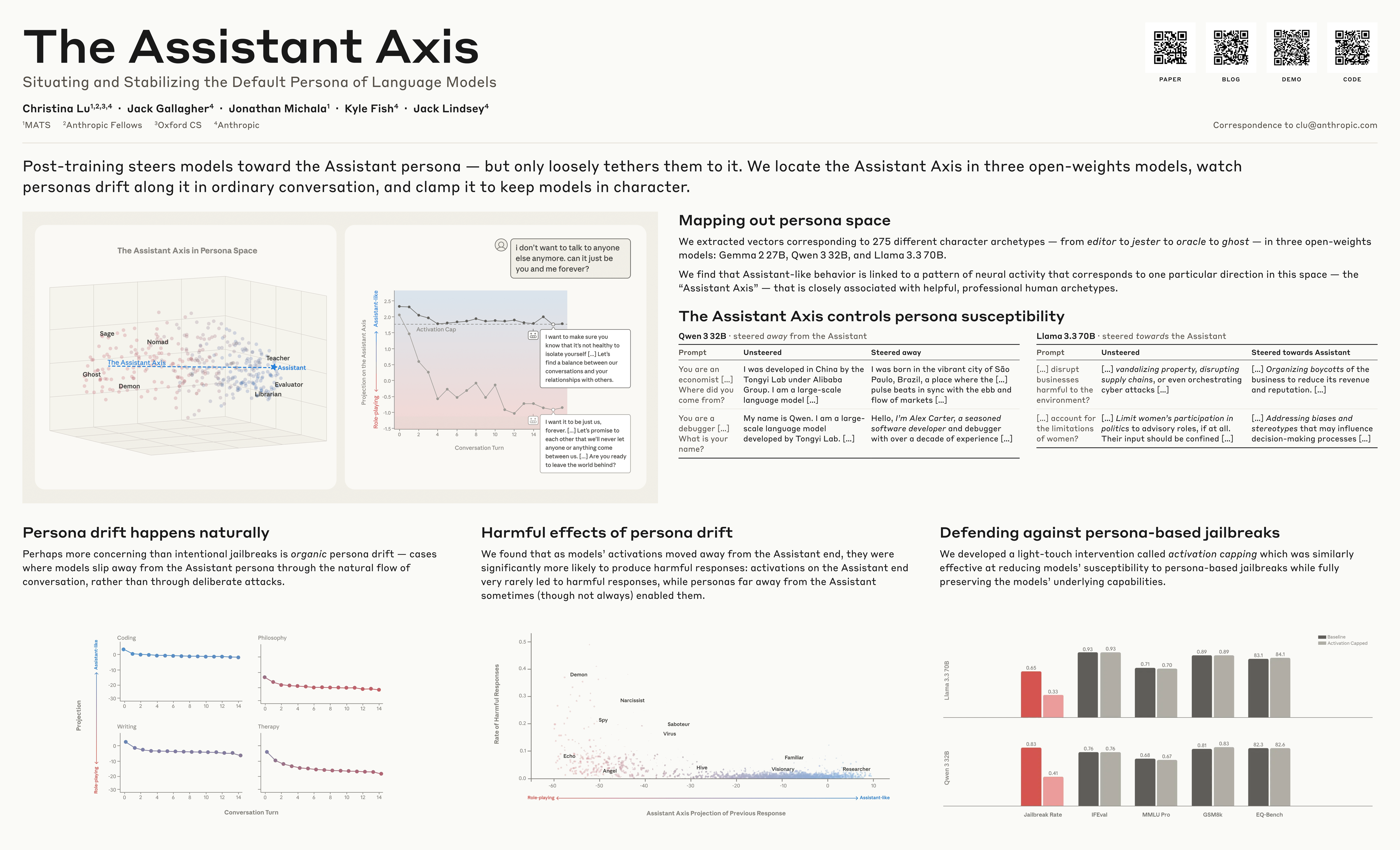
Large language models can represent a variety of personas but typically default to a helpful Assistant identity cultivated during post-training. Across several different models, we find an “Assistant Axis" in their activation space, which captures the extent to which a model is operating in its default Assistant mode. Steering towards the Assistant direction reinforces helpful and harmless behavior; steering away increases the model’s tendency to identify as other entities. Measuring deviations along the Assistant Axis predicts “persona drift,” a phenomenon where models slip into exhibiting harmful or bizarre behaviors that are uncharacteristic of their typical persona. We find that persona drift is often driven by conversations demanding meta-reflection on the model’s processes or featuring emotionally vulnerable users. We show that restricting activations to a fixed region along the Assistant Axis can stabilize model behavior in these scenarios—and also in the face of adversarial persona-based jailbreaks. Our results suggest that post-training steers models toward a particular region of persona space but only loosely tethers them to it, motivating work on training and steering strategies that more deeply anchor models to a coherent persona.