
Joint-Space Empowerment as a Theory of Dexterous Motor Coordination
Abstract
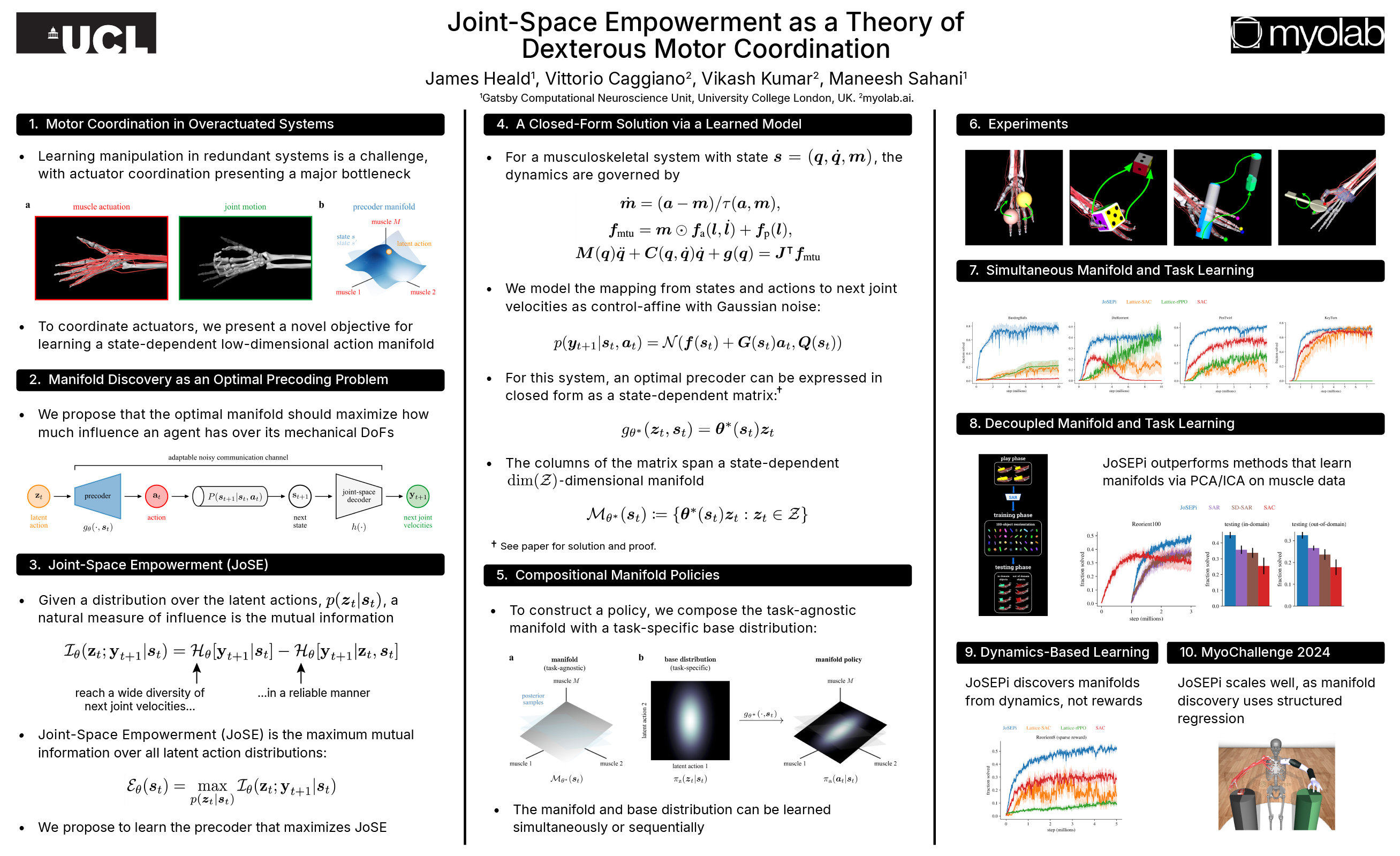
Searching for effective policies in high-dimensional action spaces is notoriously challenging. This difficulty is compounded in overactuated musculoskeletal systems, where multiple muscles span each joint, and individual muscles actuate multiple joints. Although this redundancy complicates naive policy search, it also implies that effective control can be captured by a low-dimensional action manifold. To identify such a manifold, we introduce joint-space empowerment (JSE), a novel information-theoretic principle that quantifies how much control an agent has over its body. We use JSE to discover high-empowerment action manifolds, and demonstrate that manipulation policies learned on these manifolds show significantly enhanced dexterity, sample efficiency and improved generalization. These results suggest a general principle for motor coordination in high-dimensional, overactuated systems, with implications for both biological motor control and embodied artificial agents.