
Head-in-Head in Linear Attention
Abstract
Lay Summary
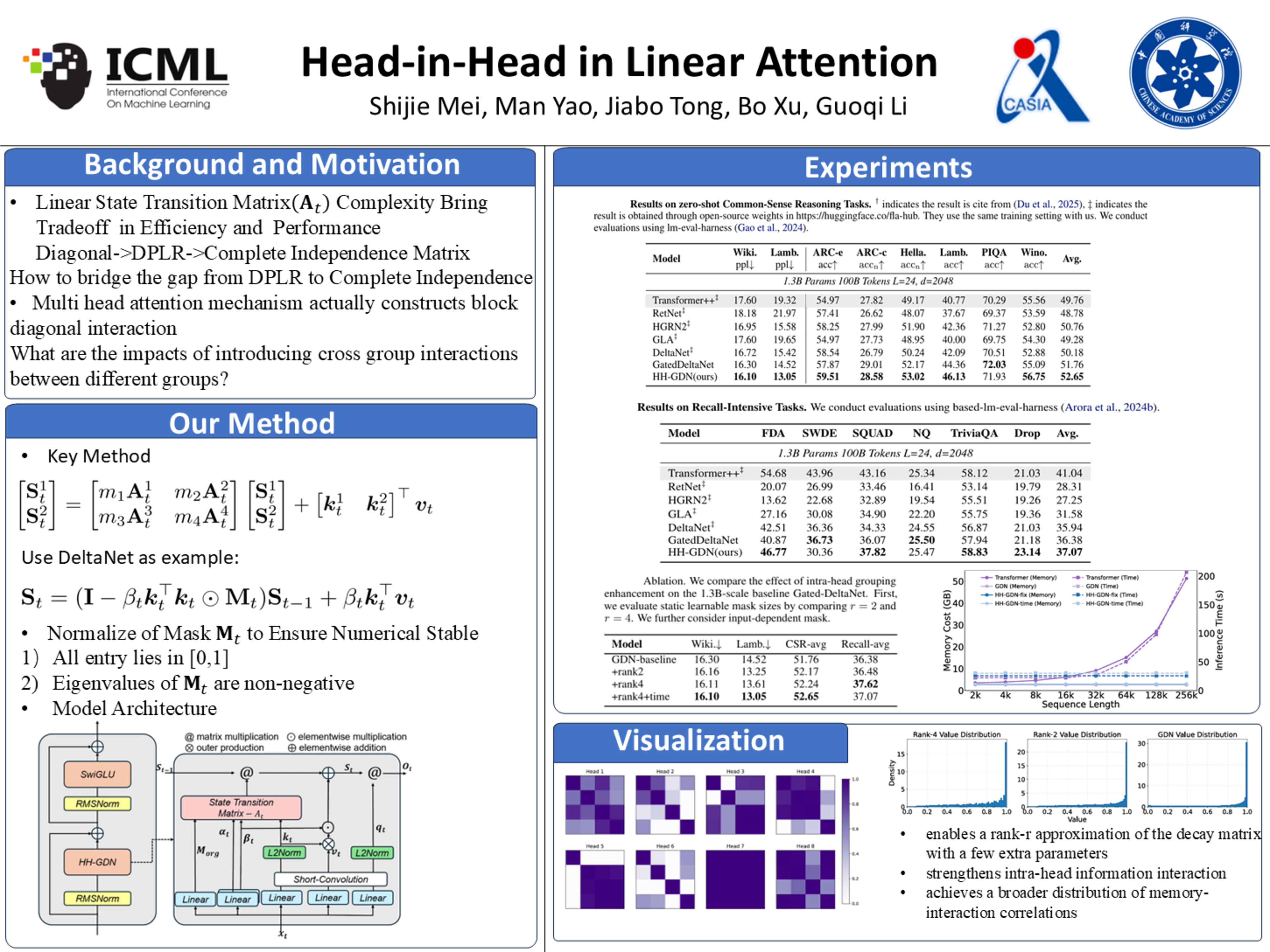
The core component of linear models is the state transition matrix, which mixes information across time steps by operating on the state from the previous time step. In this work, we investigate how far existing low-rank generation algorithms deviate from fully dense matrices, and explore how to build a bridge between the two. To this end, we introduce an additional mask matrix that performs block‑wise weighting on the original low‑rank part, effectively increasing the corresponding rank while enabling selective control over the partitioned memory states of the model. Our approach enhances the cross‑row interaction rank of the state transition matrix with minimal parameter overhead and demonstrates strong performance across various tasks. Our work reveals new possibilities for further design of state transition matrices in linear models. We have also developed corresponding operator implementations to facilitate further research in this direction.