
Federated Data and Feature Selection by Generalized CUR Decomposition
Abstract
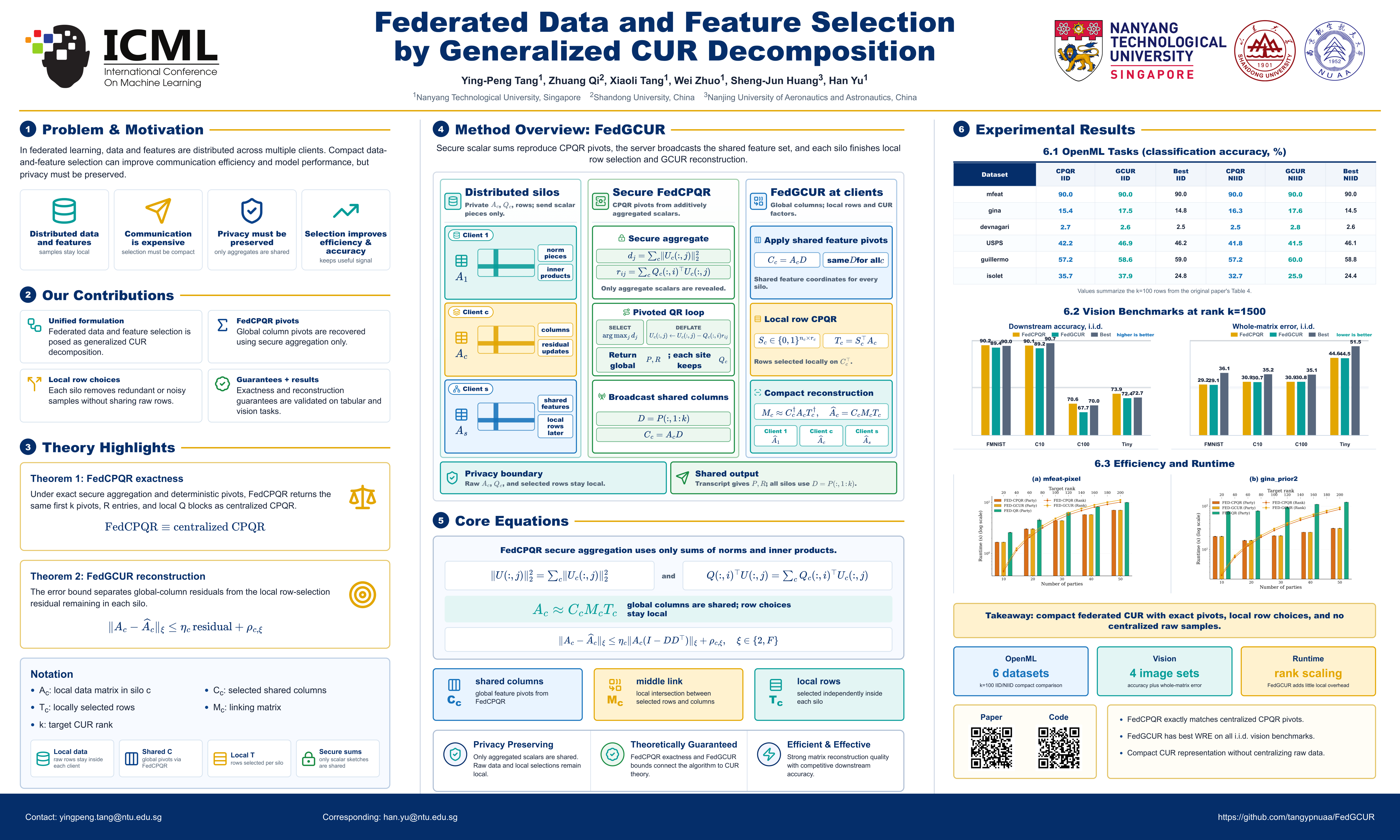
With the advance of federated learning (FL) in privacy-sensitive domains, the need for efficient and robust training becomes increasingly urgent. Communication bottlenecks, heterogeneous client distributions, and fairness requirements make it essential to select the “right” data and features for model training. Yet existing FL research often addresses feature selection and data selection separately, ignoring their interplay in real-world high-dimensional and noisy datasets, leading to suboptimal performance. In this paper, we propose a unified framework for data and feature selection by formulating the problem as a generalized CUR decomposition problem. We introduce FedGCUR, a practical framework that integrates a federated column-pivoted QR (FedCPQR) decomposition routine with per-silo row selection. We prove that FedCPQR produces exactly the same decomposition results as centralized CPQR and establish an upper bound of the reconstruction error of FedGCUR. Experiments on tabular tasks and vision benchmarks show strong downstream accuracy and absolute CUR reconstruction quality compared with representative data and feature selection baselines.
Lay Summary
Many organizations, such as hospitals, banks, or research labs, may want to train a shared AI model, but they cannot pool their raw data in one place. This setting, called federated learning, can still be slow and wasteful because each site may have many redundant examples and many unhelpful measurements. Existing methods usually choose either useful examples or useful measurements, but not both together. We propose FedGCUR, a method that selects a compact set of shared measurements across all sites and representative examples inside each site. Instead of sending raw records, the sites only combine simple aggregate statistics needed to agree on the shared measurements. The selected measurements and examples form a smaller “sketch” of the distributed data that can be used for training or reconstruction. We prove that the feature-selection step matches the corresponding centralized algorithm under exact secure aggregation, and we bound the reconstruction error of the full method. Experiments on tabular and vision datasets show that FedGCUR keeps strong predictive performance while providing good data reconstruction quality. This can make federated learning more communication-efficient and practical in privacy-sensitive applications.