
Instance-Level Costs for Nuanced Classifier Evaluation
Abstract
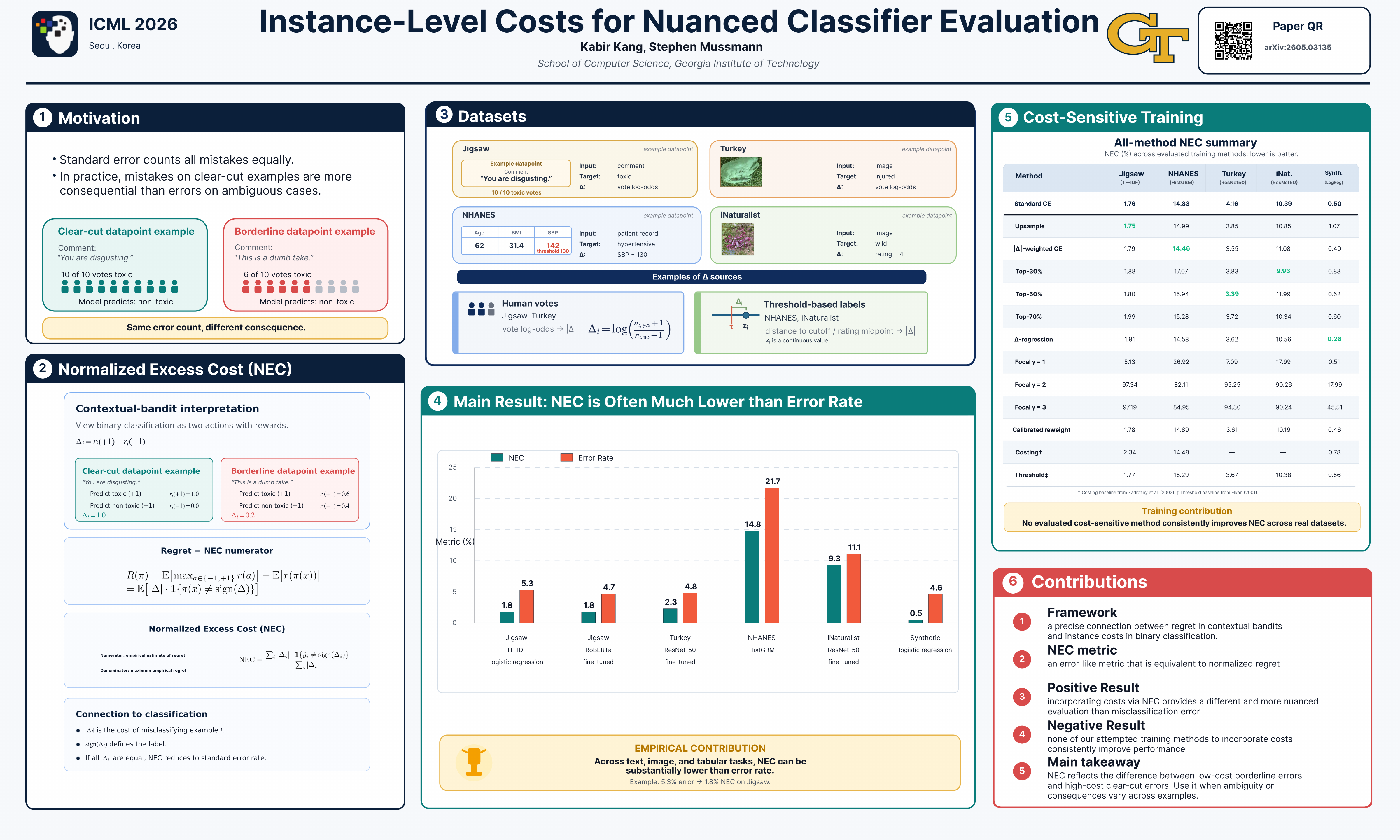
Standard classification treats all errors equally, but in applications such as content moderation and medical screening, mistakes on clear-cut cases are more costly than errors on ambiguous ones. From a contextual bandit framework, we propose normalized excess cost (NEC), a metric that weighs classification errors by per-example costs and reduces to standard error rate when costs are uniform. Costs can derive from annotator vote margins, distance from decision thresholds, or confidence ratings. Across text, image, and tabular benchmarks, we find that NEC is often substantially lower than error rate—models with 5% error rate can achieve 1.8% NEC—revealing that most mistakes concentrate on ambiguous, low-cost examples. We also find that incorporating costs into training via loss weighting, sampling strategies, or regression yields inconsistent benefits. Our framework provides a practical methodology for deriving and evaluating instance-level misclassification costs, even if cost-sensitive training offers limited benefit.
Lay Summary
When a machine learning system makes a mistake, traditional evaluation treats every error the same. But in the real world, some mistakes matter more than others. A content moderation system that misses a clearly hateful comment causes more harm than one that gets confused on a borderline joke. The current way of measuring "accuracy" misses this distinction entirely.We propose a new way to score classifiers that weighs each mistake by how much it actually matters. The weight comes from sources already present in the data — how strongly human annotators agree on a label, or how far a measurement sits from a clinical decision boundary. When we measured popular models with this new score across content moderation, medical, and image-classification tasks, we found that systems often look much better than their error rate suggests: most of their mistakes happen on cases that even humans find genuinely ambiguous. We also tested whether training models with this importance signal makes them better. Surprisingly, it usually doesn't — a finding that points to open questions about when cost-aware training actually helps.