
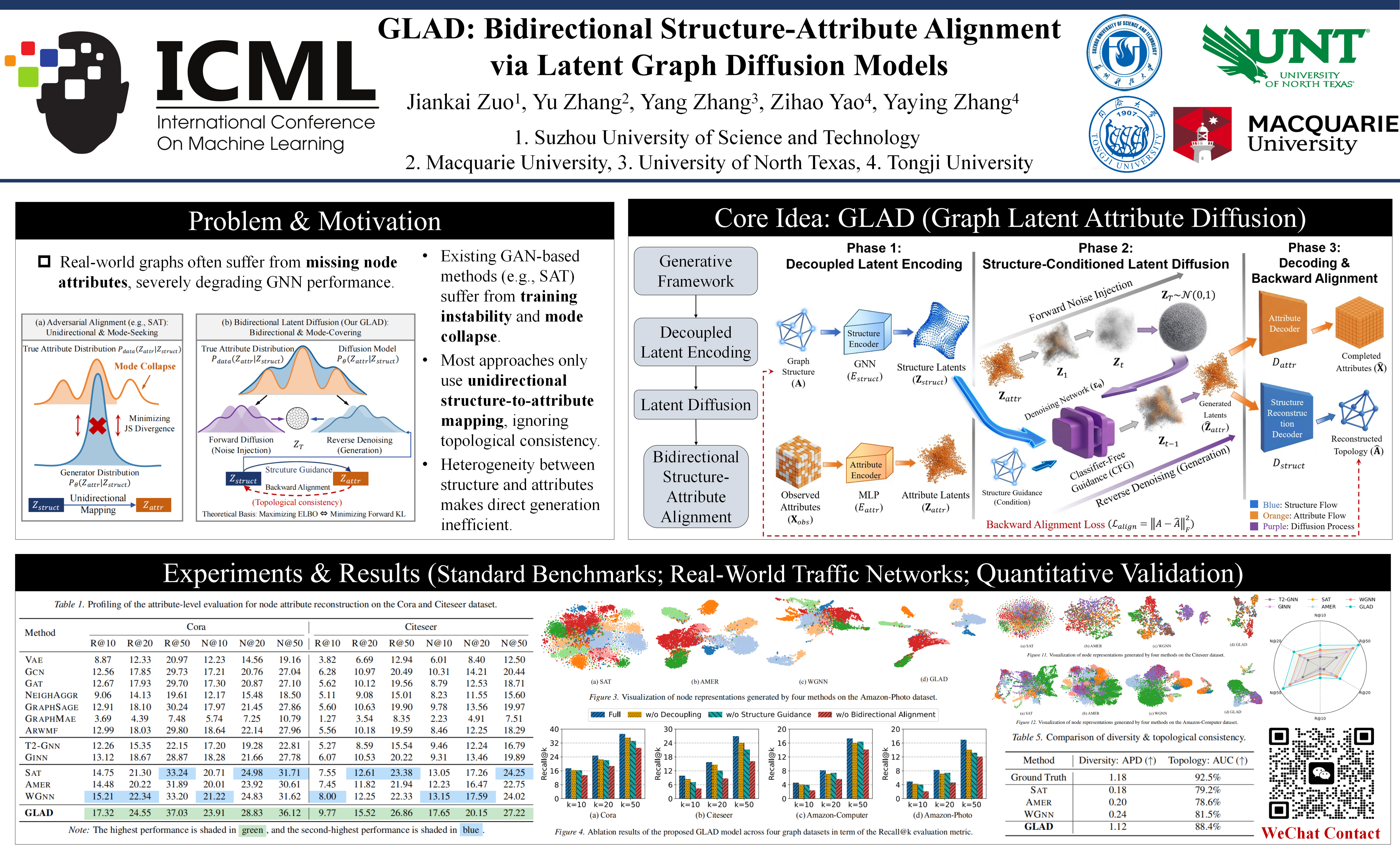
GLAD: Bidirectional Structure-Attribute Alignment via Latent Graph Diffusion Models
Abstract
Learning on graphs with missing node attributes is a prevalent yet challenging problem in real-world scenarios, as graph neural networks (GNNs) typically rely on complete attribute information. Existing solutions often employ adversarial learning in a shared latent space to align graph structure and attributes. However, these methods frequently suffer from training instability and mode collapse, failing to fully capture the complex, multi-modal joint distribution of topology and features. To address these limitations, we present GLAD, a novel generative framework for robust node attribute completion. GLAD leverages the strong generative capabilities of diffusion models to learn the conditional distribution of attributes given the graph structure within a decoupled latent space. Unlike previous unidirectional approaches, GLAD introduces a robust bidirectional alignment mechanism. Specifically, we incorporate a structure reconstruction constraint during training and structure-aware classifier-free guidance during sampling, ensuring that generated attributes are not only plausible but also maintain strict topological consistency with the underlying graph. Theoretically, we show that GLAD maximizes a tighter variational lower bound on the joint log-likelihood compared to GAN-based predecessors, leading to superior mode coverage. Extensive experiments on large-scale benchmarks demonstrate that GLAD significantly outperforms state-of-the-art baselines in both attribute recovery quality and downstream task performance.
Lay Summary
Networks, such as social platforms or city traffic systems, map out how things are connected and hold specific details about each individual piece. However, in the real world, important details are frequently missing due to issues like privacy rules, high costs, or broken recording sensors. This missing information makes it significantly harder for artificial intelligence to understand the system and make accurate predictions. Older AI methods have tried to guess this missing information, but they are often unstable to train and tend to make repetitive, limited guesses that fail to capture complex realities. To solve this, we introduce GLAD, a new generative AI framework that uses diffusion to fill in these missing network details. GLAD stands out because it uses a unique two-way checking system. It not only uses the network's existing connections to guess the missing details, but it also strictly ensures that its new guesses logically fit the overall shape of the network. In our tests, GLAD significantly outperformed previous methods at accurately recovering lost information. When applied to real-world city traffic maps with missing sensor data, GLAD successfully improved the accuracy of travel time estimates and traffic jam predictions. This approach offers a much more reliable way to build intelligent systems when dealing with incomplete data.