
Online Social Welfare Function-based Resource Allocation
Abstract
Lay Summary
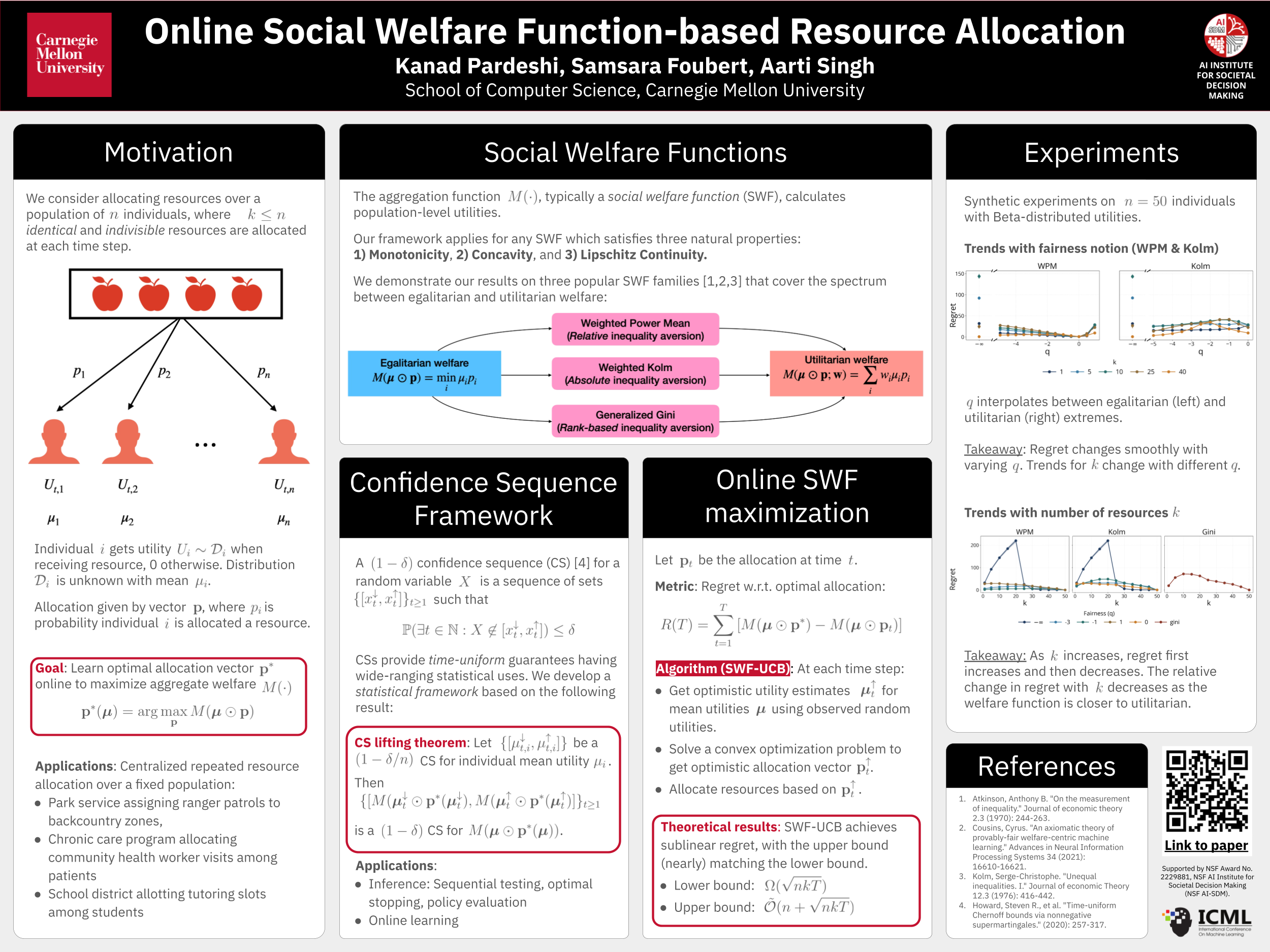
In many real-world settings, a centralized decision-maker must repeatedly allocate finite resources to a population over multiple time steps. Individuals in the population receive some random utility upon receiving the resource. A natural goal for the decision-maker is to learn/infer a randomized allocation to maximize an aggregate of the expected individual utilities, with these aggregations specified by social welfare functions. In this work, we develop a statistical framework to enable online learning and inference of these optimal allocations. Along with providing the general framework, we consider three popular families of social welfare functions and provide exact methods for them. We also conduct synthetic experiments on the online learning setup to study variations in outcomes with changing problem parameters.