
Modeling Attributional Style at Scale: A Dataset and Analysis for Psychological Attribution Assessment and Reframing
Abstract
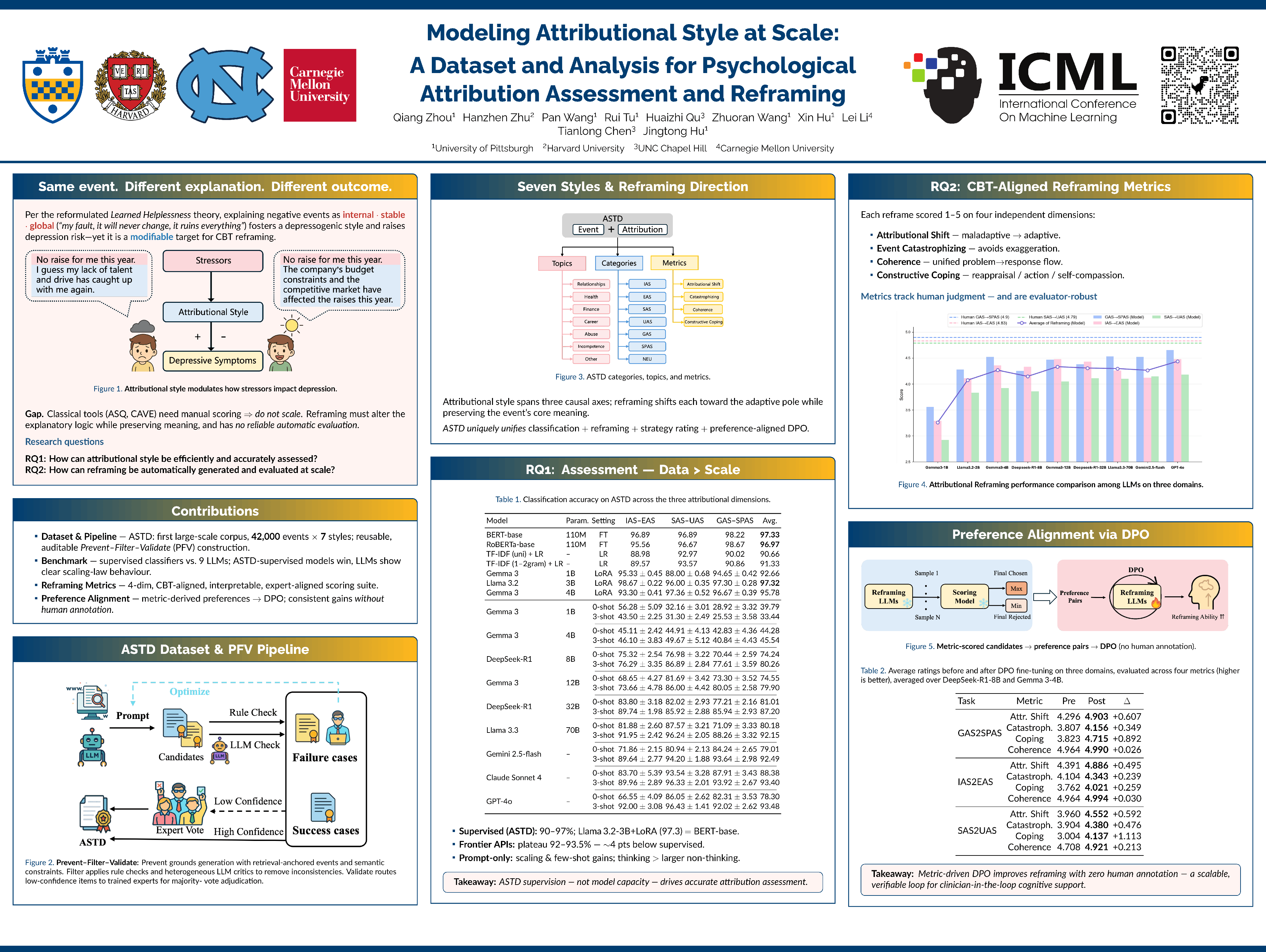
According to the reformulated Learned Helplessness theory, repeated exposure to uncontrollable negative events can foster a depressogenic attributional style—increasing susceptibility to depression yet remaining a tractable target for cognitive therapy. Computational research on attributional cognition, however, is hampered by the lack of large-scale datasets and robust evaluation protocols. In this work, we introduce the Attributional Style Transfer Dataset (ASTD) along with dedicated evaluation metrics, the first benchmark designed to model, assess, and reframe attributional explanations at scale. Constructed via a Prevent–Filter–Validate pipeline that integrates LLM-based generation with specialist validation, ASTD contains 42,000 real-world events paired with psychologically grounded attributions spanning seven styles. Using this dataset, we address two key challenges: (1) scalable assessment of attributional style via both supervised classifiers and zero/few-shot LLMs; and (2) attributional reframing and evaluation, where we propose automatic evaluation metrics to quantify psychological validity. Furthermore, we leverage our proposed metrics to construct a preference dataset, fine-tuning LLMs with Direct Preference Optimization (DPO) and achieving substantial gains in reframing quality. Together, our dataset, metrics, and methodology offer a new paradigm for understanding and modeling attributional style, with direct implications for scalable and adaptive mental health interventions.
Lay Summary
When people face setbacks---losing a job, a relationship ending, a health scare---the way they explain why it happened matters for mental health. Habitually blaming oneself ("it's my fault"), viewing causes as permanent ("this will never change"), or treating them as far-reaching ("this affects everything") is linked to higher risk of depression. Therapists can help shift these "explanation styles" toward healthier alternatives, but current assessment relies on hand-scored questionnaires that don't scale. We built ASTD, a collection of 42,000 real-life events paired with seven different explanation styles, with trained experts reviewing the cases where automated systems were uncertain. Using this dataset, we trained AI tools to (a) detect potentially harmful explanation patterns and (b) generate healthier alternative explanations. To judge those alternatives, we designed four scoring rubrics rooted in cognitive-behavioral therapy and used them to teach a language model to write better reframes---without collecting any new human labels. This turns a clinically meaningful but hard-to-measure concept into something computable at scale. The tools are intended for use under clinician supervision rather than as autonomous therapy, and could help mental-health professionals study and support more people more efficiently.