
GeoFlow: Geo-Aware Modeling of Inter-Area Relationships in Origin-Destination Flow Prediction and Generation
Abstract
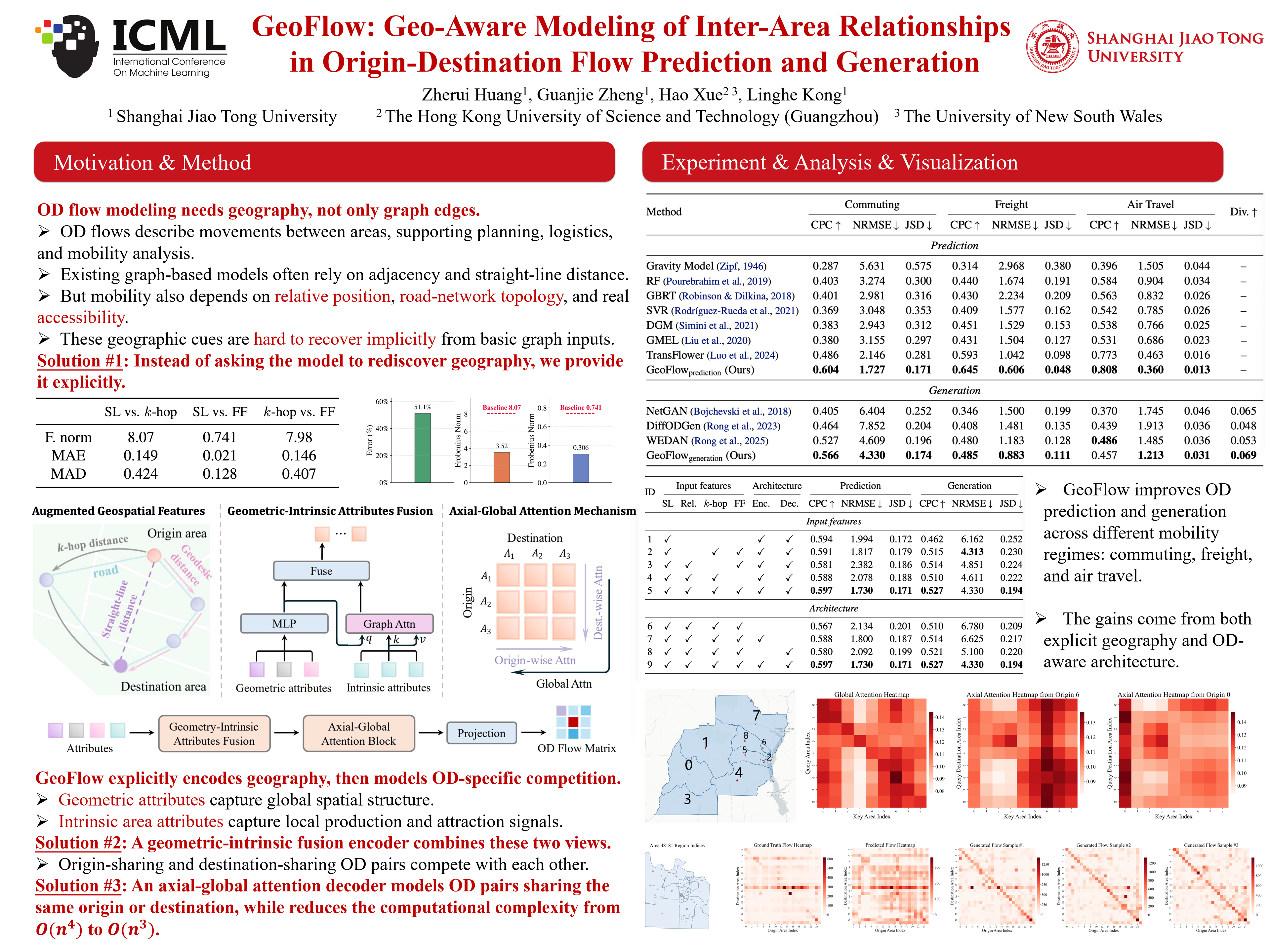
Origin–destination (OD) flow modeling underpins urban planning and mobility analysis, but prevailing graph-based methods often neglect salient geographic attributes, limiting their ability to model long-range and multi-area dependencies. In this paper, we introduce GeoFlow, a novel framework that (i) augments area representations with geospatial attributes, including relative positions, -hop and geodesic distances, (ii) employs a specialized geometric-intrinsic fusion encoder design that combines graph attention for intrinsic area signals with coordinate-aware encoders for global structure, and (iii) adopts an axial-global attention decoder to capture OD-specific competitive dependencies. For OD flow generation, GeoFlow is paired with flow matching models to produce more authentic and diverse mobility samples. Empirically, GeoFlow achieves superior performance in predictive accuracy, while substantially improving generative fidelity and diversity. Ablation and analytical studies confirm the contribution of each component. Code is available at https://github.com/ZheruiHuang/GeoFlow.
Lay Summary
Cities need to understand how people and goods move between neighborhoods, airports, or logistics regions, but collecting complete movement data is difficult because it can be expensive, incomplete, or privacy-sensitive. Existing AI methods often simplify places into abstract points and miss important geographic clues, such as whether two areas are close in space, connected through the road network, or separated by realistic travel distance. We introduce GeoFlow, a machine-learning model that gives these geographic clues directly to the model and combines them with local information about each area. GeoFlow then reasons about how origins compete for destinations and how destinations attract movement from many origins. This allows it to both predict likely movement volumes and generate multiple plausible mobility patterns. We test GeoFlow on commuting, freight, and air-travel data. Across these settings, it improves prediction accuracy and produces generated flow patterns that better match real mobility data while still showing useful diversity. This may help researchers build more reliable tools for mobility analysis and urban planning, especially when observed movement data are limited.