
CausalX: A Unified and Causally-Interpretable Plug-and-Play Model for Multi-modal Spatio-Temporal Forecasting
Abstract
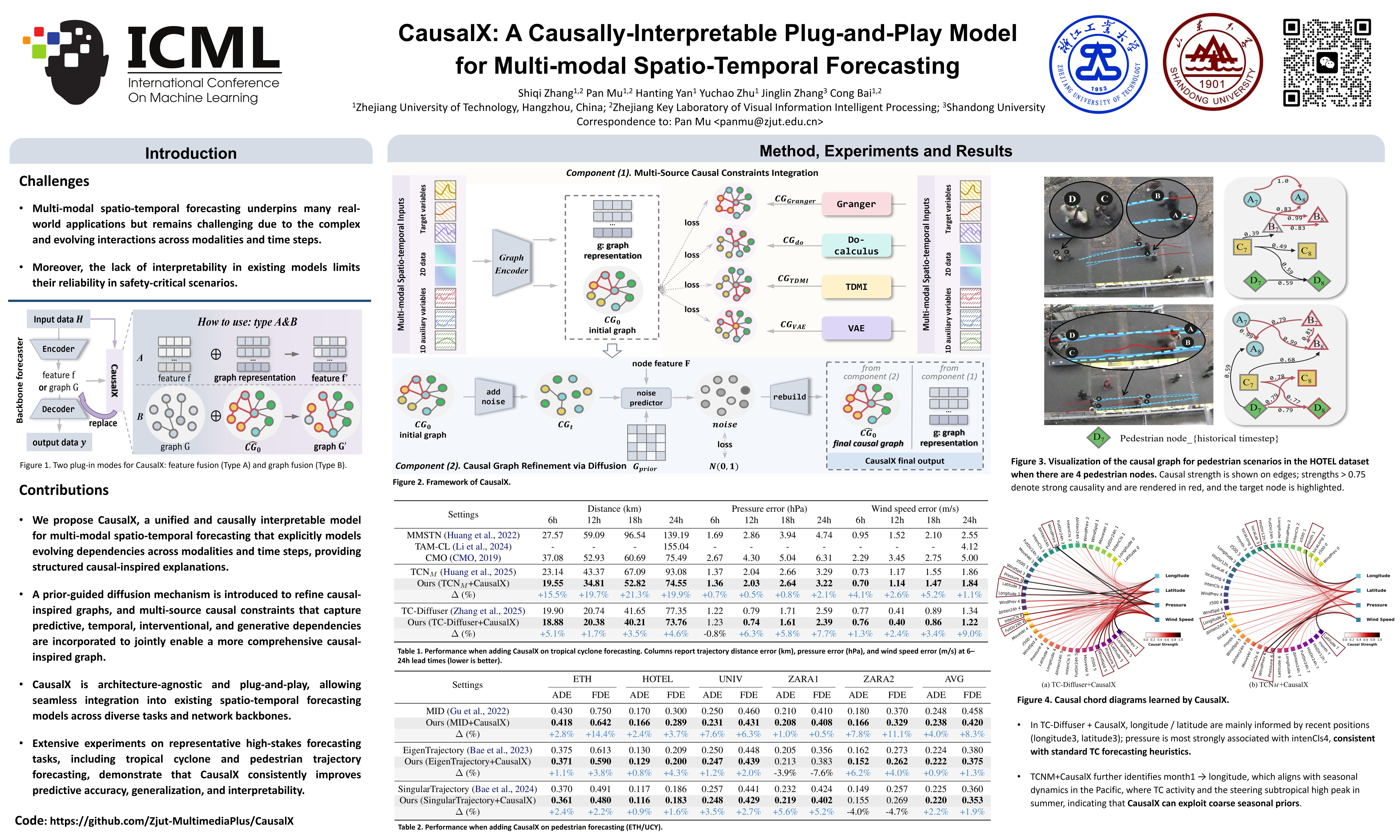
Multi-modal spatio-temporal forecasting underpins many real-world applications but remains challenging due to the complex and evolving interactions across modalities and time steps. Moreover, the lack of interpretability in existing models limits their reliability in safety-critical scenarios. In this paper, we present CausalX, a unified and causally interpretable plug-and-play model for multi-modal spatio-temporal forecasting. CausalX achieves interpretability by learning a dynamic causal graph across modalities and time, whose edge weights quantify causal attribution strength, and are further refined by a diffusion-based generative process guided by structural priors. To overcome the absence of ground-truth causal structures, CausalX aggregates multi-source constraints from causal analysis techniques and a variational autoencoder, spanning predictive, temporal, interventional, and generative aspects to jointly learn a more comprehensive causal graph. Extensive experiments on real-world forecasting tasks, including pedestrian trajectory prediction and tropical cyclone forecasting, demonstrate that CausalX achieves superior accuracy while producing interpretable causal graphs. CausalX is modular, architecture-agnostic, and generalizable, offering a new perspective on bridging causal inference and spatio-temporal forecasting.
Lay Summary
Many important decisions rely on forecasts, such as where pedestrians may move next or how a tropical cyclone may develop. Modern AI models can make accurate forecasts, but they often work as black boxes: users may see the prediction but not understand why it was made. This lack of explanation can make forecasts harder to trust in safety-critical situations. We introduce CausalX, a method that can be added to a wide range of forecasting models to make them both more accurate and easier to understand. Instead of only giving a prediction, CausalX also builds a relationship map showing which past information was most important for the forecast and how different variables, time steps, or pedestrians are related to each other. For example, it can highlight which earlier motion patterns, weather signals, or time steps influenced the prediction most. Because real-world cause-and-effect relationships are rarely known in advance, CausalX combines several different clues to build this map. In experiments on pedestrian motion and tropical cyclone forecasting, CausalX produced better forecasts and clearer explanations, helping users better interpret and use AI predictions in safety-critical settings.