
EpiCoCo: De Novo Epitope Generation via MHC-Context Co-Modeling and Contrastive Affinity Guidance
Abstract
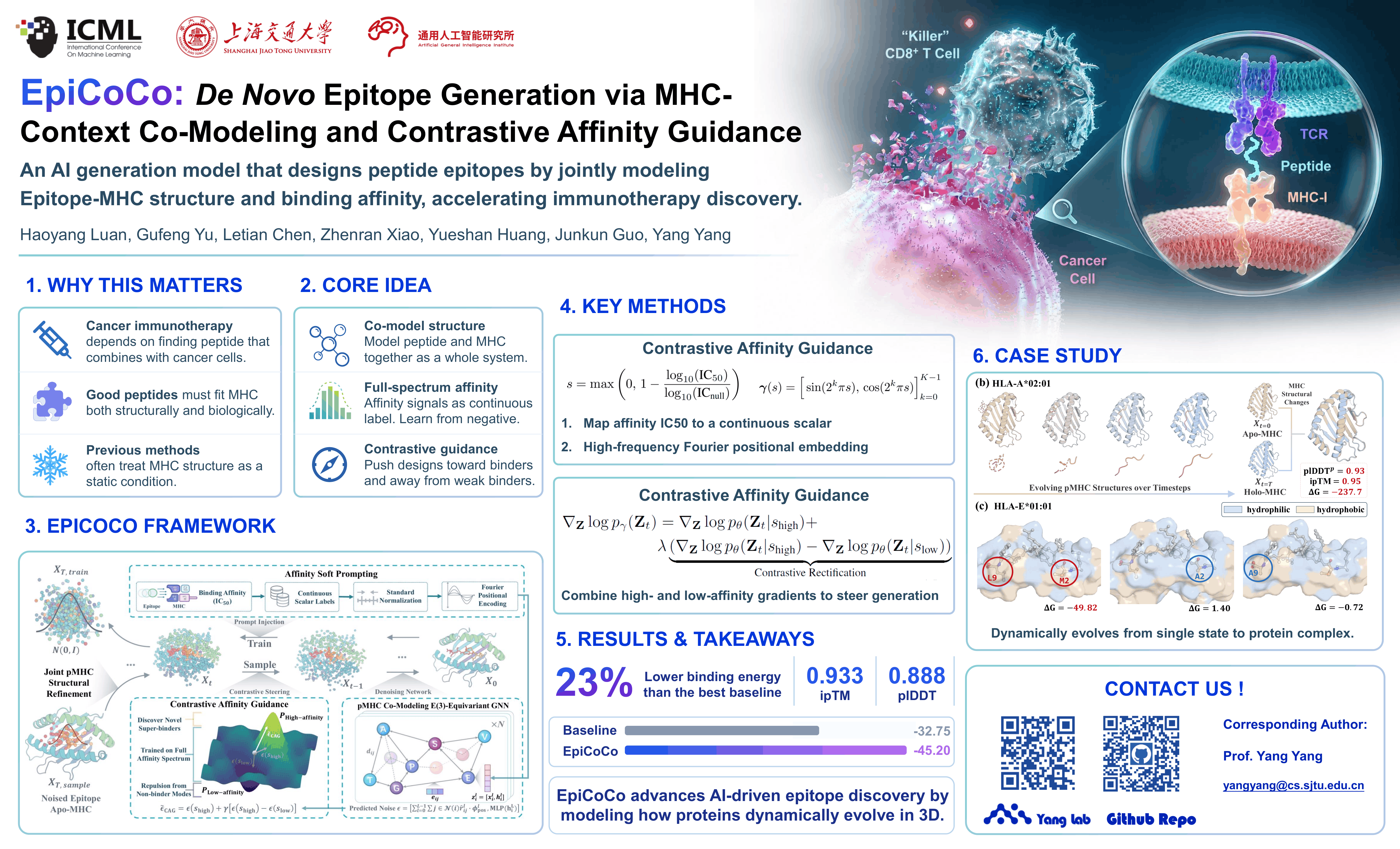
The de novo generation of high-affinity epitopes tailored to specific major histocompatibility complex (MHC) proteins is a pivotal challenge in computational immunotherapy. However, current methods struggle to effectively integrate the MHC context into the generation process, and often fail to guarantee high binding affinity due to the neglect of discriminative signals from non-binders. To bridge these gaps, we present EpiCoCo, a probabilistic framework for Epitope generation via MHC-context Co-modeling and Contrastive affinity learning. EpiCoCo treats the pMHC complex as a dynamic, co-adaptive system by operating on the joint E(3) graph. In addition, we introduce Contrastive Affinity Guidance (CAG), an inference mechanism that leverages the gradient difference between learned high- and low-affinity distributions. CAG actively drives the generation trajectory towards high-affinity manifolds while utilizing repulsive signals to filter out candidates with poor binding potential. Extensive evaluations demonstrate that EpiCoCo achieves a mean binding free energy of -45.20 REU, a 23% improvement over the state-of-the-art, while maintaining high structural plausibility. The results validate that context co-modeling and negative-informed guidance are essential for generating valid, high-potency immunotherapeutics.
Lay Summary
Designing effective immunotherapies, such as cancer vaccines, relies on generating synthetic molecular markers, epitopes, that must bind seamlessly to Major Histocompatibility Complex (MHC) proteins located on the surface of cancer cells. Current computational methods struggle with this task because they often treat these target proteins as rigid structures and fail to utilize the biological signals from weak, unsuccessful bindings. To overcome this, we developed EpiCoCo, a probabilistic AI framework that models the generated epitope and the targeted MHC protein together as a dynamic, co-adapting 3D system. Additionally, we introduced a mechanism called Contrastive Affinity Guidance. Rather than only looking at successful examples, this mechanism calculates the structural differences between high- and low-affinity interactions. It actively drives the AI's design trajectory toward strong bindings while mathematically repelling structural features known to cause poor binding potential. By leveraging both positive and negative binding data, EpiCoCo generates structurally realistic epitopes with a 23\% improvement in binding energy over current state-of-the-art models. This research provides a physically grounded, highly efficient computational tool to accelerate the discovery of potent immunotherapeutics.