
SEPS: Semantic-Enhanced Patch Slimming Framework for Fine-Grained Cross-Modal Alignment
Abstract
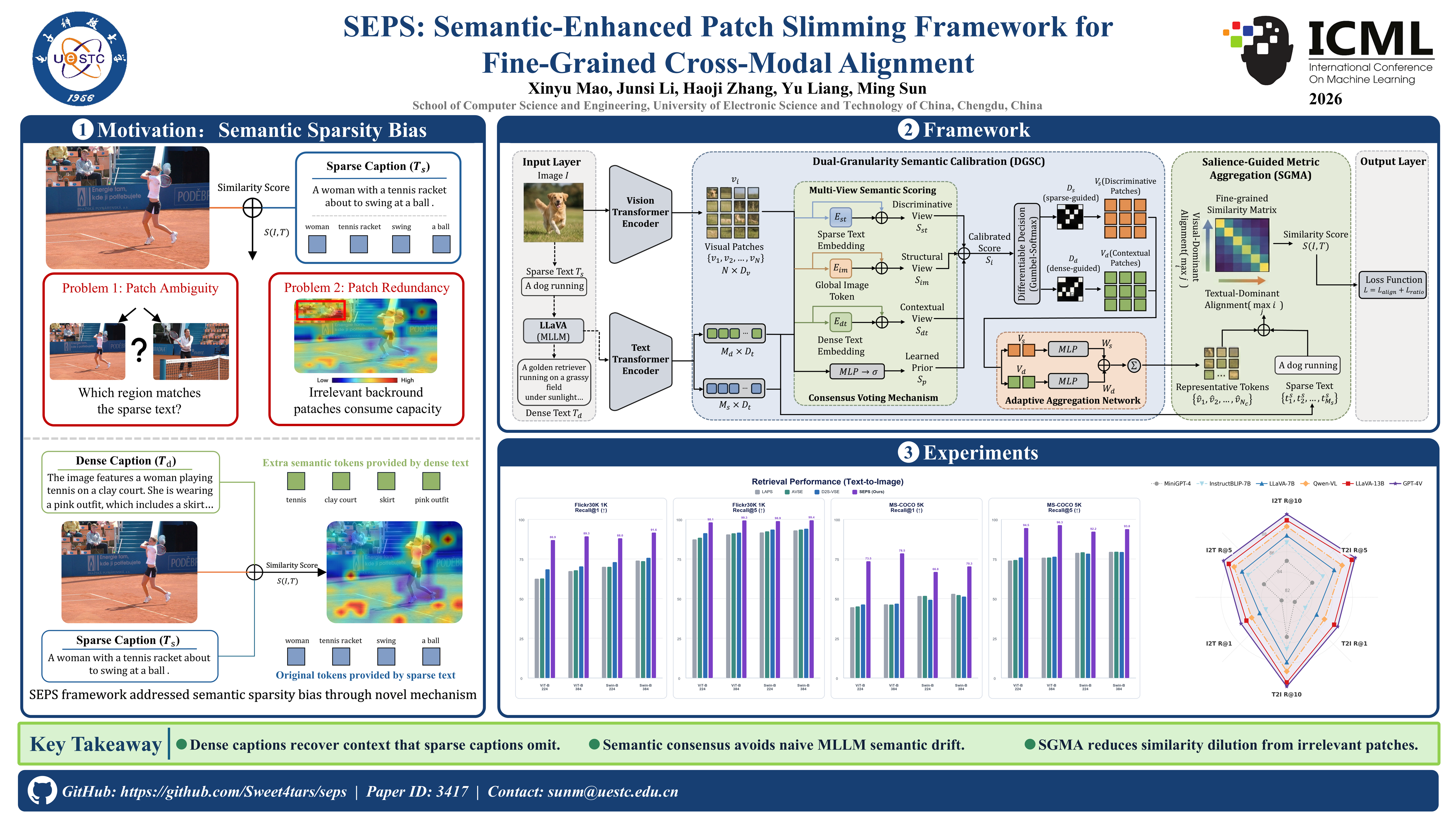
Fine-grained cross-modal alignment is pivotal for multimodal reasoning yet remains limited by Semantic Sparsity Bias—a fundamental asymmetry where dense visual signals are under-represented by sparse textual captions. This disparity leads to the inadvertent suppression of contextually vital visual regions (patch redundancy) and hinders precise concept grounding (patch ambiguity). While Multimodal Large Language Models (MLLMs) offer rich descriptive capabilities, their naive integration often induces semantic drift due to inconsistencies with sparse ground-truth captions. To systematically resolve these challenges, we present the Semantic-Enhanced Patch Slimming (SEPS) framework. Central to SEPS is a novel Dual-Granularity Semantic Calibration mechanism, which synthesizes a Holistic Visual-Linguistic Anchor from MLLMs to synergize with original sparse queries. This mechanism transforms patch selection into a semantic consensus process, ensuring that retained patches satisfy both local discriminability and global contextual integrity. Furthermore, we propose a Salience-Guided Metric Aggregation strategy to mitigate the similarity dilution effect inherent in global mean pooling, thereby amplifying highly-relevant patch-word correspondences. Extensive experiments on Flickr30K and MS-COCO datasets demonstrate that SEPS surpasses existing state-of-the-art approaches across diverse backbones, delivering significant performance gains in text-to-image retrieval tasks. The complete implementation is available at https://anonymous.4open.science/r/SEPS/.
Lay Summary
Many AI systems need to match images with text, such as finding the right picture for a written query. This is difficult because an image contains many details, while a caption often mentions only a few of them. As a result, current systems may ignore important image regions or be distracted by irrelevant details. We introduce SEPS, a method that uses a multimodal language model to produce a richer description of each image and combines it with the original caption. This helps the system decide which parts of the image are truly useful, preserving both the objects named in the caption and the surrounding context that explains them. SEPS also changes how image-text similarity is computed, giving more weight to the most meaningful word-region matches rather than averaging over all parts equally. On standard image-text retrieval benchmarks, SEPS improves performance across several visual backbones. These results suggest a practical way to make image search and multimodal understanding more accurate and efficient.