
Video-BCI: Bayesian Cognitive Integration of Self-Prior Hypotheses for Video Understanding
Abstract
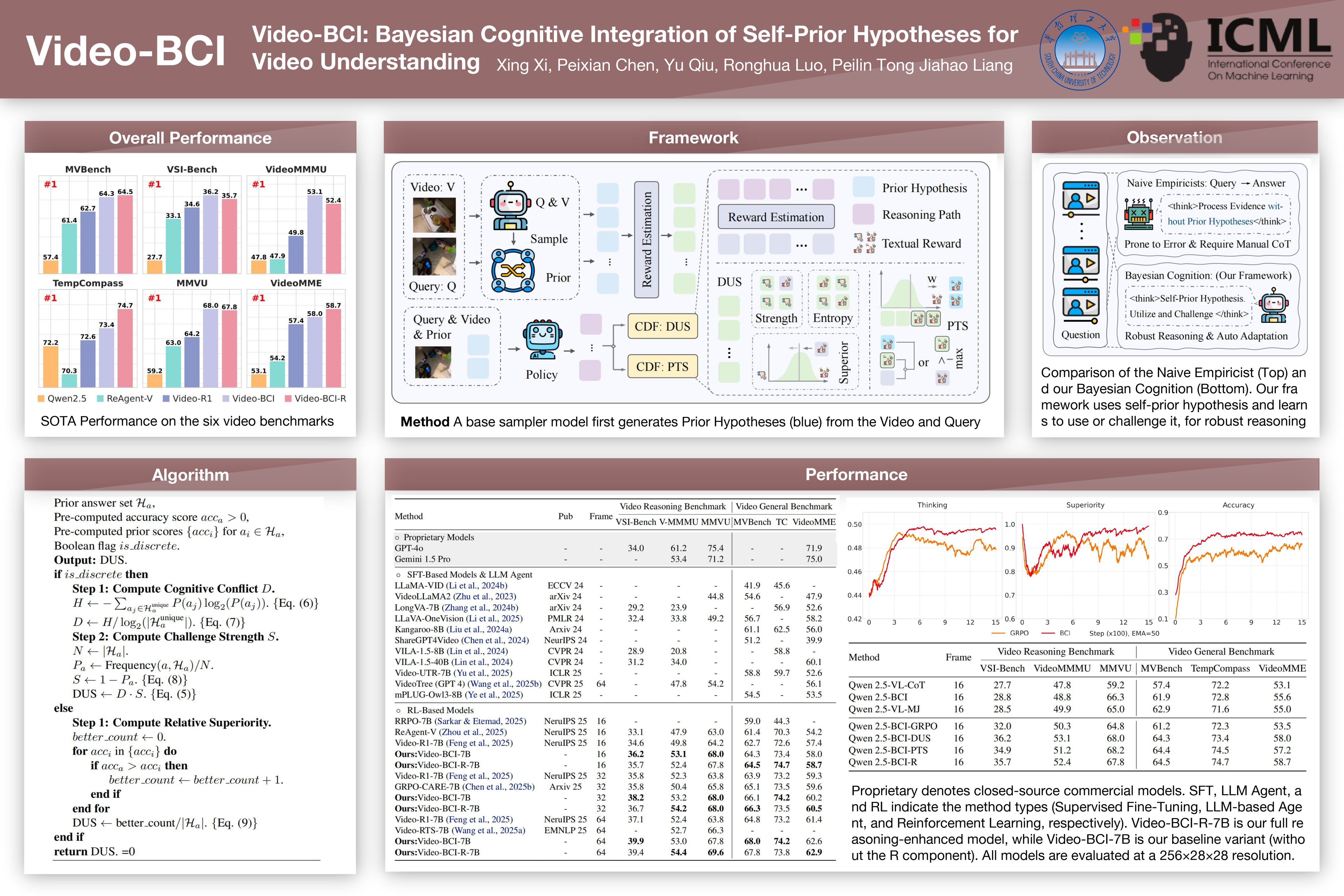
Recent progress in vision-language models (VLMs) has driven significant advances in video understanding. However, existing methods often act as naive empiricists, mapping video input directly to output without any mechanism to introspect or challenge inherent bias. In this work, we challenge this paradigm by reframing video reasoning as a Bayesian cognitive process. We propose Video-BCI (Bayesian Cognitive Integration of Self-Prior Hypotheses), a novel framework that first samples a set of Self-Prior Hypotheses to represent the model's intuitive yet potentially biased cognitive state, and then guides the VLMs to perform a critical integration of these priors. This process encourages the model to challenge erroneous majority consensus in cases of high information divergence and to distill superior reasoning chains from its own prior space. The integration is driven by a composite Cognitive Utility Function comprising two intrinsic learning signals: Dialectical Uncertainty Signal (DUS) and Process Tracing Signal (PTS). The DUS incentivizes correct, non-majority judgments by quantifying both the conflict (entropy) among priors and their consensus-challenging strength. The PTS guides the model to trace and learn from reasoning paths within its own priors that lead to better answers, enabling self-driven procedural knowledge distillation. Extensive experiments on six mainstream benchmarks show that Video-BCI achieves new state-of-the-art (SOTA) results across the board. For example, it surpasses the previous best on the MMVU benchmark by 3.8%.
Lay Summary
AI models that understand videos typically jump straight to conclusions, much like someone making a snap judgment without thinking it through. This can lead to biased or incorrect answers. In this paper, we introduce Video-BCI, a new method that teaches AI to think more like a careful human. Instead of giving an immediate answer, our model first comes up with several initial gut-feeling guesses. It then critically reviews these guesses, learning to recognize and challenge its own initial biases—especially when the most obvious or popular answer might be wrong. By tracing its own reasoning steps, the AI figures out the best logic to solve the problem. When tested, this self-reflecting approach significantly outperformed existing state-of-the-art AI video models across six major tests, proving that teaching AI to double-check its own intuition leads to much smarter and more accurate results.