
Parametric Prior Mapping Framework for Non-stationary Probabilistic Time Series Forecasting
Abstract
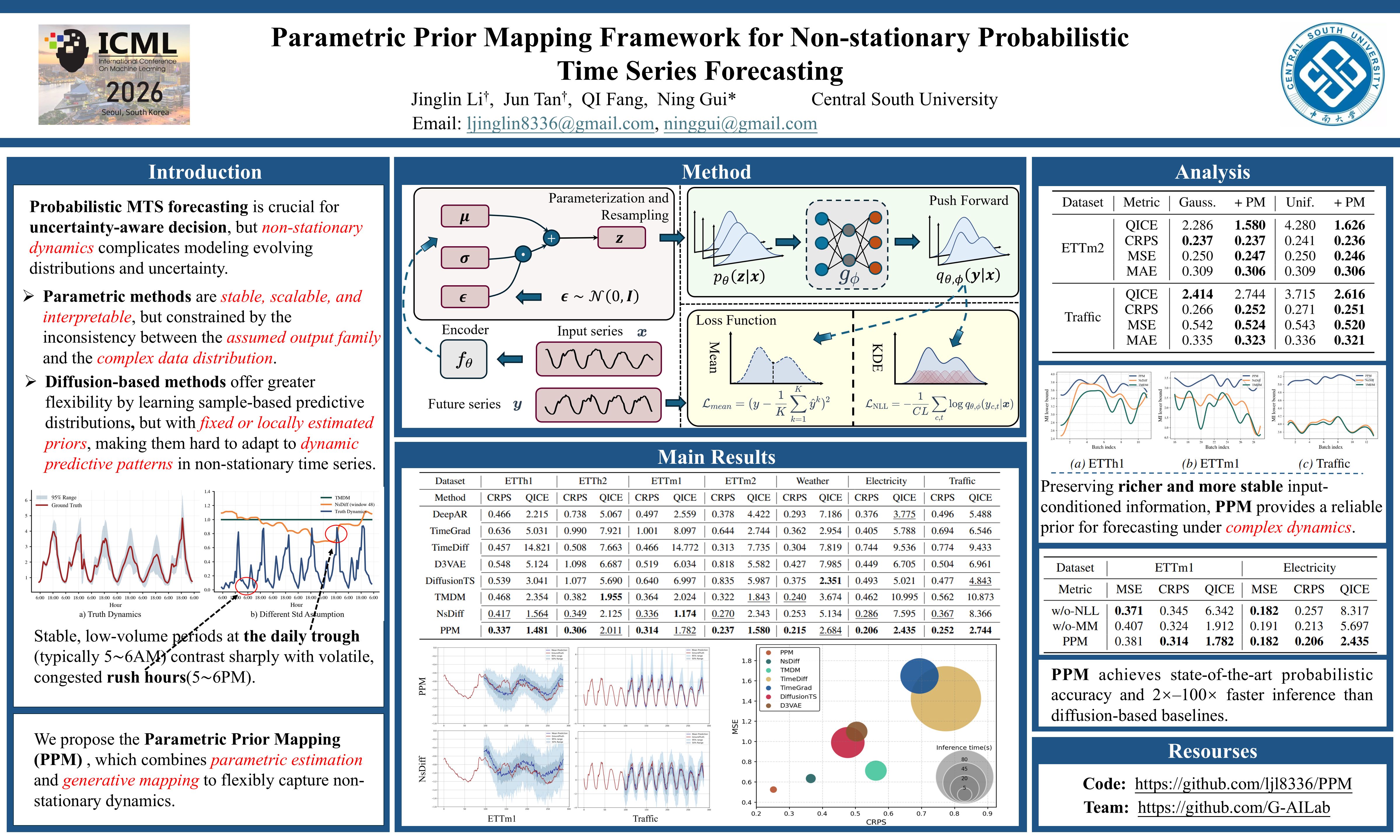
Effectively modeling non-stationary dynamics in probabilistic multivariate time series(MTS) forecasting requires balancing expressiveness with robustness. Existing parametric approaches benefit from strong inductive biases but lack flexibility, whereas deep generative models struggle to capture complex temporal dependencies without extensive data and computation. We introduce Parametric Prior Mapping (PPM), a framework that injects parametric structural priors into a generative modeling process. Specifically, PPM utilizes a parametric estimator to derive a dynamic, adaptive prior that guides the learning of a complex predictive distribution via a learnable mapping. This design allows the model to retain the efficiency of parametric methods while exploiting the expressive power of generative models. Trained with a hybrid objective, PPM yields precise forecasts with well-calibrated uncertainty estimates. Empirical results show that PPM outperforms existing baselines in handling non-stationary data, offering a superior trade-off between accuracy and computational efficiency. The code is available at https://github.com/ljl8336/PPM.
Lay Summary
Many real-world systems change over time. For example, traffic flow may vary because of rush hours or special events, and electricity demand may shift with weather or human activity. Forecasting such time series is challenging because the future is not fixed: there may be several possible outcomes, and a useful model should describe this uncertainty rather than only give one predicted value. This paper introduces Parametric Prior Mapping (PPM), a method for probabilistic time series forecasting under changing conditions. PPM learns from the past observations and generates multiple possible futures, together with their uncertainty. Its main idea is to first build a flexible description of the current forecasting situation, and then map this description into future predictions. In this way, the model can adjust its predictions when the data pattern changes. PPM is also designed to be efficient. Unlike some recent generative forecasting methods that need many repeated refinement steps, PPM can generate forecasts more directly. Experiments on real-world datasets show that PPM achieves strong forecasting performance and provides reliable uncertainty estimates. This makes it useful for practical forecasting problems where both accuracy and uncertainty are important.