
Approximating Drift-Diffusion Models for User Decisions under Nudging and External Information
Abstract
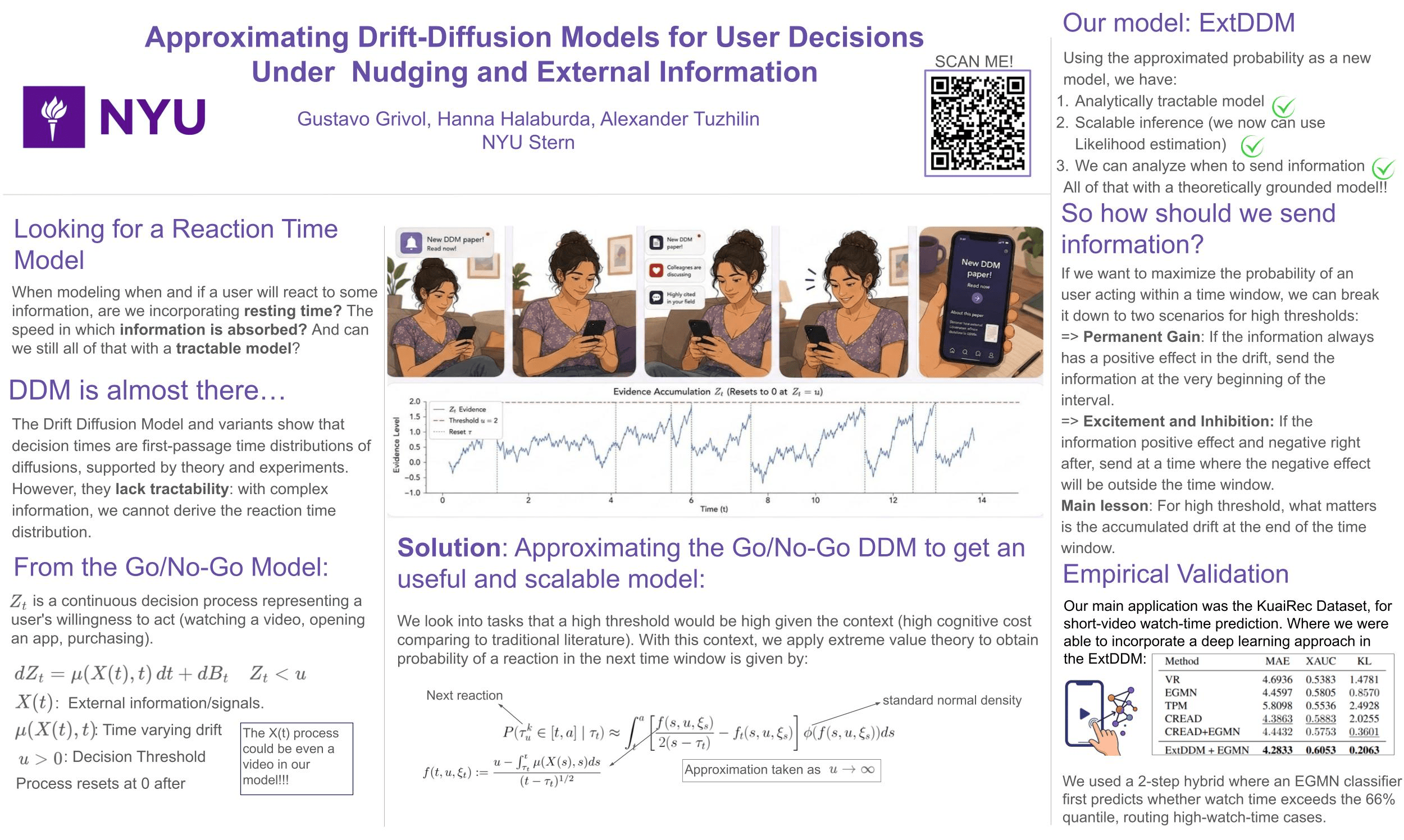
Modeling decision-making outside of controlled environments requires accounting for asynchronous, exogenous signals, such as notifications or algorithmic feeds, that dynamically alter user response times. Standard Drift-Diffusion Models (DDM) become analytically intractable when drift rates vary continuously with time. In this paper, we derive a closed-form analytical approximation for the first-passage time distribution of a single-boundary DDM with time-dependent drift, valid in the high-threshold regime. The main result allows us to analytically study the optimal timing of external signals to maximize the probability of a user response within our approximation framework. To evaluate our response time model, we conduct an extensive empirical comparison with state-of-the-art methods for user watch-time prediction and evaluation in simulated environments.
Lay Summary
Predicting when users will make decisions is difficult because real-world interruptions constantly shift their attention and their willingness to interact, and the underlying cognitive processes are hard to model mathematically. We developed a new mathematical approximation that characterizes these decision times, even amidst continuous external information. This tool helps platforms better understand user behavior, optimize when to send helpful notifications, and analyze how information translates into decisions over a given time window.