
Plug-and-Play Label Map Diffusion for Universal Goal-Oriented Navigation
Abstract
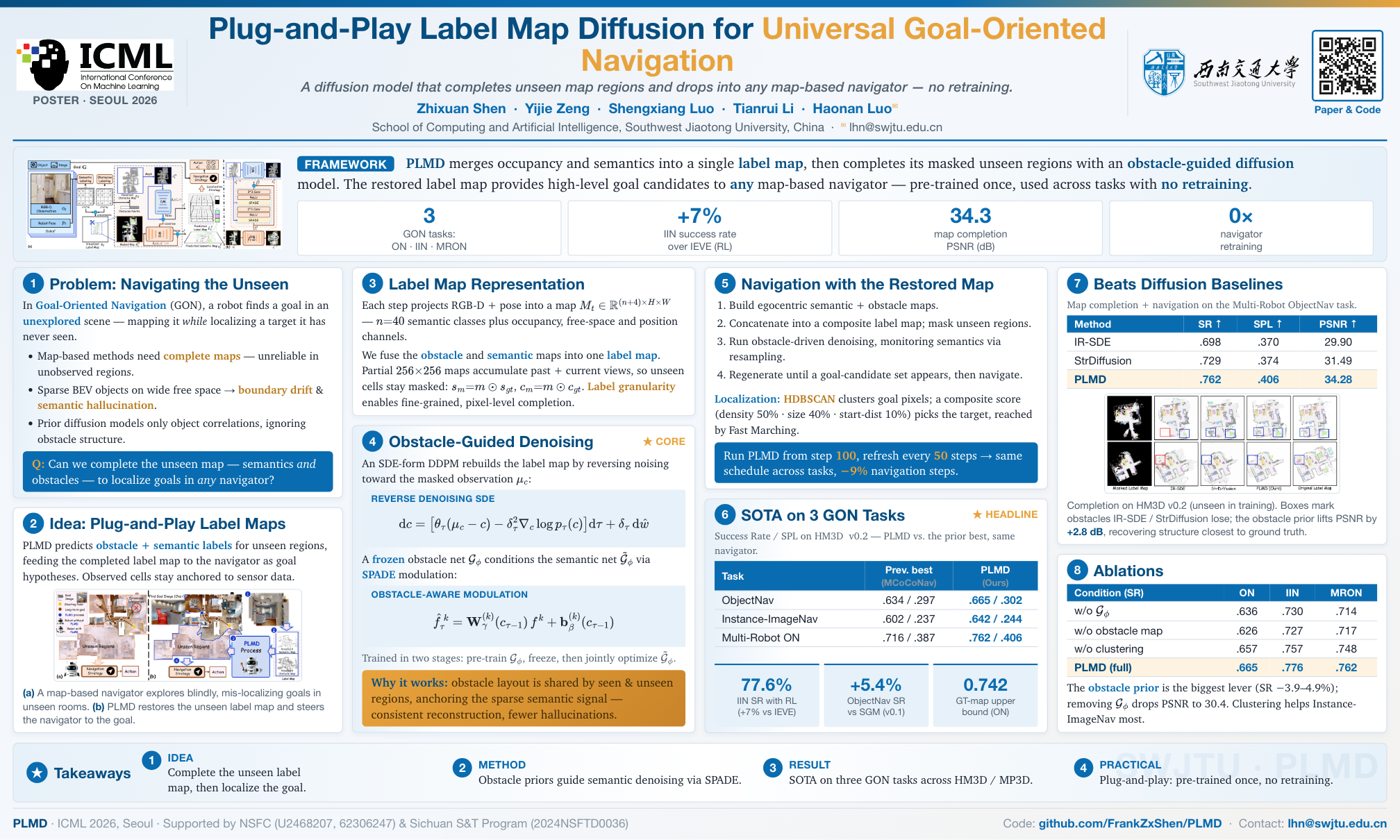
In embodied vision, Goal-Oriented Navigation (GON) requires robots to locate a specific goal within an unexplored environment. The primary challenge of GON arises from the need to construct a Bird's-Eye-View (BEV) map to understand the environment while simultaneously localizing an unobserved goal. Existing map-based methods typically employ self-centered semantic maps, often facing challenges such as reliance on complete maps or inconsistent semantic association. To this end, we propose Plug-and-Play Label Map Diffusion (PLMD), which defines a novel map completion diffusion model based on Denoising Diffusion Probabilistic Models (DDPM). PLMD generates obstacle and semantic labels for unobserved regions through a diffusion-based completion process, thereby enabling goal localization even in partially observed environments. Moreover, it mitigates inconsistent semantic association by leveraging structural consistency between known and unknown obstacle layouts and integrating obstacle priors into the semantic denoising process. By substituting predicted labels for unobserved regions, robots can accurately localize the specified objects. Extensive experiments demonstrate that PLMD (I) effectively expands the region of unknown maps, (II) integrates seamlessly into existing navigation strategies that rely on semantic maps, (III) achieves state-of-the-art performance on three GON tasks. Code is available at: .
Lay Summary
Imagine asking a robot to find a chair in an unfamiliar house. As it explores, it builds a floor plan in its head, but can only "see" rooms it has entered, making it hard to guess where the chair might be. Existing methods try to fill these gaps but often produce unrealistic guesses, like rooms without walls. We built a tool called PLMD that helps the robot "imagine" the parts of the house it hasn't seen yet. The key idea: let the robot first sketch where walls likely are, then use that structure to guess where furniture might be like a person picturing an unseen room from a glimpse through a doorway. PLMD can be plugged into any existing robot navigation method without retraining it, and across three different goal-finding tasks it helps robots reach their targets more reliably and with shorter paths. We hope this brings us closer to home robots that can confidently search for things in places they have never visited before.