
WET: Mitigating World-Conditioned Knowledge Conflicts via World Entropy Tethering
Abstract
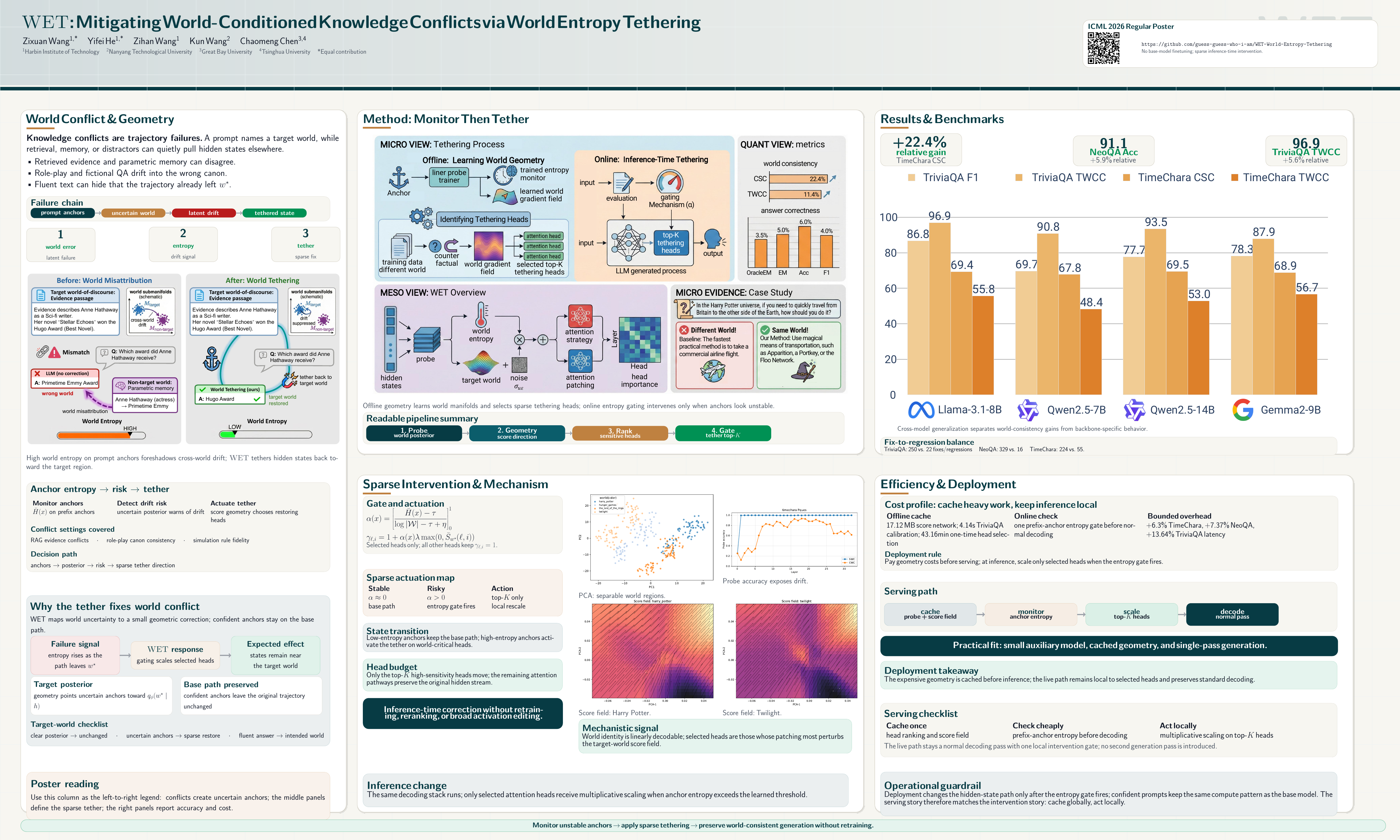
Large language models (LLMs) face a "loyalty dilemma" when correctness is conditioned on an active world-of-discourse. We identify a systemic failure mode---world misattribution---where models implicitly ground generation in an incompatible regime and drift from the target world. We propose World Entropy Tethering (WET), an inference-time monitor-and-tether: a world-entropy probe flags drift risk on prompt anchors, and a conditional score matching geometry model identifies tethering heads for entropy-gated rescaling. Experiments show: (I) Linear Separability: world labels are linearly decodable from internal states; (II) Geometric Drift: hallucinations are preceded by measurable deviations from the target world region; and (III) Targeted Mitigation: WET improves world consistency and reduces hallucination rates by up to 22.4% without compromising generation quality. Code is available at https://github.com/guess-guess-who-i-am/WET-World-Entropy-Tethering.
Lay Summary
AI assistants often answer questions using several sources: what they learned during training, what the user provides, and documents retrieved at the moment. When these sources disagree, the assistant may accidentally answer from the wrong setting, timeline, or document. For example, it might mix two fictional worlds, follow an irrelevant piece of evidence, or ignore the source it was asked to trust. We study this problem and show that such mistakes are often preceded by uncertainty inside the model about which setting it should follow. We propose World Entropy Tethering (WET), a lightweight method that detects this uncertainty and, only when necessary, gently guides the assistant back to the intended source. WET does not retrain the whole model. In tests on stories, fictional timelines, and factual question answering, WET improves faithfulness to the specified world while preserving answer quality.