
PluRel: Synthetic Data unlocks Scaling Laws for Relational Foundation Models
Abstract
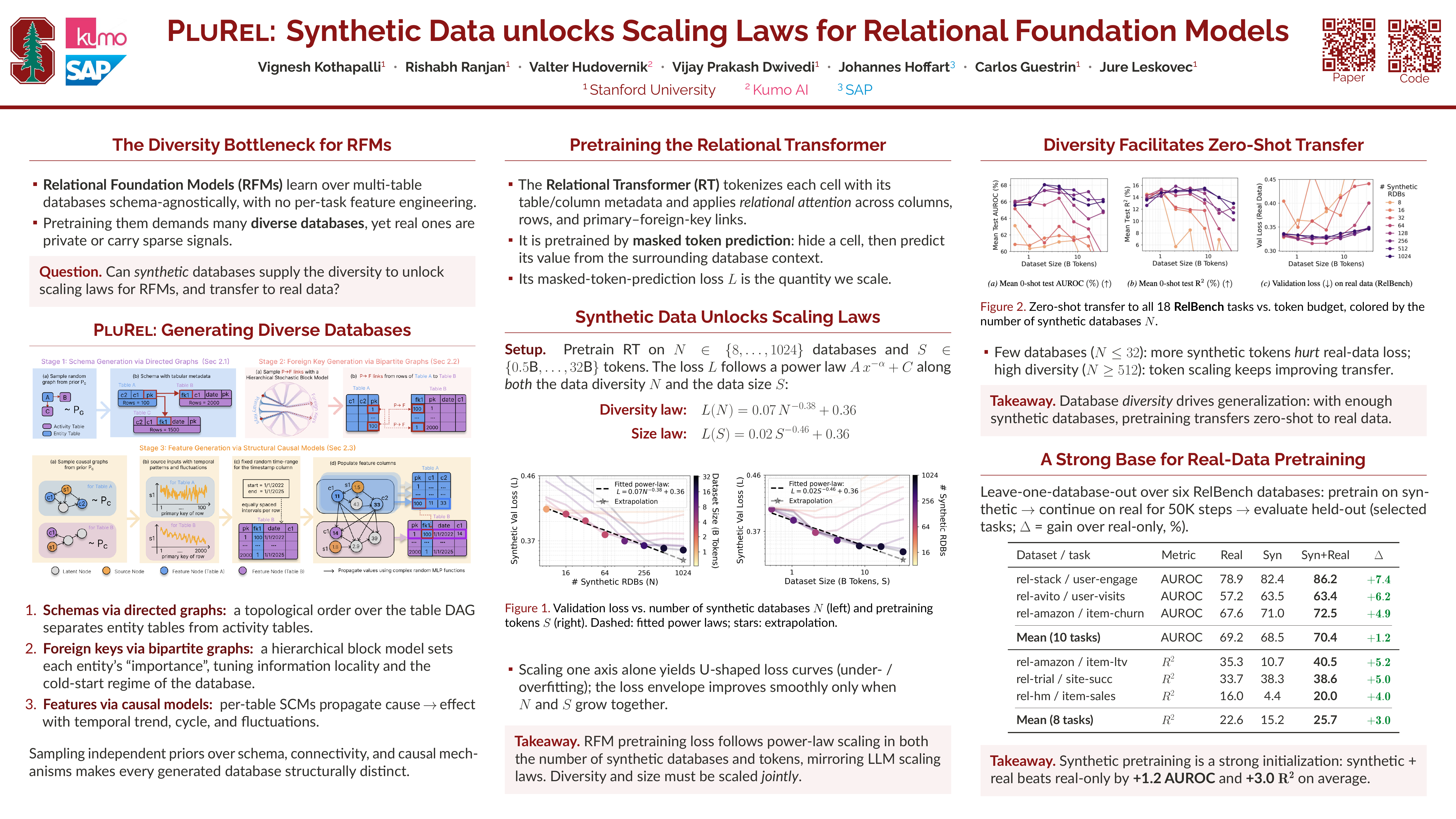
Relational Foundation Models (RFMs) facilitate data-driven decision-making by learning from complex multi-table databases. However, the diverse relational databases needed to train such models are rarely public due to privacy constraints. While there are methods to generate synthetic tabular data of arbitrary size, incorporating schema structure and primary--foreign key connectivity for multi-table generation remains challenging. Here we introduce PluRel, a framework to synthesize multi-tabular relational databases from scratch. In a step-by-step fashion, PluRel models (1) schemas with directed graphs, (2) inter-table primary-foreign key connectivity with bipartite graphs, and, (3) feature distributions in tables via conditional causal mechanisms. The design space across these stages supports the synthesis of a wide range of diverse databases, while being computationally lightweight. Using PluRel, we observe for the first time that (1) RFM pretraining loss exhibits power-law scaling with the number of synthetic databases and total pretraining tokens, (2) scaling the number of synthetic databases improves generalization to real databases, and (3) synthetic pretraining yields strong base models for continued pretraining on real databases. Overall, our framework and results position synthetic data scaling as a promising paradigm for RFMs. Webpage: https://star-project.stanford.edu/plurel
Lay Summary
Many important real-world datasets are stored not as simple spreadsheets, but as collections of connected tables. Customers linked to purchases, patients linked to hospital visits, or users linked to online activity. These relational databases are central to modern decision-making, but they are rarely public because they often contain private or business-sensitive information. We wanted to understand whether AI models can learn general skills for working with such databases in the same way that language models learn from massive amounts of text. The challenge is that there are not enough diverse public databases to train on. Our paper introduces PluRel, a system for generating realistic synthetic relational databases from scratch. PluRel creates the table structure, the links between rows across tables, and the values inside each table, including time-varying patterns. These synthetic databases act like practice worlds where models can learn how relational data behaves. We find that training on more synthetic databases leads to predictable improvements, similar to scaling laws seen in language models. We also show that synthetic pretraining can help models perform better on real database tasks. Overall, PluRel suggests that synthetic data may be a practical path toward building foundation models for relational databases.