
Identifying and Correcting Label Noise for Robust GNNs via Influence Contradiction
Abstract
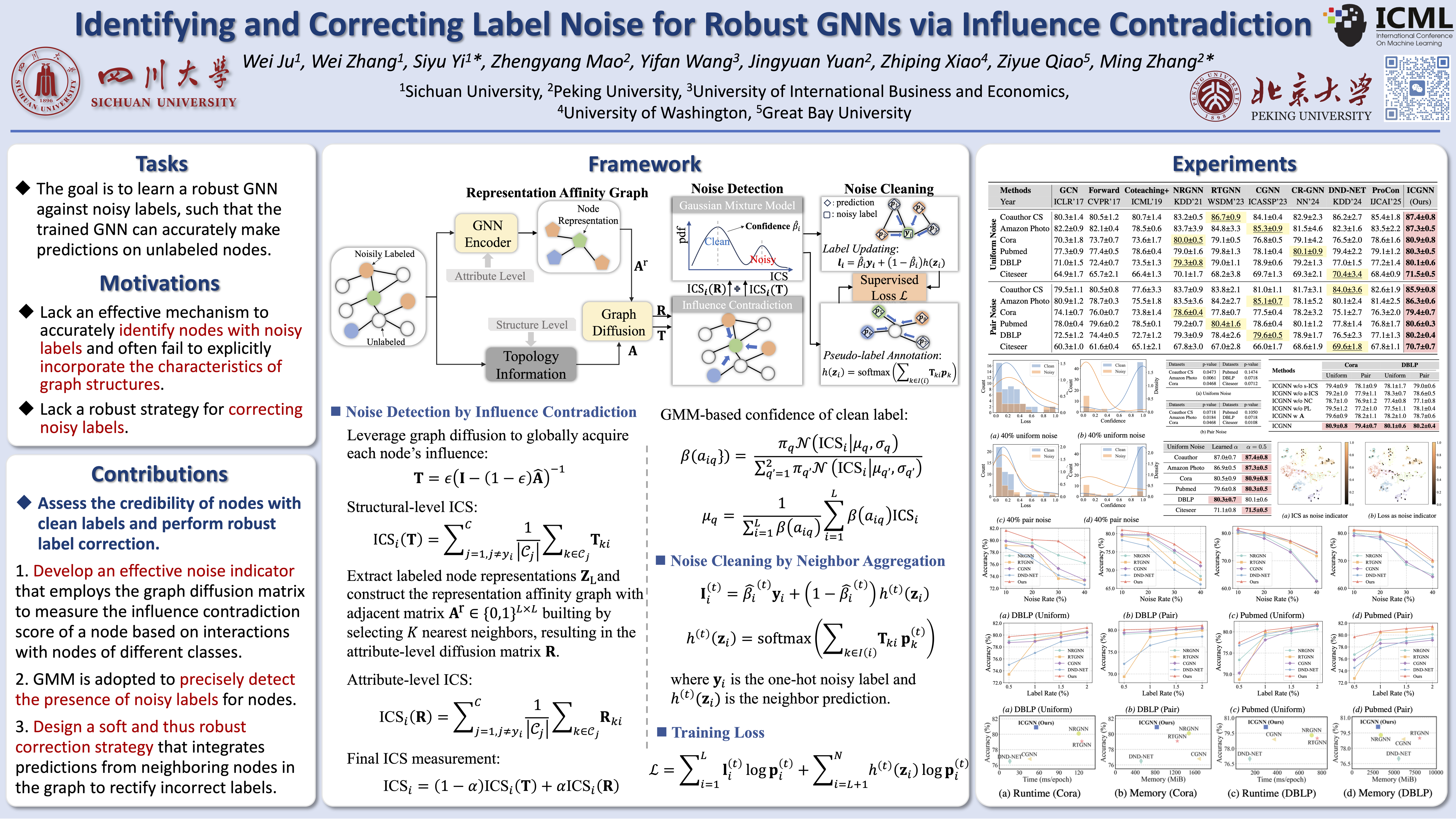
Graph Neural Networks (GNNs) have shown remarkable capabilities in learning from graph-structured data with various applications such as social analysis and bioinformatics. However, the presence of label noise in real scenarios poses a significant challenge in learning robust GNNs, and their effectiveness can be severely impacted when dealing with noisy labels on graphs, often stemming from annotation errors or inconsistencies. To address this, in this paper we propose a novel approach called ICGNN that harnesses the structure information of the graph to effectively alleviate the challenges posed by noisy labels. Specifically, we first design a novel noise indicator that measures the influence contradiction score (ICS) based on the graph diffusion matrix to quantify the credibility of nodes with clean labels, such that nodes with higher ICS values are more likely to be detected as having noisy labels. Then we leverage the Gaussian mixture model to precisely detect whether the label of a node is noisy or not. Additionally, we develop a soft strategy to combine the predictions from neighboring nodes on the graph to correct the detected noisy labels. At last, pseudo-labeling for abundant unlabeled nodes is incorporated to provide auxiliary supervision signals and guide the model optimization. Experiments on benchmark datasets show the superiority of our approach over competitive baselines in noisy label scenarios. The source code is available at: https://github.com/wayc04/ICGNN.
Lay Summary
Graph Neural Networks (GNNs) are powerful tools for analyzing relational data, such as social networks or biological systems. However, in real-world applications, the labels used for training are often imperfect because of human mistakes or inconsistent annotations. These noisy labels can seriously reduce the accuracy and reliability of GNN models. To tackle this problem, we propose a new method called ICGNN that uses the structure of the graph itself to identify and correct unreliable labels. Our approach first measures how consistent a node is with the information coming from its neighbors, allowing the model to detect nodes that are likely to have incorrect labels. We then apply a statistical model to distinguish clean labels from noisy ones more accurately. After detecting suspicious labels, ICGNN softly combines information from neighboring nodes to revise them instead of directly replacing them. In addition, we use pseudo-labeling to take advantage of unlabeled nodes and further improve learning. Experiments on multiple benchmark datasets demonstrate that ICGNN achieves better performance than existing methods when noisy labels are present.