
ConsMSA: Semantic Distribution Consistency Learning for Multimodal Sentiment Analysis
Pan Wang ⋅ Lipeng Ke ⋅ Huajun Ying ⋅ Pritish Mohapatra ⋅ Rohan Sarkar ⋅ Suresh Lakhani ⋅ sankar venkataraman ⋅ Jingtong Hu
Abstract
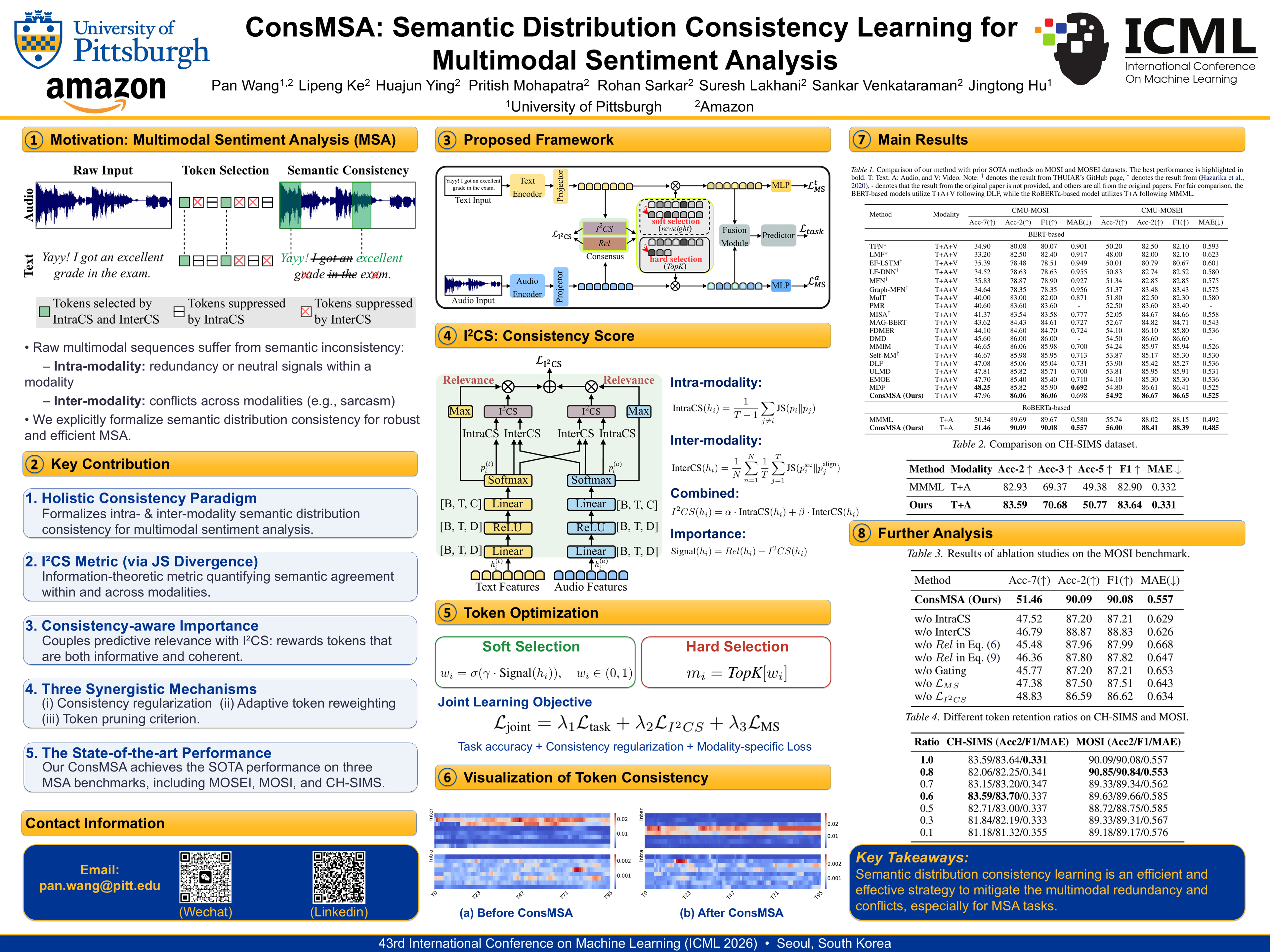
Multimodal sentiment analysis (MSA) aims to predict human sentiments by integrating signals from different modalities such as text, video, and audio. However, raw multimodal sequences often suffer from semantic inconsistency--exhibiting redundancy or conflicts within and across modalities--which hinders robust understanding and increases computational cost. To this end, we introduce ConsMSA, which explicitly formalizes semantic distribution consistency across both $\textit{intra}$- and $\textit{inter}$-modality, providing a consistency-aware mechanism for robust and efficient multimodal sentiment prediction. Specifically, ConsMSA projects multimodal token features into a shared sentiment space to compute an Intra- and Inter-modality Consistency Score ($I^2CS$). By coupling this score with predictive relevance, we formulate consistency-aware importance signals that are utilized: (i) as a consistency regularizer to align latent distributions during training, (ii) to derive semantic-aware weights for adaptive multimodal token reweighting, and (iii) as a practical criterion to prune redundant or conflicting tokens. Extensive experiments on CMU-MOSI, CMU-MOSEI, and CH-SIMS demonstrate that ConsMSA achieves state-of-the-art performance while remaining robust under aggressive token compression--retaining only 10\% of tokens yields comparable accuracy. These results establish semantic distribution consistency as a promising foundation for synergizing predictive robustness with computational efficiency.
Lay Summary
In multimodal sentiment analysis (MSA), raw input sequences often contain redundant noise and conflicting signals that limit both model efficiency and accuracy. We address this with ConsMSA, a framework that utilizes semantic distribution consistency and predictive relevance to explicitly filter out inconsistent data. By applying these metrics for regularization and token compression, ConsMSA achieves state-of-the-art results on three major MSA benchmarks. Remarkably, it preserves competitive accuracy even after pruning 90% of tokens, demonstrating that optimizing semantic consistency is an effective strategy for building robust and compute-efficient MSA models.
Video
Chat is not available.
Successful Page Load