
Emergent Visual Representations through Unsupervised Spiking Networks with Synaptic Pruning
Abstract
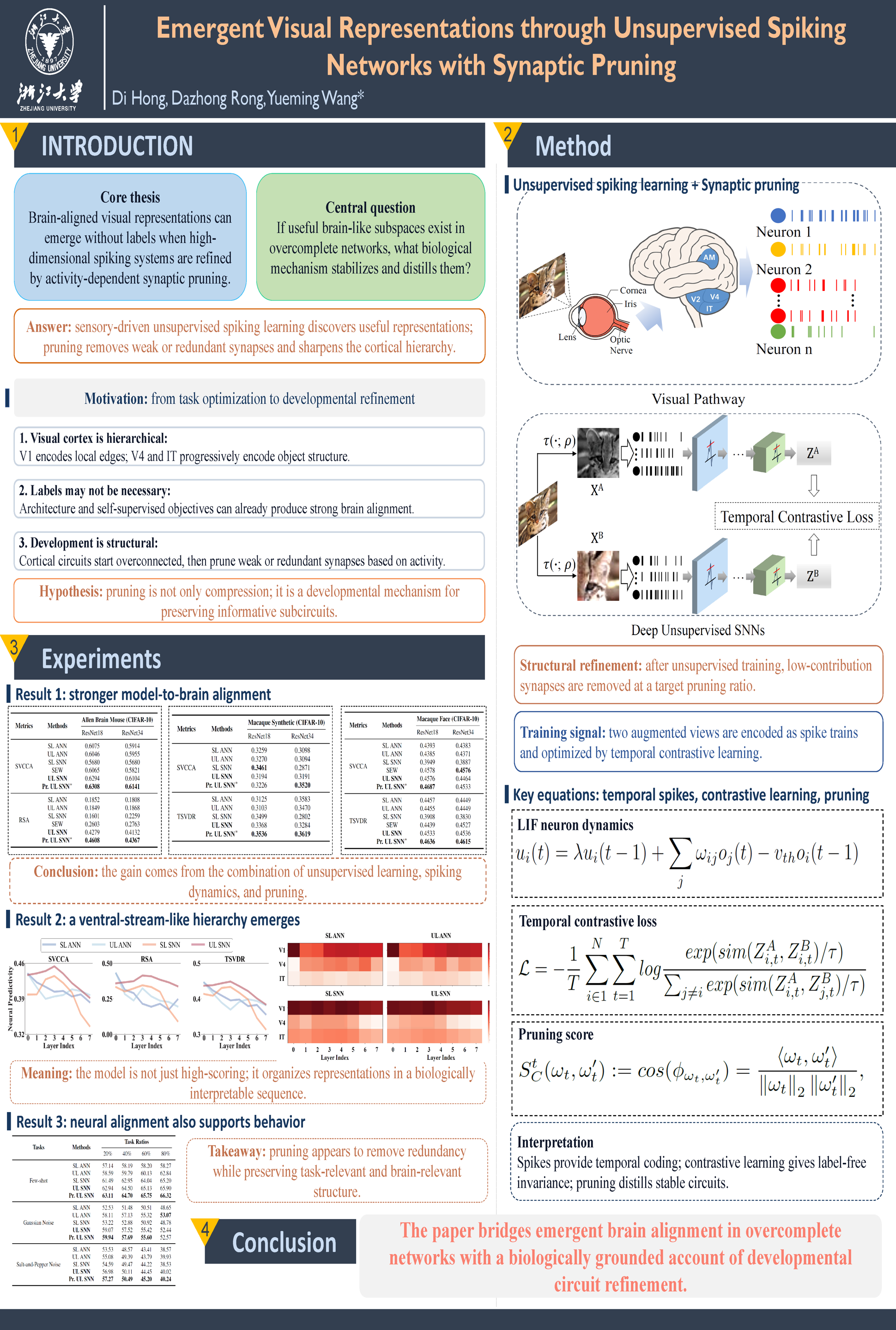
Recent work has shown that brain-aligned visual representations can emerge even in randomly initialized, high-dimensional neural networks, suggesting that cortical representations may be discovered rather than fully learned through task optimization. However, how such latent brain-relevant representations are stabilized and refined during development remains unclear. Motivated by this perspective and by neuroscientific evidence of activity-dependent synaptic pruning, we study how brain-aligned representations can emerge and be refined from high-dimensional unsupervised spiking systems. We propose a biologically grounded deep SNN that integrates unsupervised learning with developmental pruning dynamics. Starting from an overcomplete spiking architecture, the model self-organizes through sensory-driven activity while selectively eliminating weak or redundant synapses, progressively yielding compact and informative representations. Without using labels, the resulting network forms hierarchical visual representations that strongly align with neural responses across multiple areas of the mouse and macaque visual cortex, outperforming supervised and unsupervised ANN and SNN baselines. Synaptic pruning further improves alignment and robustness under noisy and few-shot recognition settings. By unifying high-dimensional unsupervised spiking representations with activity-dependent synaptic pruning, this work provides a computational account of developmental refinement in visual cortex and bridges recent findings on emergent brain alignment in random networks with biologically grounded models of representation learning.
Lay Summary
The human brain learns to see the world without receiving constant labels or instructions. Babies are not told the name of every object they see, yet their visual system gradually develops the ability to recognize faces, shapes, and objects efficiently and robustly. One important process during brain development is synaptic pruning, where the brain removes weak or unnecessary neural connections to refine its circuitry. In this paper, we explore whether artificial intelligence systems can learn in a similar way. We build a type of brain-inspired AI called a spiking neural network, which communicates using sparse electrical “spikes” similar to biological neurons. Instead of relying on labeled data, the network learns by observing visual patterns and organizing itself through experience. At the same time, the system gradually removes redundant connections through a pruning process inspired by biological brain development. We find that this combination of unsupervised learning and developmental pruning allows the network to form visual representations that closely resemble activity patterns measured in the brains of mice and monkeys. Remarkably, the resulting representations are more brain-like than those produced by several conventional deep learning systems, including both standard neural networks and other spiking models. Beyond matching neural activity, the learned representations are also practical and robust. The model performs well when only a small amount of labeled data is available and remains reliable even when images are noisy or degraded. Overall, this work suggests that brain-like visual intelligence may emerge naturally from large, initially overconnected neural systems that learn through experience and are later refined by pruning. The findings provide a possible computational explanation for how the developing brain organizes efficient and meaningful visual representations without requiring extensive supervision.