
Group Distributionally Robust Optimization-Driven RL for LLM Reasoning
Abstract
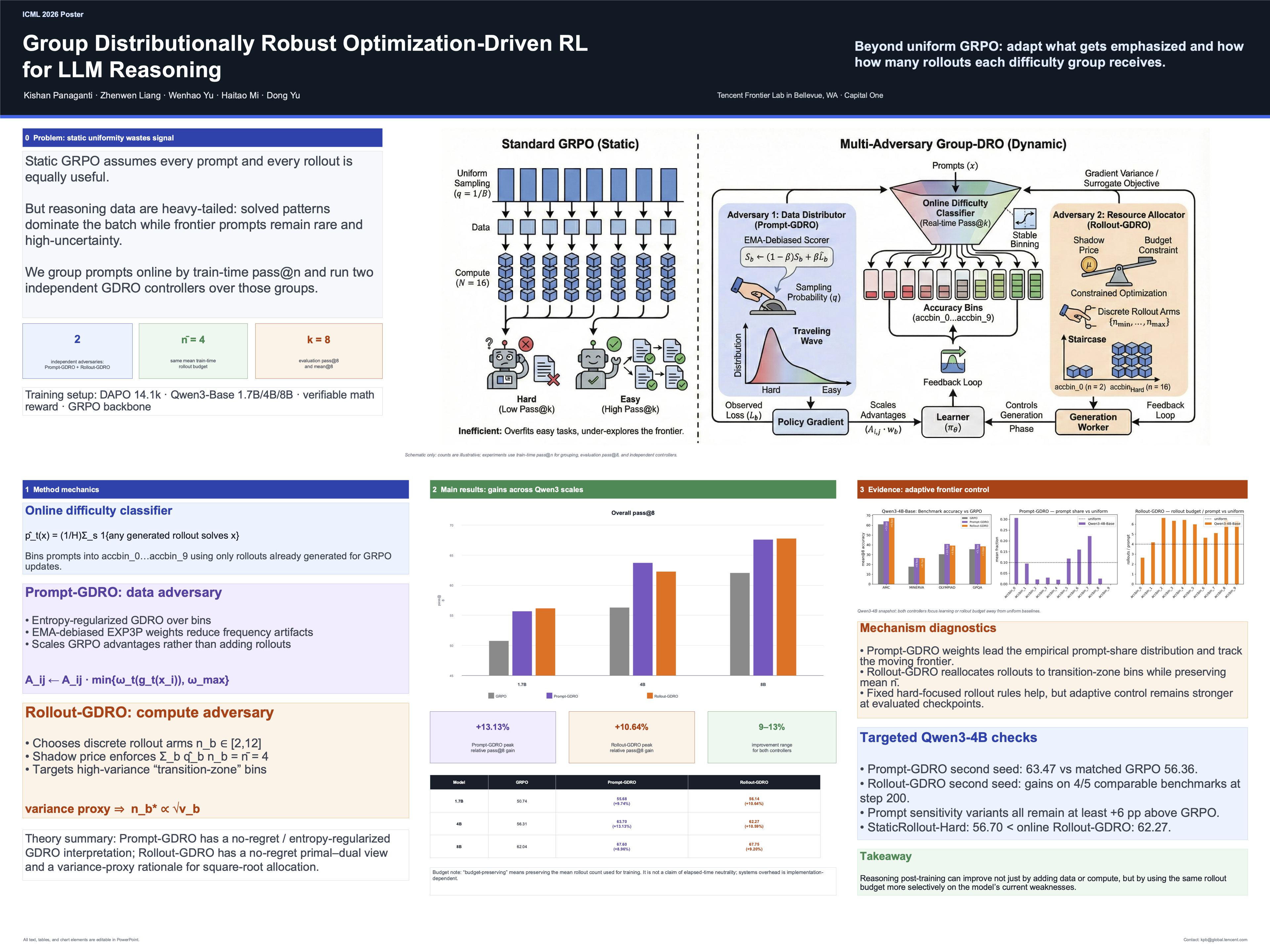
Lay Summary
When language models are trained to solve math problems, the usual recipe treats every training problem similarly and gives every problem the same number of practice attempts. This can be wasteful: many problems are already easy for the model, while rare or newly learnable problem types may need more attention. Our work studies how to make this training process adapt to the model’s current weaknesses. We introduce a simple online difficulty signal that watches how often the model succeeds on recent training attempts and groups problems by how hard they currently are. Using this signal, one version of our method gives more training weight to persistently difficult groups, while another gives more practice attempts to uncertain groups without increasing the average number of attempts. In this way, the training process automatically follows the model’s “reasoning frontier” instead of relying on a fixed curriculum. On several math-reasoning benchmarks with Qwen3 models, these adaptive choices improve the model’s chance of solving problems compared with standard GRPO training. The broader lesson is that better reasoning training may come not only from more data or more compute, but from using the available training budget more selectively.