
PACE: Post-Causal Entropy Modeling for Learned LiDAR Point Cloud Compression
Abstract
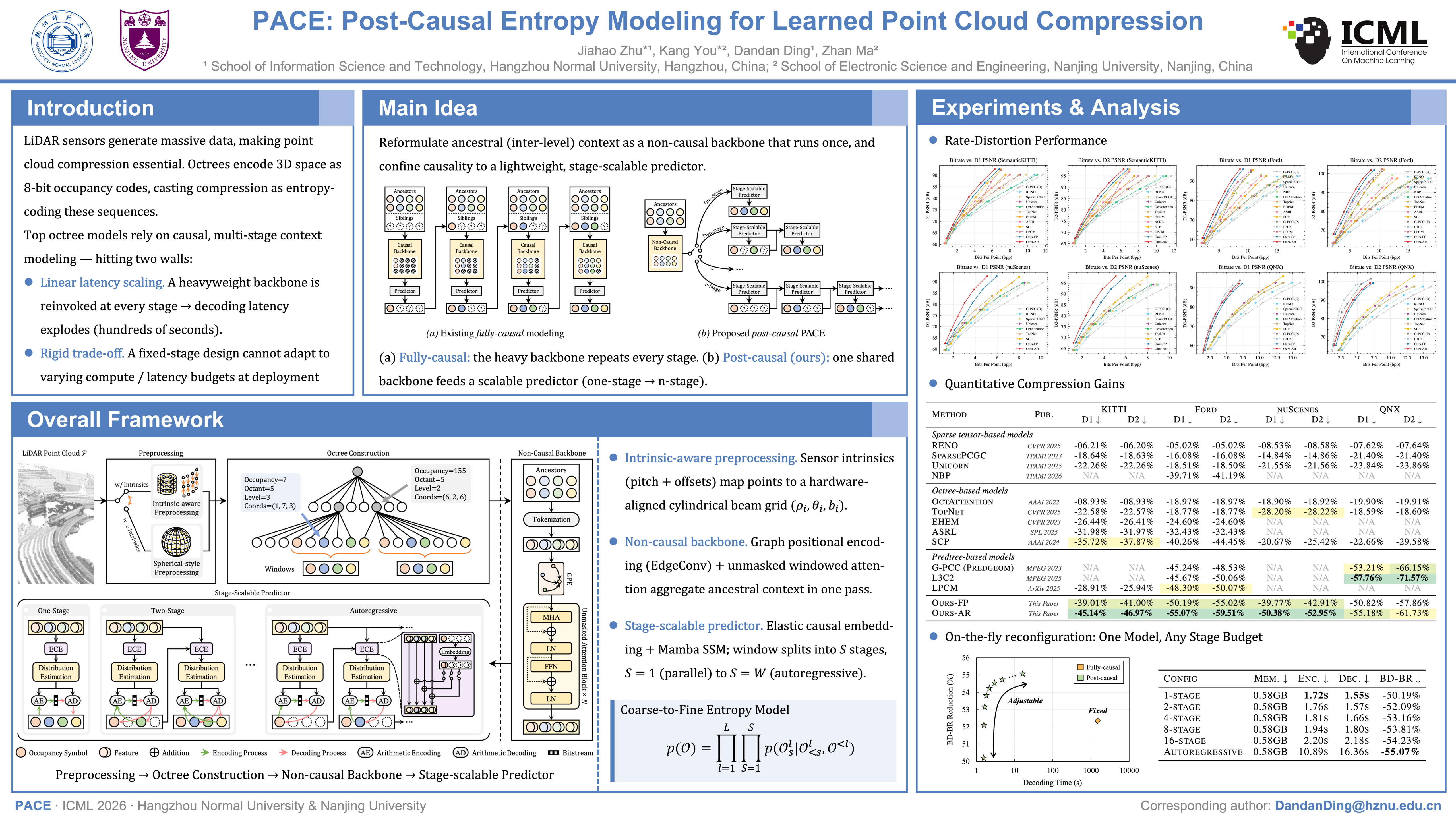
LiDAR point cloud compression is vital for autonomous systems to handle massive data from high-resolution sensors. While learned entropy modeling built upon octree structures yields high compression gains, it faces two critical bottlenecks: 1) prohibitive latency, particularly during decoding, caused by causal, multi-stage context modeling; and 2) a rigid performance-latency trade-off, preventing a single model from adapting to varying constraints. These limitations stem from the tight coupling between the context aggregation backbone and probability prediction. To address this, we propose PACE, a new framework that reformulates ancestral context aggregation as a non-causal backbone and confines causality to a lightweight, stage-scalable predictor, eliminating repetitive backbone executions and reducing computational overhead. The predictor supports an arbitrary number of prediction stages, enabling seamless adaptation across diverse performance-latency trade-offs without reloading parameters. Experiments demonstrate that PACE sets a new state-of-the-art in compression efficiency, achieving notable BD-BR savings and reducing decoding latency by over 90\% in autoregressive mode, making it attractive for practical applications.
Lay Summary
Self-driving cars use LiDAR sensors to capture detailed 3D maps, producing massive data that must be compressed efficiently. Existing methods are either slow or inflexible, because they repeatedly run expensive computations during both compression and decompression. PACE introduces a key conceptual shift: rather than mixing feature extraction and sequential prediction into one coupled pipeline, we separate them. The heavy feature extraction step runs once in parallel, while only a lightweight predictor operates sequentially. This simple decoupling eliminates redundant computation and enables a single model to flexibly trade off speed against compression quality on the fly. PACE achieves state-of-the-art compression while cutting decompression time by over 90%.