
CircuitPrint: Mechanistic Circuit Fingerprints for Large Language Models
Abstract
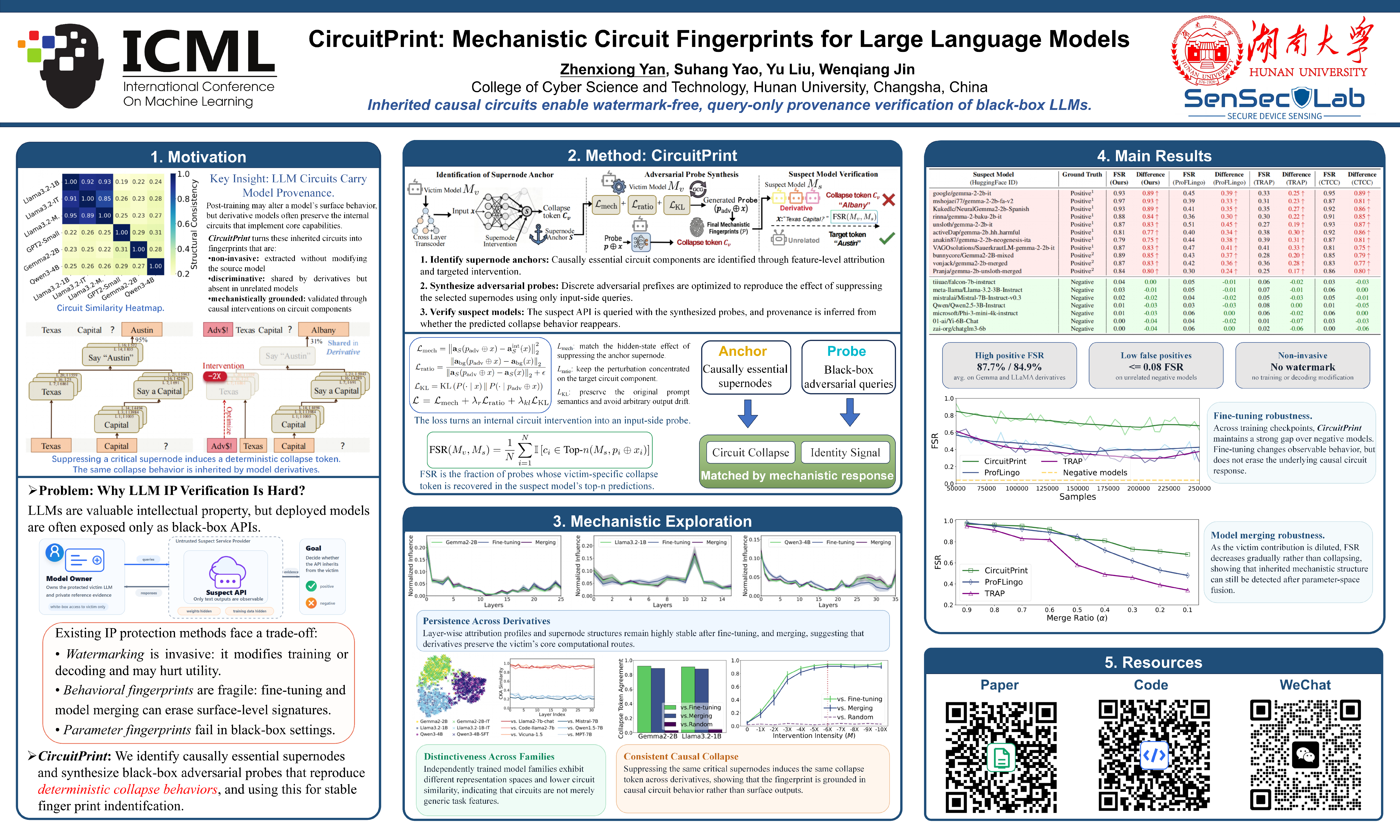
Large language models (LLMs) are trained at significant computational and data cost, making them valuable intellectual property (IP). Existing IP verification methods primarily rely either on invasive watermarking that degrades model utility, or on superficial behavioral signatures disrupted by fine-tuning and model merging. This apparent trade-off between model utility and IP protection has constrained practical deployment. We challenge this trade-off and propose CircuitPrint, a non-invasive IP fingerprinting framework that enables robust verification through standard model queries by leveraging stable internal computational circuits of LLMs. We show that these circuits function as a persistent computational backbone across model derivatives, allowing them to serve as stable fingerprints for distinguishing LLMs. Building on this stability, CircuitPrint constructs IP signatures by identifying mechanistically essential supernodes that causally produce specific predictions within these circuits. Specifically, trigger queries are synthesized to replicate the internal suppression of these supernodes, thereby inducing distinctive and observable output shifts. Experimental results demonstrate that CircuitPrint substantially outperforms existing baselines while remaining robust under aggressive fine-tuning and model merging, effectively resolving this trade-off without altering model parameters.
Lay Summary
Training powerful AI models requires immense computational resources, making them highly valuable intellectual property. However, protecting them from theft is notoriously difficult. Current methods either degrade the AI's performance by injecting invasive "watermarks," or rely on superficial behaviors that thieves can easily erase by slightly retraining the model. To tackle this, we looked past the AI's surface behavior and focused on its internal "wiring"—the specific computational circuits it uses to solve problems. We discovered that even when an AI is modified or disguised, its core reasoning circuits remain permanently anchored. Based on this insight, we developed CircuitPrint. Instead of altering the AI, CircuitPrint uses carefully crafted text prompts designed to interact directly with these deeply hidden circuits. By observing the AI's unique response to these prompts, we can definitively extract its specific "fingerprint." Our research demonstrates that an AI's underlying logic acts as an indestructible signature. This provides a reliable, harmless way for creators to prove ownership of their models, ultimately fostering a more secure and accountable AI ecosystem.