
NaRA: Noise-Aware LoRA for Parameter-Efficient Fine-Tuning of Diffusion LLMs
Abstract
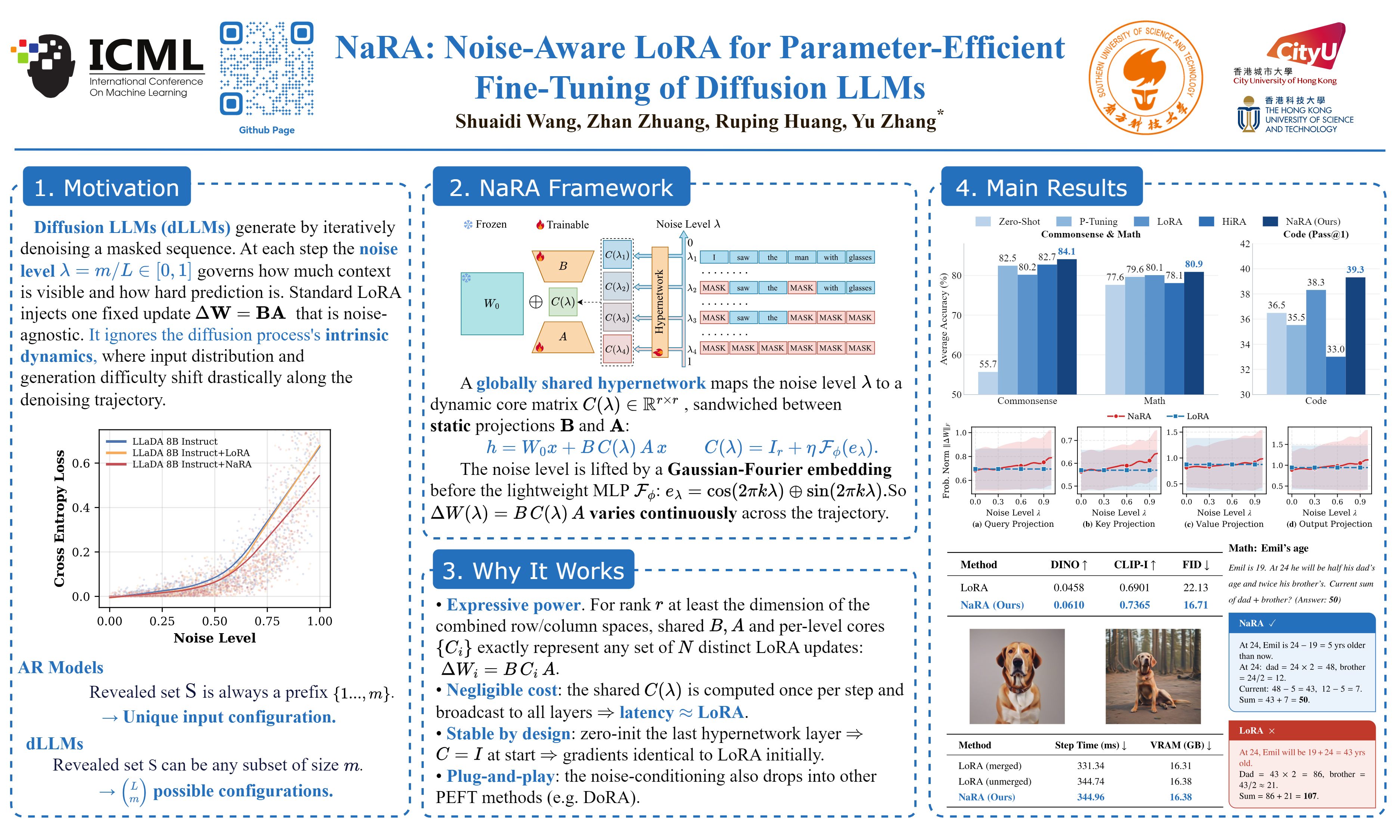
Diffusion Large Language Models (dLLMs) have emerged as a promising non-autoregressive generative paradigm. Given the prohibitive computational cost of full fine-tuning, Parameter-Efficient Fine-Tuning (PEFT) has become the standard approach. However, existing PEFT methods (e.g., LoRA), originally tailored for autoregressive models, rely on static parameters that are agnostic to the noise level. Consequently, they ignore the intrinsic dynamics of the diffusion process, where input distributions and generation difficulty shift significantly along the denoising trajectory, rendering them suboptimal for dLLMs. To address this, we propose Noise-aware Low-Rank Adaptation (NaRA), which introduces a low-rank core matrix generated by a lightweight, globally shared hypernetwork conditioned on the noise level. This design enables the update matrices to vary continuously along the diffusion process while keeping parameter and latency overhead negligible. We provide a theoretical justification for the proposed NaRA framework and empirically demonstrate consistent improvements over noise-agnostic baselines across commonsense reasoning, mathematical reasoning, and code generation benchmarks. Our code is available at https://github.com/generaldi/NaRA.
Lay Summary
Diffusion large language models generate text through a multi-step denoising process, but adapting them to new tasks efficiently is difficult. Existing parameter-efficient methods, such as LoRA, treat all denoising steps the same, even though the model faces very different inputs when the noise level is high or low. This mismatch limits their effectiveness on diffusion models. We propose NaRA, a noise-aware version of LoRA that changes its update weights according to the current noise level. Instead of using one fixed adapter for every step, NaRA uses a lightweight shared hypernetwork to generate a small core matrix that smoothly adapts the model as denoising proceeds. This keeps the extra cost very small while allowing the fine-tuning behavior to match the diffusion process more closely. Across commonsense reasoning, math reasoning, and code generation tasks, NaRA consistently outperforms standard LoRA and other parameter-efficient baselines. It also transfers to image diffusion models, showing that the idea is broadly useful. Overall, our work shows that diffusion models benefit from task adaptation methods that change with the noise level rather than remaining static throughout generation.