
A Regime-Aware Trajectory Prediction Framework for 1000+ Systems Biology Models
Abstract
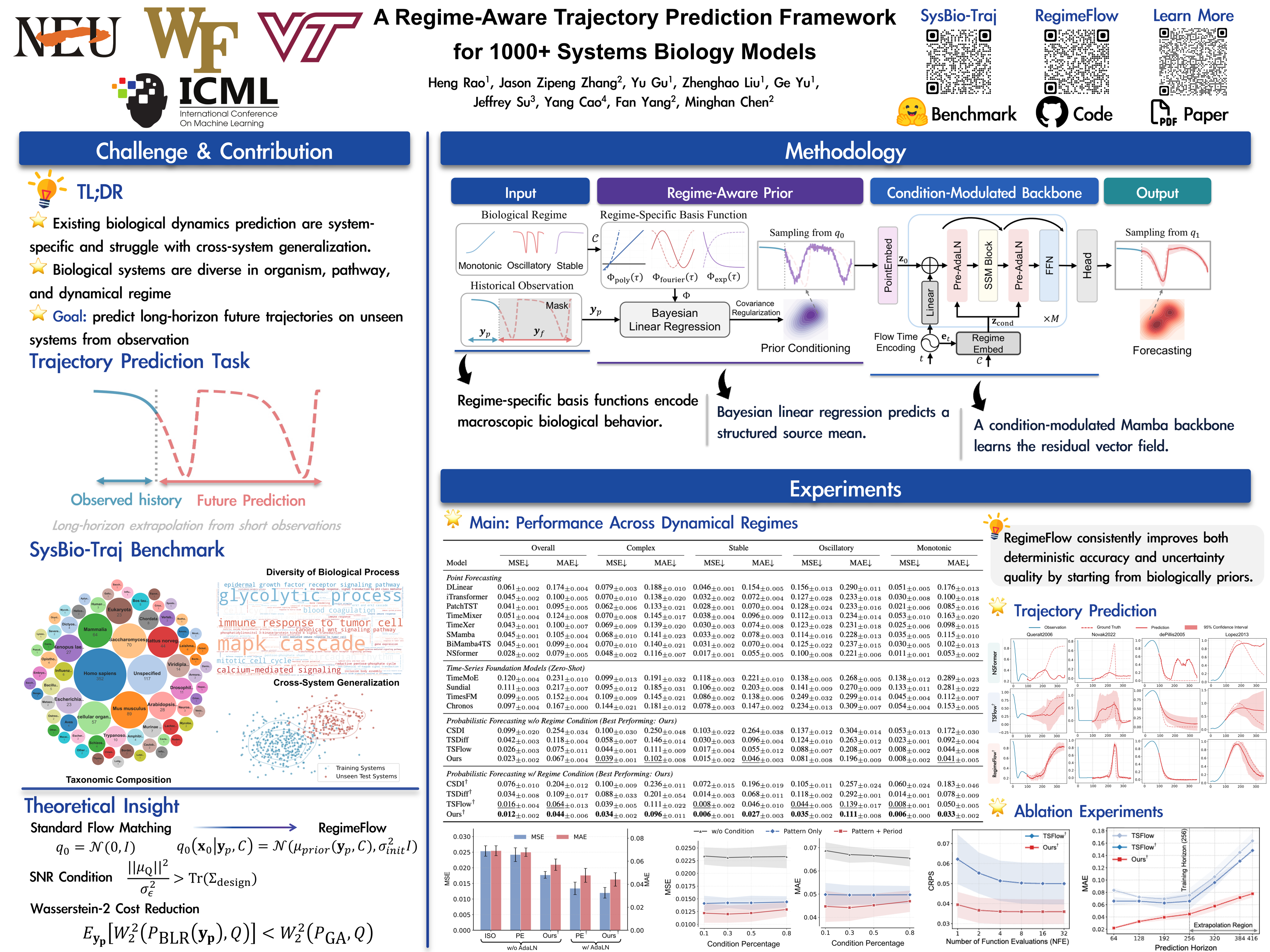
Predicting long-horizon trajectories of biological dynamical systems remains challenging due to substantial system heterogeneity. Most existing machine learning approaches are system-specific, requiring retraining for each new system and exhibiting limited generalization across distinct biological regimes. To address this limitation, we create a large-scale benchmark of over 1,000 ODE-based systems biology models spanning diverse organisms, biological processes, and dynamical behaviors. Building on this benchmark, we propose a regime-aware trajectory prediction framework that enables cross-system generalization and uncertainty quantification for unseen systems. Our approach introduces structured initial states derived from biological regime priors, such as growth trends and oscillatory rhythms, into conditional flow matching, replacing the standard Gaussian source distribution. We provide theoretical justification for this initialization and empirically demonstrate state-of-the-art accuracy (31\% MAE reduction), well-calibrated uncertainty (17\% CRPS improvement), and efficient long-horizon inference across the benchmark.
Lay Summary
Biological systems, such as cells, organs, and disease processes, often change over time in complex ways. Accurately predicting these changes is important for understanding biology, but it is difficult because each biological system can behave very differently. Many existing machine learning methods work well only for the specific system they were trained on, making them hard to apply broadly. In this work, we build a large collection of more than 1,000 biological system models covering diverse organisms and biological processes. This collection provides a common testbed for evaluating whether artificial intelligence methods can make predictions on biological systems they have not seen before. We also introduce RegimeFlow, a new prediction framework that uses simple biological behavior patterns, such as steady behavior, growth or decline, and rhythmic oscillations, to guide its forecasts. Instead of starting predictions from an uninformed guess, RegimeFlow begins from a biologically plausible direction and then refines the future trajectory. Experiments show that this approach improves long-term prediction accuracy, provides more reliable uncertainty estimates, and runs efficiently across many different biological systems.