
FedScar: Correcting Geometric Bias for Flatness-Consistent Federated Learning
Abstract
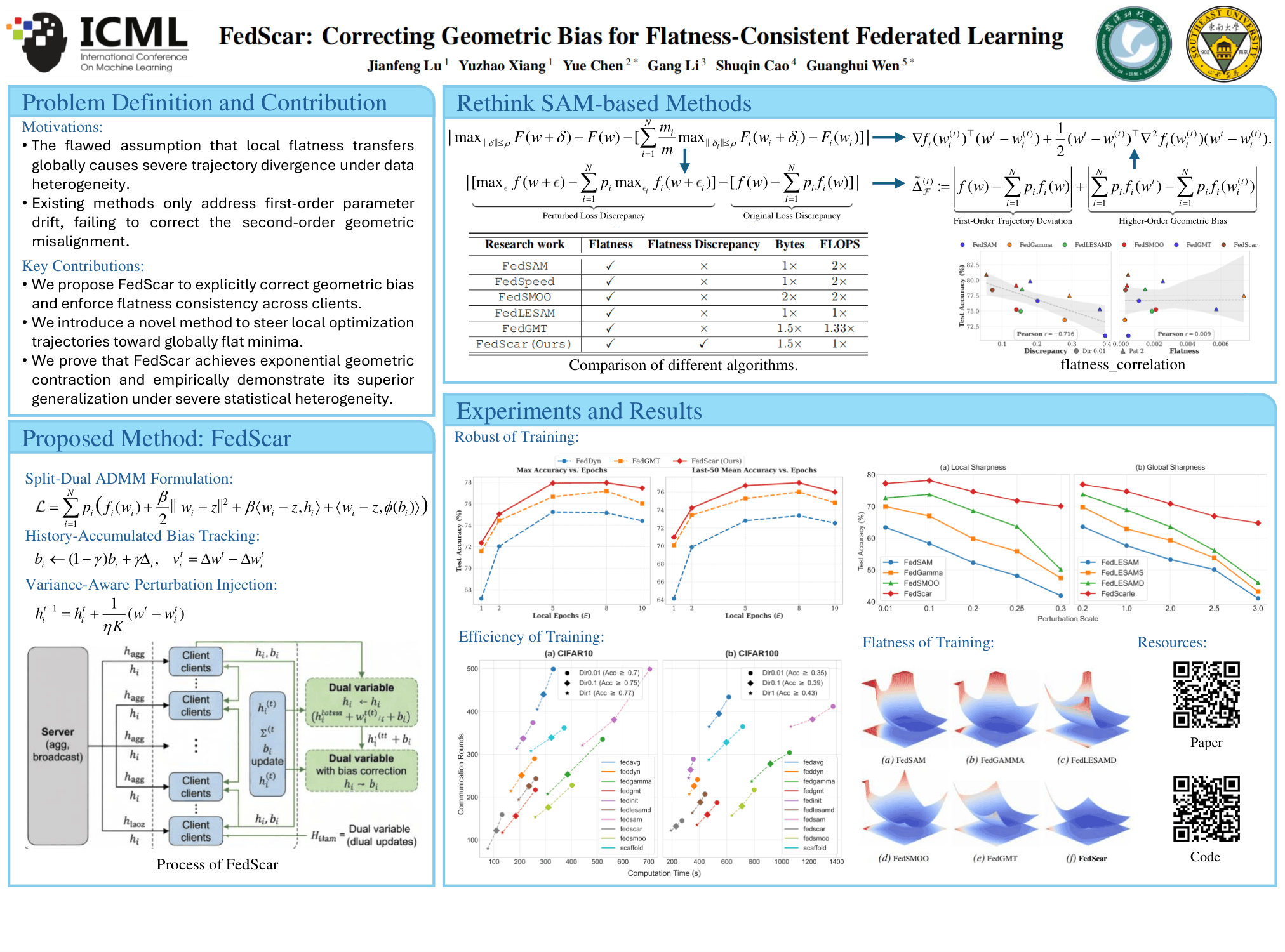
Federated Learning (FL) often suffers from degraded generalization under statistical heterogeneity, where client updates systematically deviate from the global objective. While recent Sharpness-Aware Minimization (SAM) methods promote locally flat solutions, they implicitly assume that local flatness transfers to the global model, which generally does not hold under heterogeneous data distributions. This mismatch gives rise to a flatness discrepancy induced by misaligned loss landscapes. To address this issue, we propose FedScar, a federated optimization framework that explicitly corrects heterogeneityinduced geometric inconsistency. FedScar maintains a history-accumulated geometric bias to capture persistent curvature skew across clients, and employs a variance-aware injection mechanism to steer local updates toward regions that are flat with respect to the global objective. We provide a theoretical interpretation of FedScar as a Split-Dual ADMM formulation, which jointly enforces parameter consensus and geometric alignment. Extensive experiments under severe heterogeneity demonstrate that FedScar consistently reduces flatness discrepancy and improves generalization over state-of-the-art methods, without incurring additional communication overhead. The source code is available at https://github.com/Ultraman6/FedScar.
Lay Summary
Federated Learning (FL) enables many devices or organizations to collaboratively train a shared model without sharing private data. However, when participants hold very different data, their local training may guide the model toward solutions that work well locally but generalize poorly globally. Existing methods encourage locally stable solutions, but such local stability may not match the stability needed by the global model. To address this, we propose FedScar, a lightweight framework that tracks persistent training bias caused by data differences and uses it to correct local updates. Experiments show that FedScar improves accuracy and robustness under severe data heterogeneity and sparse participation, while maintaining communication efficiency.