
Towards the Explainability of Temporal Graph Networks via Memory Backtracking and Topological Attribution
Abstract
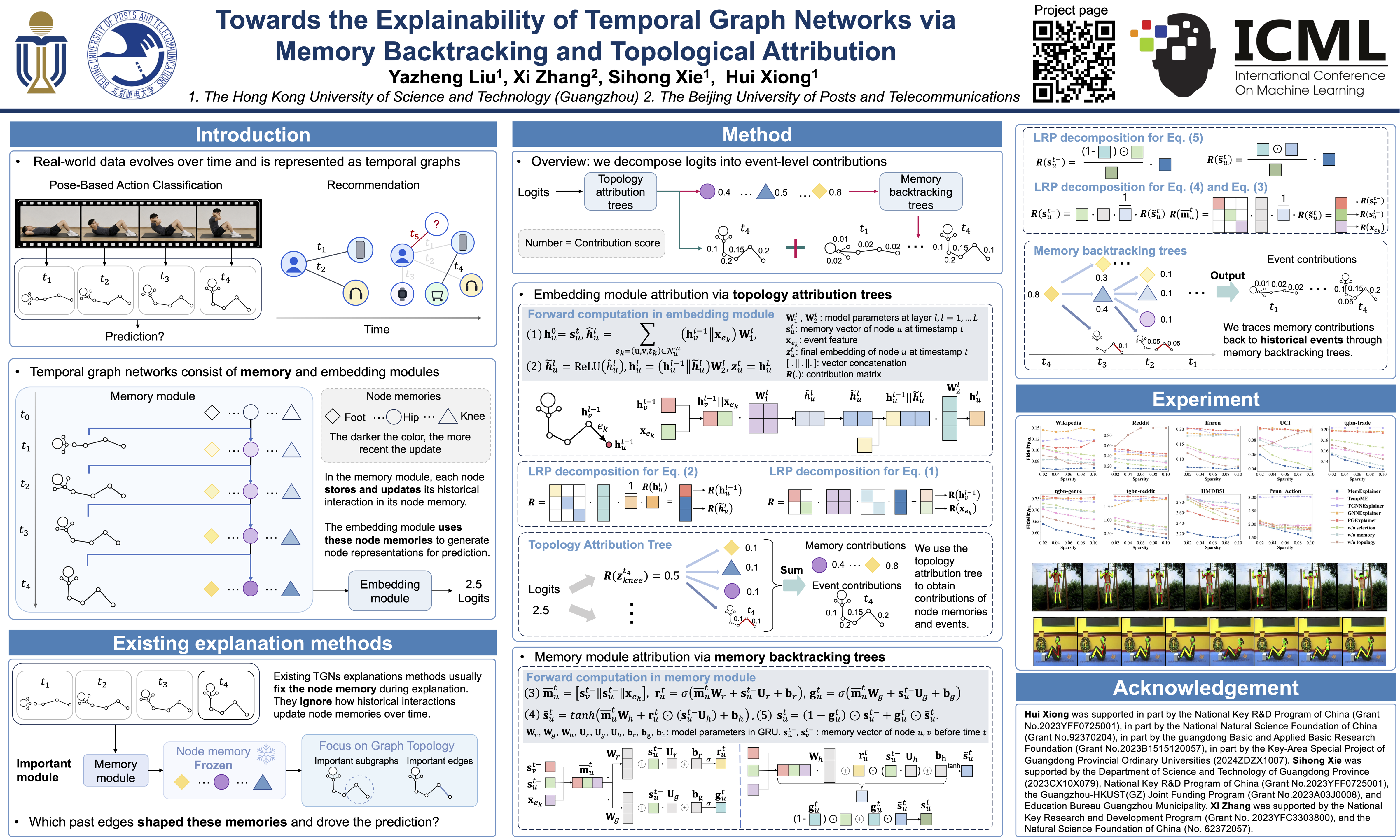
Temporal graphs are ubiquitous in real-world applications such as social networks and finance, where Temporal Graph Networks (TGNs) capture both structural and temporal dependencies, achieving in superior predictive accuracy. Understanding which historical events drive specific model predictions can enhance trustworthiness of TGNs. Existing explanation methods overlook the memory module, the core component that records and updates node histories, leaving the influence of past events unexplored. To address this challenge, we propose a method that attributes TGNs predictions through the topology attribution tree and memory backtracking tree. The topology attribution tree captures the influence of neighbors and their memory vectors, then the memory backtracking tree quantifies how historical events shape node memory vectors. We apply the LRP in TGNs, ensuring that the total contribution of events equals the model’s logits. Finally, top-k selection may lack faithfulness due to the nonliear relationship between logits and probabilities. We design optimization objectives to map logits to probabilities and identify the important events. Experiments on nine temporal graph datasets, spanning node property prediction, link prediction tasks and graph classification tasks, show that our method provides faithful explanations and outperforms state-of-the-art baselines.