
MotionGRPO: Overcoming Low Intra-Group Diversity in GRPO-Based Egocentric Motion Recovery
Abstract
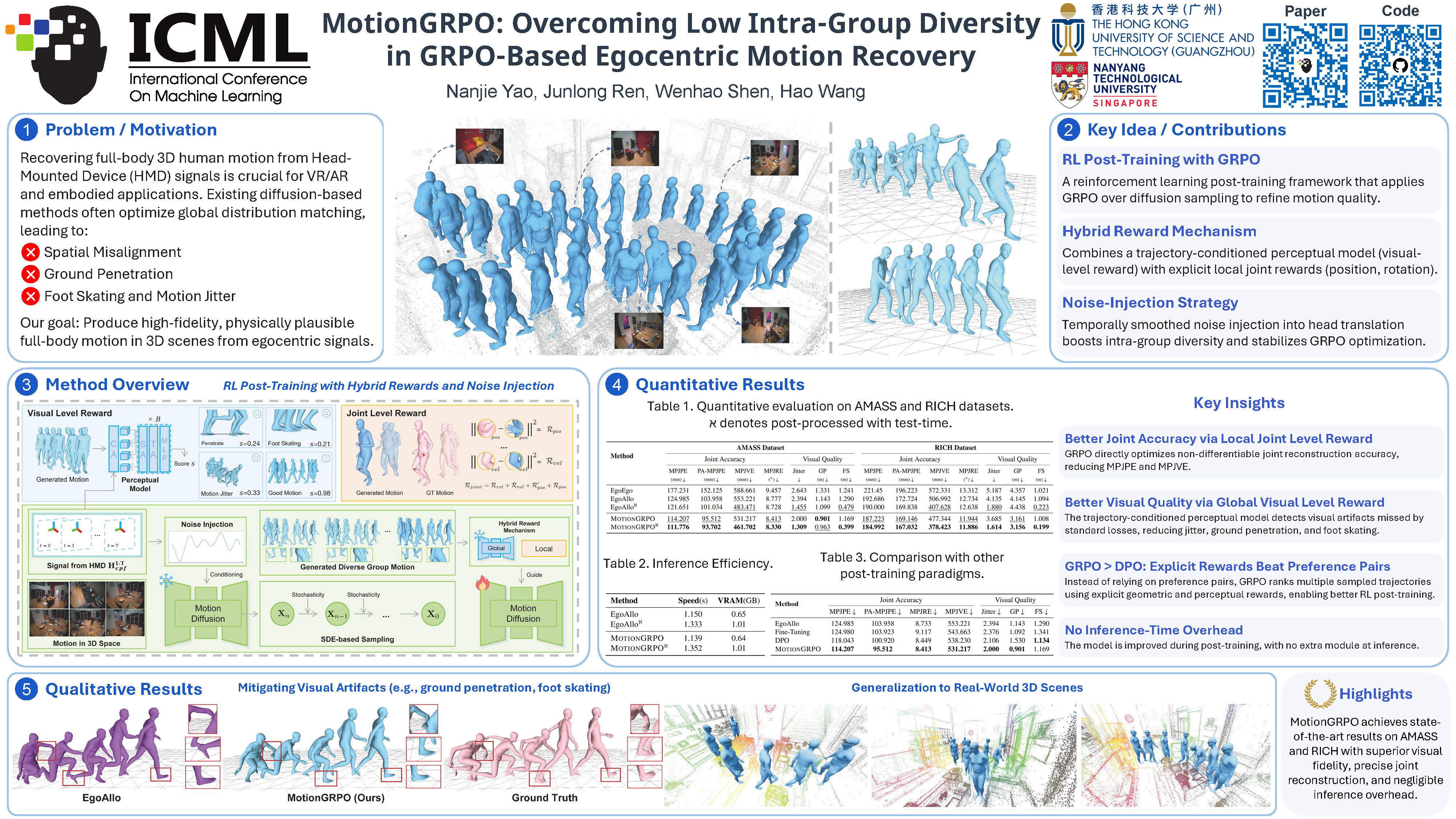
This paper studies full-body 3D human motion recovery from head-mounted device signals. Existing diffusion-based methods often rely on global distribution matching, leading to local joint reconstruction errors. We propose MotionGRPO, a novel framework leveraging reinforcement learning post-training to inject fine-grained guidance into the diffusion process. Technically, we model diffusion sampling as a Markov decision process optimized via Group Relative Policy Optimization (GRPO). To this end, we introduce a hybrid reward mechanism that combines a learned conditioned perceptual model for global visual plausibility and explicit constraints for local joint precision. Our key technical insight is that policy optimization in diffusion-based recovery suffers from vanishing gradients due to limited intra-group sample diversity. To address this, we further introduce a noise-injection strategy that explicitly increases sample variance and stabilizes learning. Extensive experiments demonstrate that MotionGRPO achieves state-of-the-art performance with superior visual fidelity. Code is available at: https://github.com/3DAgentWorld/MotionGRPO/
Lay Summary
Imagine wearing a virtual reality headset and seeing your digital twin move exactly like you do, even the parts of your body the headset can’t actually see. Currently, AI systems struggle to recreate these full-body movements accurately from just a headset, often resulting in digital avatars with glitchy, awkward, or unrealistic poses. To solve this, we created MotionGRPO, a framework that acts like a digital coach for AI. Instead of just showing the AI examples of movement, we use a feedback system that "rewards" the AI when its predictions are both physically realistic and visually smooth. One common hurdle in training these systems is that they can become "stuck" or repetitive during the learning process. We overcame this by introducing a controlled amount of variety while the AI practices, ensuring it learns to handle a wide range of human motions more reliably. Our research makes high-quality body tracking possible using only standard headsets, removing the need for expensive, clunky full-body suits. This brings us closer to a future where virtual interactions feel as natural as meeting in person, enhancing everything from immersive gaming and fitness to remote medical consultations.