
cMoLLM at Scale: Horizontal Scaling Laws for Convolutionally-Gated Mixture-of-LLMs
Abstract
Lay Summary
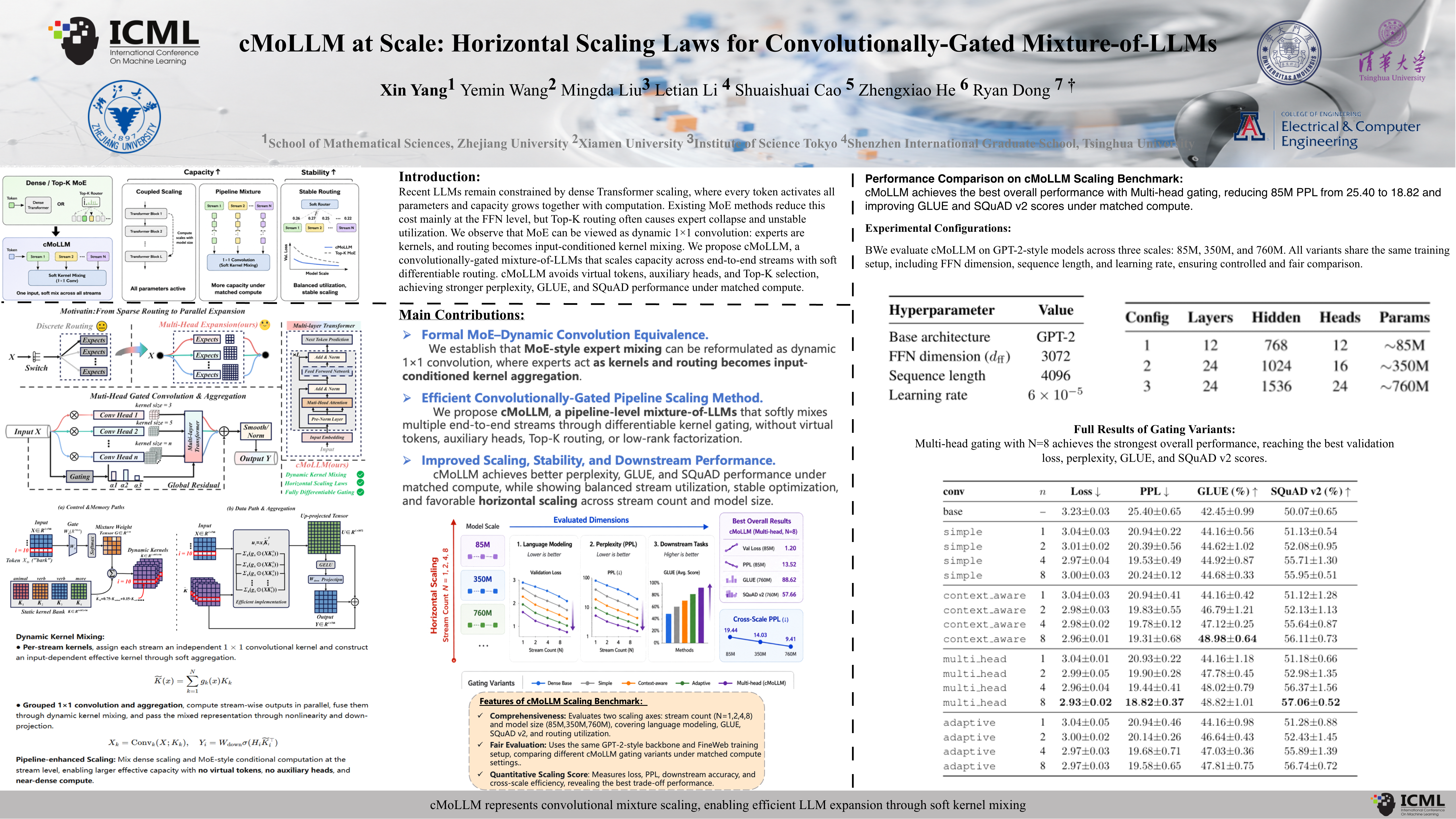
Large language models grow more capable as they scale, but the standard Transformer architecture activates every parameter for every input token, meaning that adding capacity inevitably increases computation. Mixture-of-Experts (MoE) methods address this by selectively activating subsets of parameters, yet existing pipeline-level approaches either confine mixing to isolated components or suffer from instability and poor stream utilization. This paper introduces cMoLLM, which extends MoE-style routing across the entire model pipeline by running multiple parallel LLM streams and fusing their outputs through fully differentiable dynamic convolution. A key theoretical contribution is showing that mixture layers are mathematically equivalent to variable-kernel dynamic convolutions, where each stream acts as a convolutional expert and routing corresponds to input-conditioned kernel aggregation. This framing enables end-to-end optimization without the gradient collapse or homogenized routing that plague prior methods. Empirically, cMoLLM consistently improves language modeling perplexity and performance on GLUE and SQuAD benchmarks in GPT-2-style models trained on FineWeb, while exhibiting more balanced stream utilization and favorable scaling behavior relative to ParaScale- and AltUp-style baselines under identical compute budgets.