
Dynamic Thinking-Token Selection for Efficient Reasoning in Large Reasoning Models
zhenyuan guo ⋅ Tong Chen ⋅ Wenlong Meng ⋅ Chen GONG ⋅ Xin Yu ⋅ Chengkun Wei ⋅ Wenzhi CHEN
Abstract
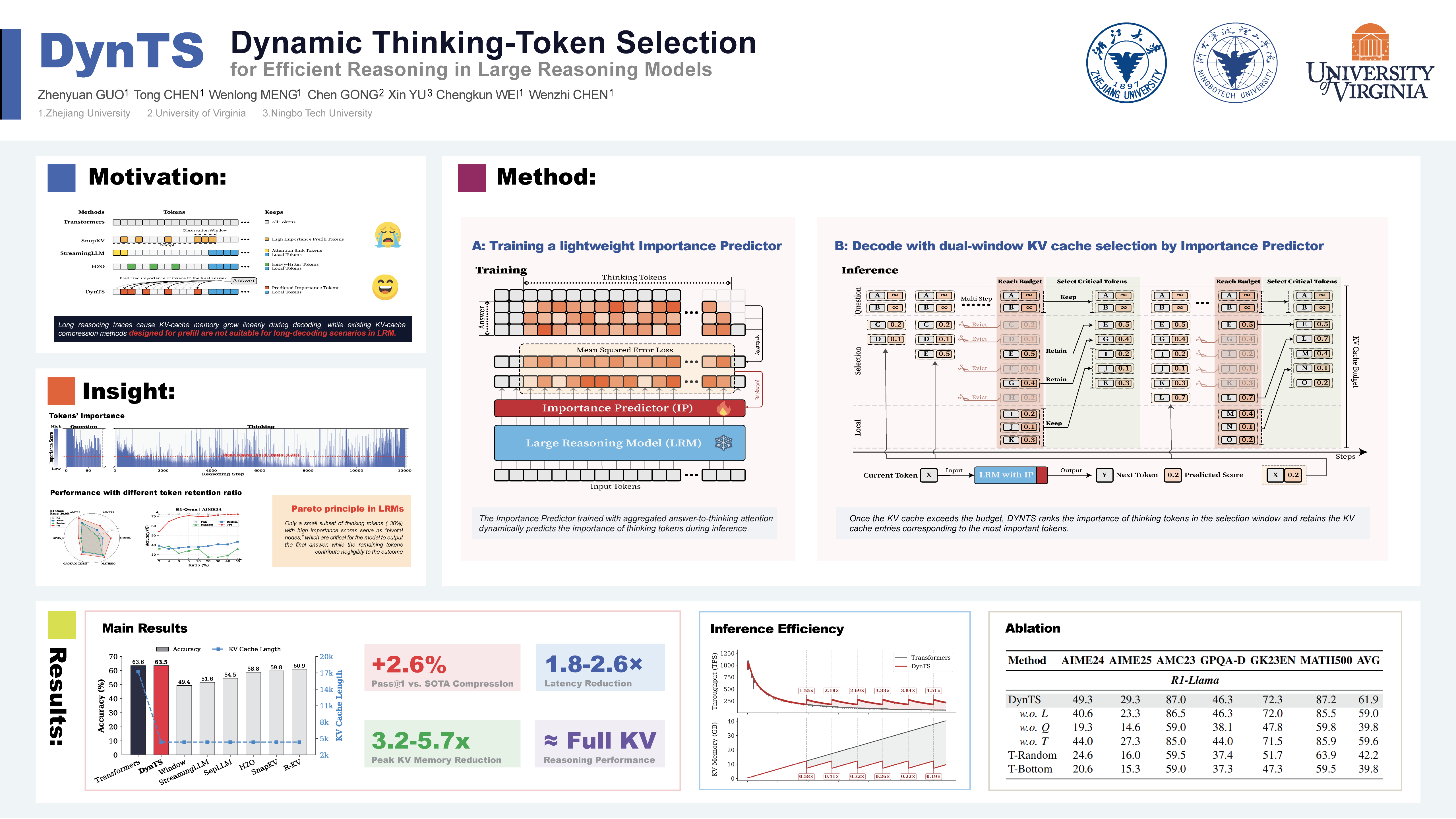
Large Reasoning Models (LRMs) excel at solving complex problems by explicitly generating a reasoning trace before deriving the final answer. However, these extended generations incur substantial memory footprint and computational overhead, bottlenecking LRMs' efficiency. This work uses attention maps to analyze the influence of reasoning traces and uncover an interesting phenomenon: *only some decision-critical tokens in a reasoning trace steer the model toward the final answer, while the remaining tokens contribute negligibly.* Building on this observation, we propose **Dyn**amic **T**hinking-Token **S**election (**DynTS**). This method identifies decision-critical tokens and retains only their associated Key-Value (KV) cache states during inference, evicting the remaining redundant entries to optimize efficiency. Across six benchmarks, **DynTS** surpasses the state-of-the-art KV cache compression methods, improving Pass@1 by $2.6\\%$ under the same budget. Compared to vanilla Transformers, it reduces inference latency by $1.84–2.62\times$ and peak KV-cache memory footprint by $3.32–5.73\times$ without compromising LRMs' reasoning performance.
Lay Summary
Large reasoning models generate many intermediate reasoning steps to solve hard problems, but this process can expand the KV cache, slowing inference and increasing memory costs. We find that only a small portion of these thinking tokens are truly important for the final answer. DYNTS trains a token-importance predictor to identify and select critical tokens on the fly during the model inference. This reduces memory use and speeds up inference while preserving reasoning accuracy, making powerful reasoning models more practical to deploy on limited hardware.
Video
Chat is not available.
Successful Page Load