
Self-Refining Video Sampling
Abstract
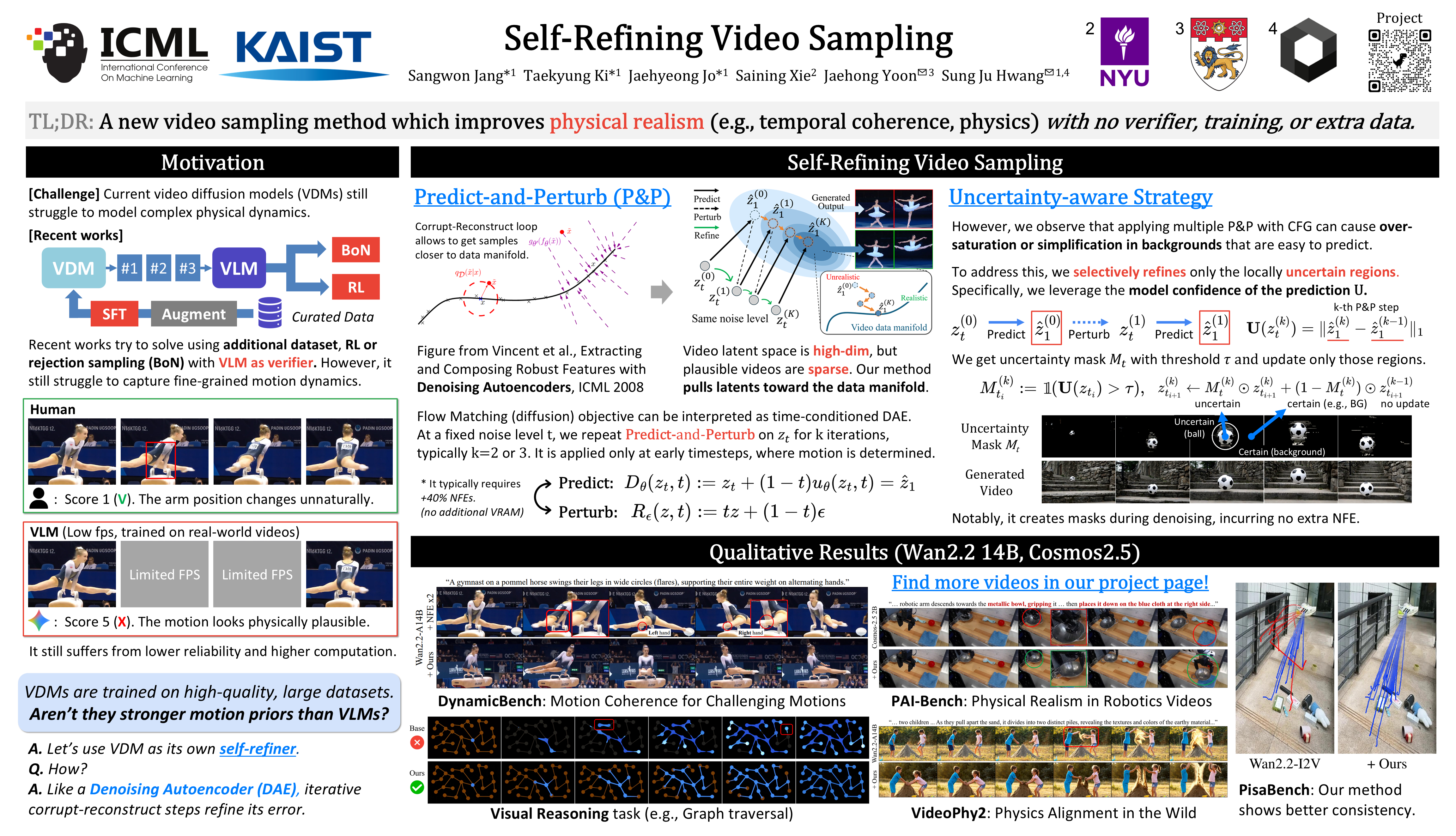
Modern video generators still struggle with complex physical dynamics, often falling short of physical realism. Existing approaches address this using external verifiers or additional training on augmented data, which is computationally expensive and still limited in capturing fine-grained motion. In this work, we present self-refining video sampling, a simple method that uses a pre-trained video generator trained on large-scale datasets as its own self-refiner. By interpreting the generator as a denoising autoencoder, we enable iterative inner-loop refinement at inference time without any external verifier or additional training. We further introduce an uncertainty-aware refinement strategy that selectively refines regions based on self-consistency, which prevents artifacts caused by over-refinement. Experiments on state-of-the-art video generators demonstrate significant improvements in motion coherence and physics alignment, achieving over 70% human preference compared to the default sampler and guidance-based sampler.
Lay Summary
Video generators still struggle with complex motion and physical dynamics, while existing approaches often require external verifiers or additional training, making them costly and still limited in capturing fine-grained motion. We ask whether the video generator itself can serve as a better refiner, since it has already learned rich motion and structure priors from large-scale video data. We propose Self-Refining Video Sampling, a training-free method that uses a pre-trained video generator to refine its own samples during inference. The method repeatedly predicts a cleaner video and perturbs it again, guiding the sample toward more coherent and physically plausible motion. It also refines only uncertain regions, such as moving objects, while preserving stable backgrounds. This improves motion coherence, physical realism, and spatial consistency without additional training or external verifiers.