
Group Cognition Learning: Making Everything Better Through Controlled Two-Stage Agents Collaboration
Abstract
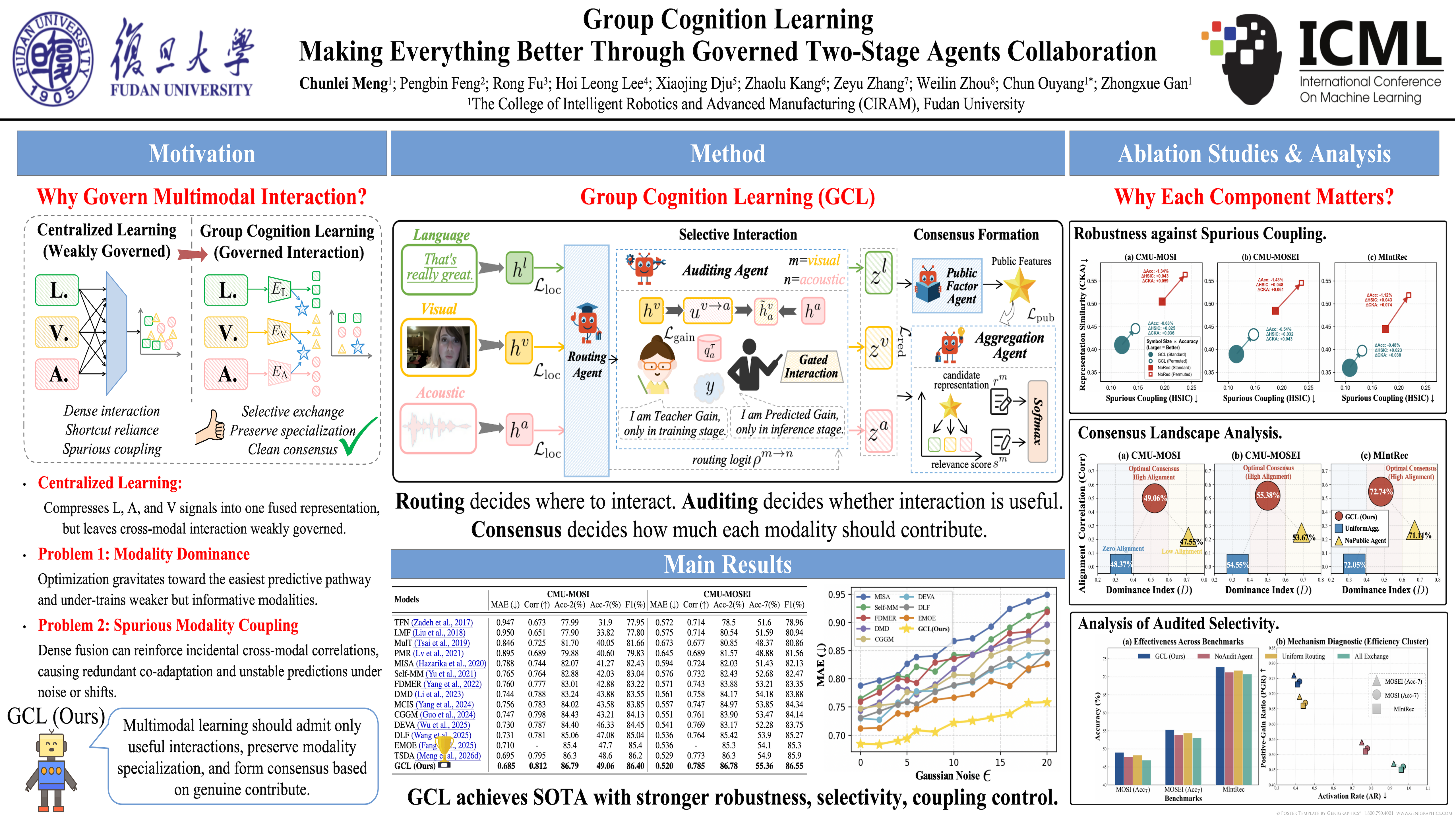
Centralized multimodal learning commonly compresses language, acoustic, and visual signals into a single fused representation for prediction. While effective, this paradigm suffers from two limitations: modality dominance, where optimization gravitates towards the path of least resistance, ignoring weaker but informative modalities, and spurious modality coupling, where models overfit to incidental cross-modal correlations. To address these, we propose \textbf{Group Cognition Learning (GCL)}, a governed collaboration paradigm that applies a two-stage protocol after modality-specific encoding. In Stage 1 (Selective Interaction), a Routing Agent proposes directed interaction routes, and an Auditing Agent assigns sample-wise gates to emphasize exchanges that yield positive marginal predictive gain while suppressing redundant coupling. In Stage 2 (Consensus Formation), a Public-Factor Agent maintains an explicit shared factor, and an Aggregation Agent produces the final prediction through contribution-aware weighting while keeping each modality representation as a specialization channel. Extensive experiments on CMU-MOSI, CMU-MOSEI, and MIntRec demonstrate that GCL mitigates dominance and coupling, establishing state-of-the-art results across both regression and classification benchmarks. Analysis experiments further demonstrate the effectiveness of the design.
Lay Summary
Modern AI systems often need to understand a situation from several sources at once, such as words, voice, facial expressions, images, or videos. A common approach is to mix all available information together and let the system make a decision. However, this can cause the system to rely too much on the easiest source, such as text, or to learn misleading connections that do not hold in new situations. We propose Group Cognition Learning, a method that makes different information sources work together in a more careful way. It first checks which information exchanges are actually helpful and blocks those that may introduce noise. It then combines the remaining evidence while still preserving what each source contributes on its own. Experiments across several tasks show that this approach improves prediction accuracy, remains more stable when inputs are noisy, and makes the decision process easier to inspect.