
VLA-ATTC: Adaptive Test-Time Compute for VLA Models with Relative Action Critic Model
Abstract
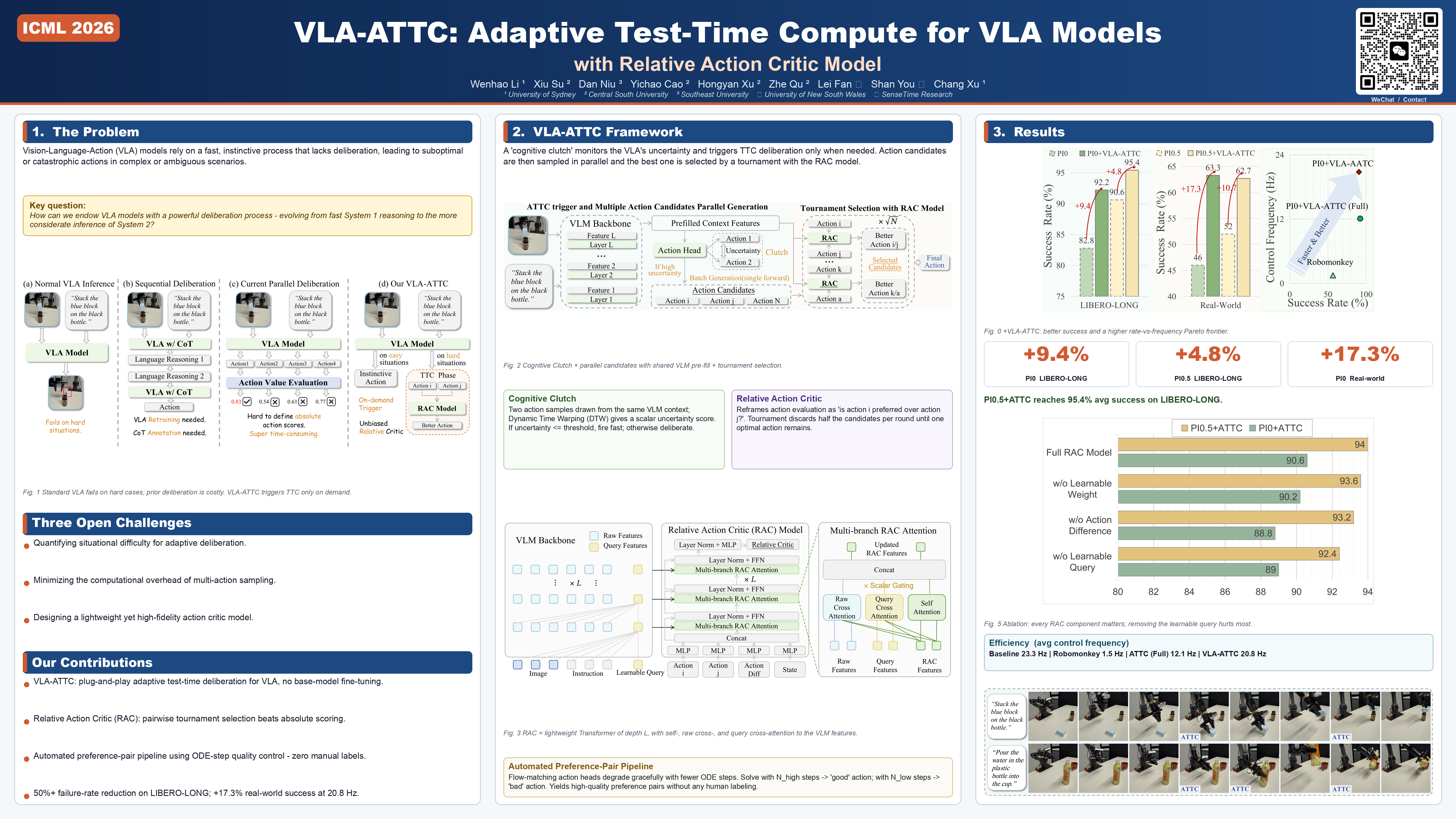
Vision-Language-Action (VLA) models have demonstrated remarkable capabilities and generalization in embodied manipulation. However, their decision-making relies on a fast, instinctive process that lacks deliberation. This strategy often leads to suboptimal or catastrophic actions when facing complex or ambiguous scenarios that require greater consideration. In this paper, we introduce \textbf{VLA-ATTC}, a framework that endows VLA models with adaptive test-time compute (TTC). VLA-ATTC employs an uncertainty-based ``cognitive clutch'' to dynamically transition from reflexive execution to a TTC deliberation phase when necessary. During TTC phase, a novel \textbf{Relative Action Critic} (RAC) model identifies the optimal action from generated candidates via pairwise comparisons. This relative mechanism replaces unstable absolute value estimation, significantly simplifying the learning objective. Furthermore, we introduce an efficient sampling strategy to amortize computational costs and an automated data pipeline that curates preference pairs without manual annotation. On the LIBERO-LONG benchmark, VLA-ATTC reduces the failure rate of the SOTA model PI0.5 by over 50\%.
Lay Summary
Vision-language-action models help robots understand visual scenes, follow language instructions, and perform physical actions. However, these models often act quickly without checking whether a situation is difficult or uncertain, which can lead to failures in complex tasks. This work introduces VLA-ATTC, a method that allows a robot to “think more” only when needed. When the model is confident, it acts directly; when uncertainty is high, it generates several possible actions and uses a lightweight comparison model to select the better one. This avoids costly reasoning at every step while improving reliability. Experiments in simulation and on real robots show that VLA-ATTC substantially improves task success while maintaining fast control speed, making it a practical approach for safer and more robust robotic manipulation.