
ST-Veto: Spatio-Temporal Token Veto for Diffusion MLLMs via Taylor Prediction and Visual Grounding
Abstract
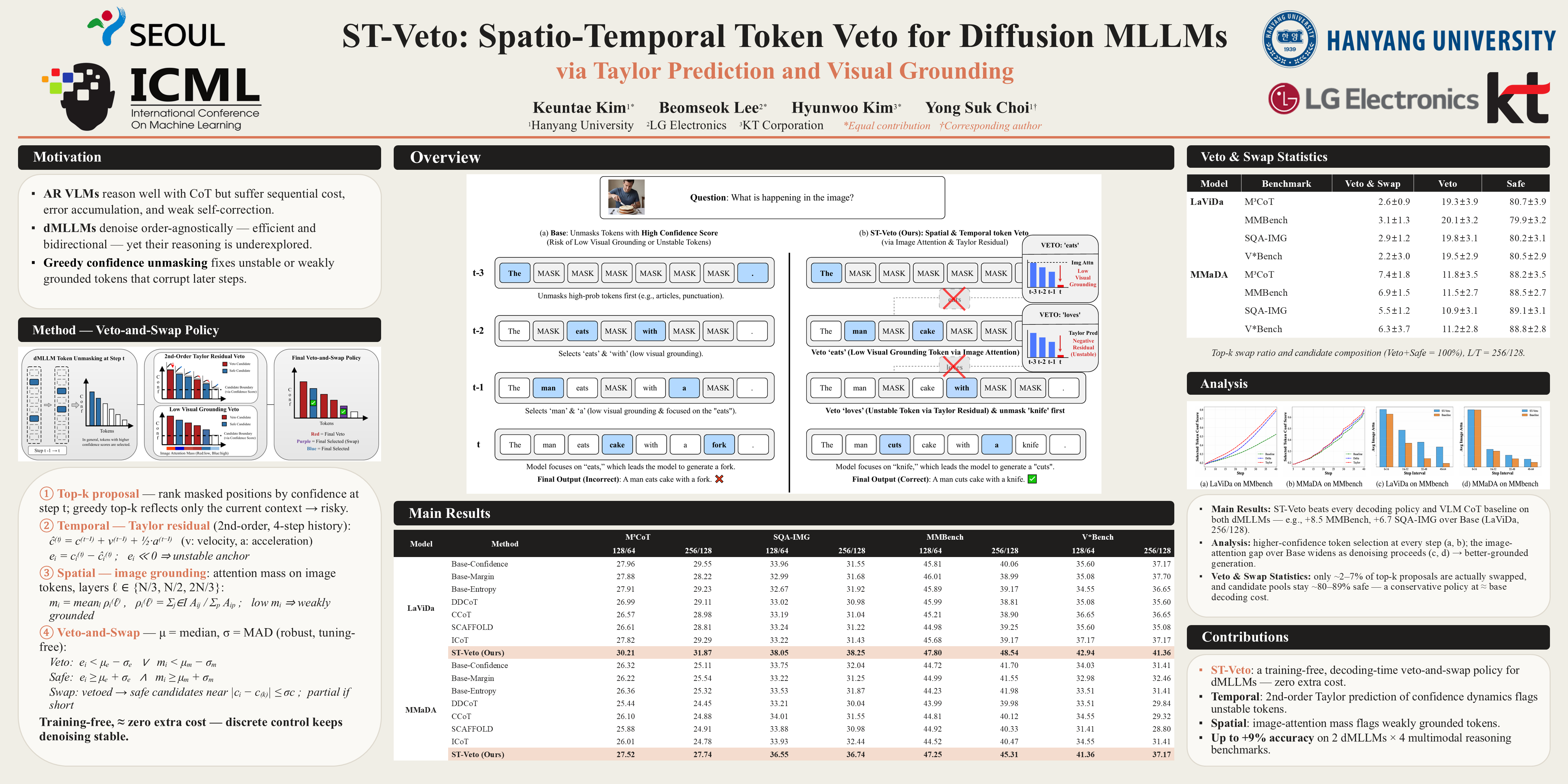
Vision Language Models (VLMs) achieve strong reasoning with Chain-of-Thought (CoT) prompting but incur high sequential-generation cost, error accumulation, and limited self-correction. Diffusion Multimodal Large Language Models (dMLLMs) unmask tokens in an order-agnostic process, improving efficiency and enabling iterative refinement, yet their reasoning and how to enhance it remain underexplored. We propose a training-free method, Spatio-Temporal Token Veto (ST-Veto), which leverages the ability to observe all token positions at each diffusion step. Rather than relying only on current-step confidence, ST-Veto vetoes temporally unstable tokens via second-order Taylor prediction of confidence dynamics and filters weakly grounded tokens using image-attention mass, swapping them with safer candidates. Across multiple dMLLMs and multimodal reasoning benchmarks, ST-Veto consistently outperforms standard decoding policies and prior VLM reasoning methods, improving accuracy by up to 9\% with no additional training or generation cost. Analyses show that ST-Veto steers generation toward higher-confidence, better-grounded paths.
Lay Summary
Vision-language AI systems can answer questions about images, but conventional systems usually generate text one word at a time, which can be slow and can make early mistakes difficult to fix. Diffusion-based multimodal language models offer a different approach by generating and revising many words in parallel, but it is still unclear how to make their reasoning reliable. This paper proposes ST-Veto, a method that helps these models choose better words during generation. It checks whether a word remains stable over the generation process and whether it is supported by the image. Unreliable words are delayed and replaced with safer alternatives. Experiments show that this improves image-based reasoning accuracy without extra training or additional generation cost.