
A Unified Framework for Deep Hypergraph Clustering Beyond Homophily
Abstract
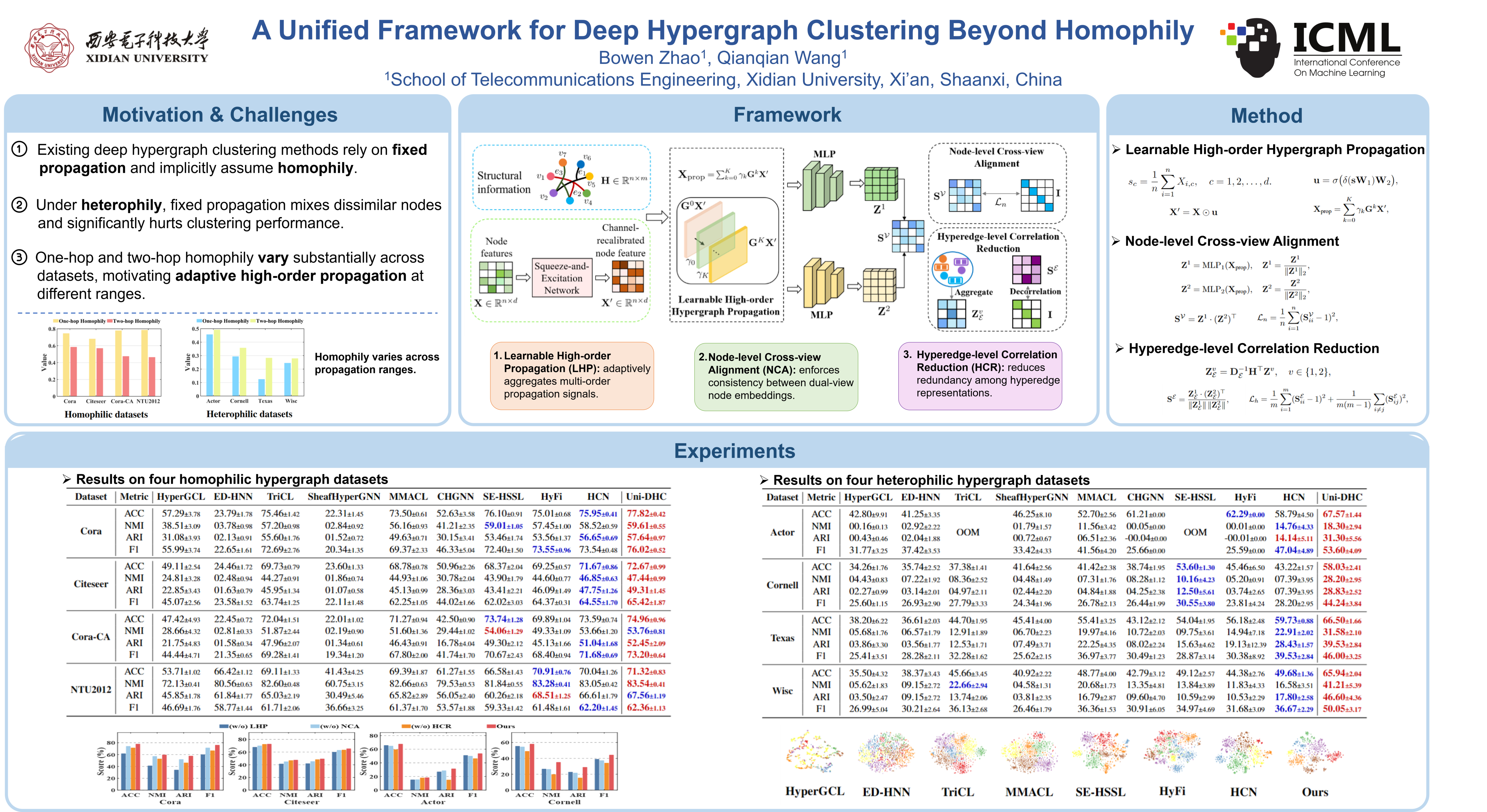
Deep hypergraph clustering exhibits compelling capacity for node representation learning via modeling high-order relationships. However, most existing methods adopt fixed propagation mechanisms and implicitly assume homophily, which presumes that adjacent nodes possess similar characteristics. This assumption might deviate from real-world situations, particularly under heterophilic conditions, thereby degrading clustering performance. To address this limitation, we propose a \textbf{Uni}fied Framework for \textbf{D}eep \textbf{H}ypergraph \textbf{C}lustering (Uni-DHC). Specifically, we design a learnable high-order hypergraph propagation strategy that fuses multi-order information and adaptively learns their importance derived from raw data. To stabilize unsupervised training and eliminate structural redundancy caused by high-order aggregation, we additionally enforce node-level consistency and hyperedge-level decorrelation constraints. From the spectral perspective, we demonstrate that conventional HGNN-style propagation corresponds to a fixed low-pass filter, whereas our designed method induces a learnable polynomial spectral filter. Extensive experiments on homophilic and heterophilic datasets illustrate that Uni-DHC consistently outperforms state-of-the-art methods, achieving prominent performance improvement in heterophilic settings.
Lay Summary
Many real-world data are not simply connected in pairs. For example, a paper may be written by several authors, and a user may interact with multiple items in a recommendation system. Hypergraphs are useful for modeling such group relationships. However, existing hypergraph clustering methods often assume that connected objects are similar to each other. This assumption does not always hold in practice, since objects linked in the same group may belong to different categories or have different meanings. This paper proposes a new framework for hypergraph clustering that can better handle such complex situations. Instead of using a fixed way to pass information between connected objects, our method learns how much information should be collected from different neighborhood ranges. This allows the model to adapt to both similar and dissimilar connection patterns. We also introduce two simple training objectives to make the learned representations more consistent and reduce redundant information among hyperedges. Experiments on several benchmark datasets show that the proposed method produces better clustering results than existing methods, especially when connected objects are not necessarily similar. This suggests that the method can be useful for analyzing complex relational data in areas such as social networks, recommendation systems, and biological data.