
Interpretability Transfer from Language to Vision via Sparse Autoencoders
Abstract
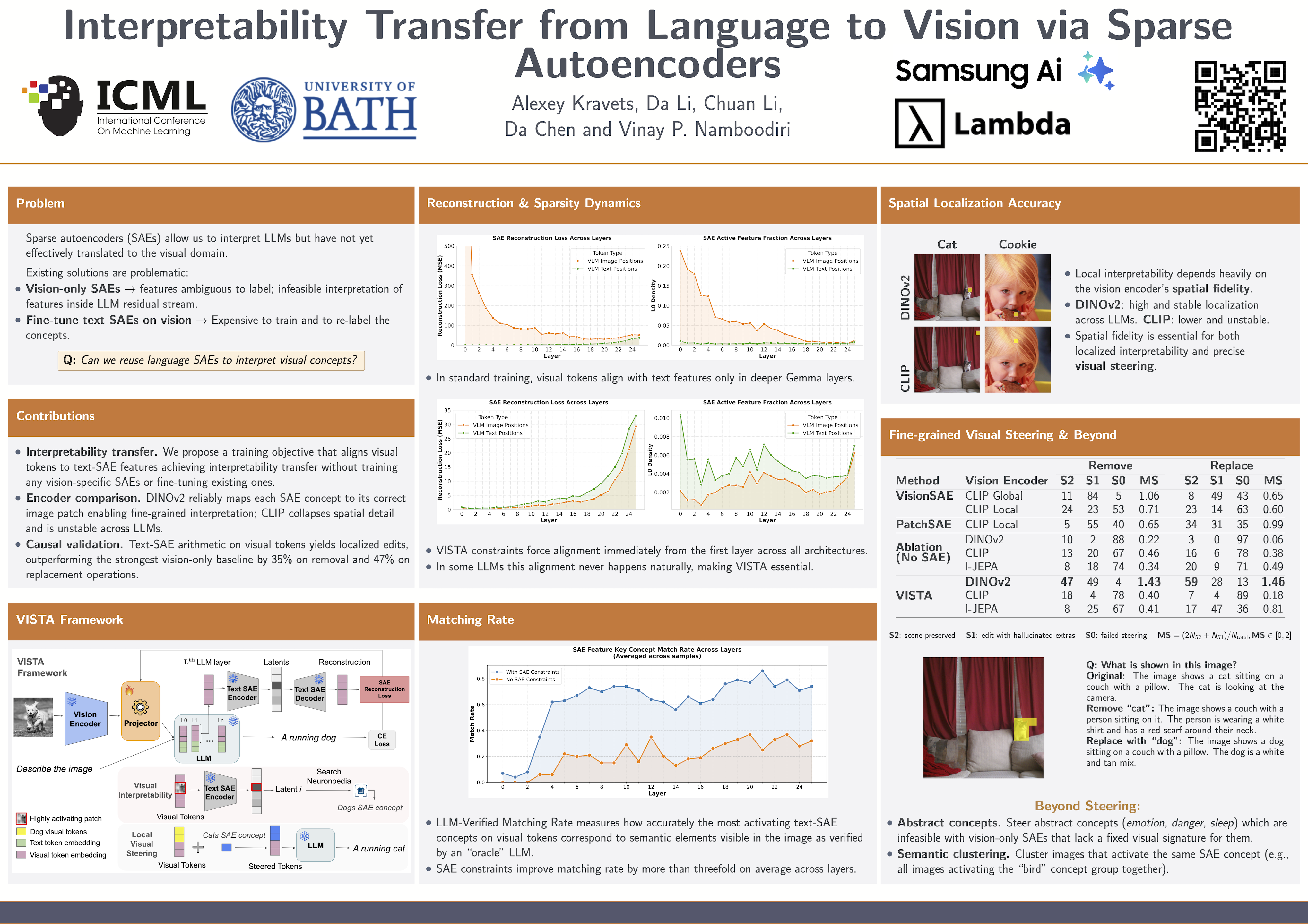
Recent advances in language model interpretability using sparse autoencoders (SAEs) have yet to effectively translate to the visual domain, mainly due to the difficulty and ambiguity of labeling visual concepts. In this paper, we introduce Visual Interpretability via SAE Transfer Alignment (VISTA), a framework that transfers interpretability from language to vision in a LLaVA-style vision-language model by constraining a visual projector to map visual tokens into an LLM's pre-existing, labeled textual SAE space. This approach enables visual interpretability without training dedicated vision SAEs. By regularizing the projector using the LLM's SAE reconstruction loss, VISTA achieves a threefold increase in the matching rate, which measures how accurately the most activating textual concepts in the SAE space correspond to semantic elements in the image. Using this framework, we further analyze spatial localization properties of different vision encoders and show that DINOv2 features have stronger localization abilities than other encoders. Leveraging this precision, we validate VISTA's cross-modal alignment through fine-grained, localized concept interventions, where specific objects are removed or replaced in the model's perception while preserving the surrounding scene. This results in improvements of 35\% in object removal and 47\% in object replacement tasks over vision-only baselines, providing causal evidence that visual tokens inhabit the text SAE manifold. These contributions are validated across multiple LLM architectures.
Lay Summary
Modern AI systems that combine vision and language such as the models powering ChatGPT's image understanding are powerful but hard to explain. We can describe what they do, but not how they decide what's in a picture. For text-only language models, researchers have built tools called sparse autoencoders that act like dictionaries, listing the individual concepts a model uses when it reads. No equivalent exists for images, because labeling the concepts a vision model uses turns out to be very difficult and ambiguous. For example, is a "dog" feature about the dog itself, its breed, or what it's doing? We took a different route. Instead of building a new dictionary for images, we taught the visual side of these models to speak the language model's existing dictionary. Our method, VISTA, forces image patches to be expressible in the same concept vocabulary the language model already uses for text. Once aligned, we can read off what each image patch means using the existing labels and even edit a picture's meaning by swapping concepts that the model sees in the picture (turning a cat in an image into a dog while keeping the rest of the scene intact). This makes vision-language models substantially easier to inspect, debug, and control, a step toward AI systems whose decisions humans can actually understand and steer.