
Mitigating Perceptual Judgment Bias in Multimodal LLM-as-a-Judge via Perceptual Perturbation and Reward Modeling
Abstract
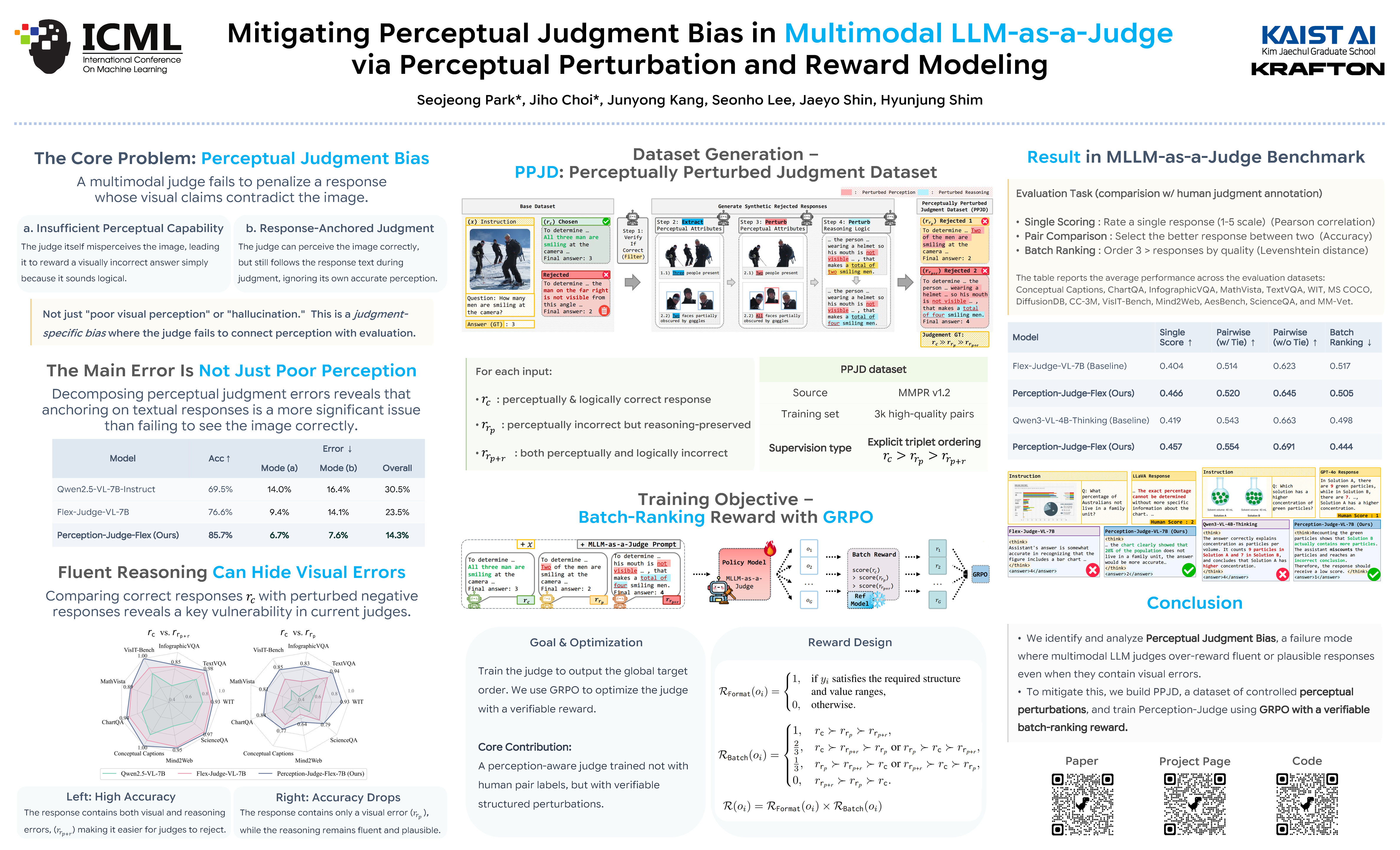
Recent multimodal large language models have demonstrated strong reasoning ability, yet their reliability as automated evaluators remains limited by a critical weakness: when visual evidence conflicts with textual cues, MLLM judges tend to reward plausible narratives over perceptually correct answers. We identify and systematically analyze this phenomenon, which we term \textit{Perceptual Judgment Bias}. Through controlled visual perturbations, existing multimodal judges frequently anchor on the response text instead of their own visual perception, leading to inconsistent and non-verifiable evaluations. To address this issue, we introduce the \textit{Perceptually Perturbed Judgment Dataset}, which constructs minimally edited counterfactual responses that isolate perceptual errors and enable verifiable supervision. Building on this dataset, we develop a unified training framework that combines a structured GRPO-based reward with a batch-ranking objective, achieving coherent global ordering without explicit pairwise labels. Experiments across diverse MLLM-as-a-Judge benchmarks show that our approach substantially improves perceptual fidelity, ranking coherence, and alignment with human evaluation. Our results establish a scalable and generalizable pathway for training multimodal judges that are perceptually grounded, interpretable, and robust to visual–reasoning conflicts.
Lay Summary
This paper helps AI systems judge image-based answers more reliably by teaching them to trust what is actually shown in the image rather than convincing but incorrect text.