
Towards Generative Graph Matching for Graph Edit Distance Computation
Abstract
Lay Summary
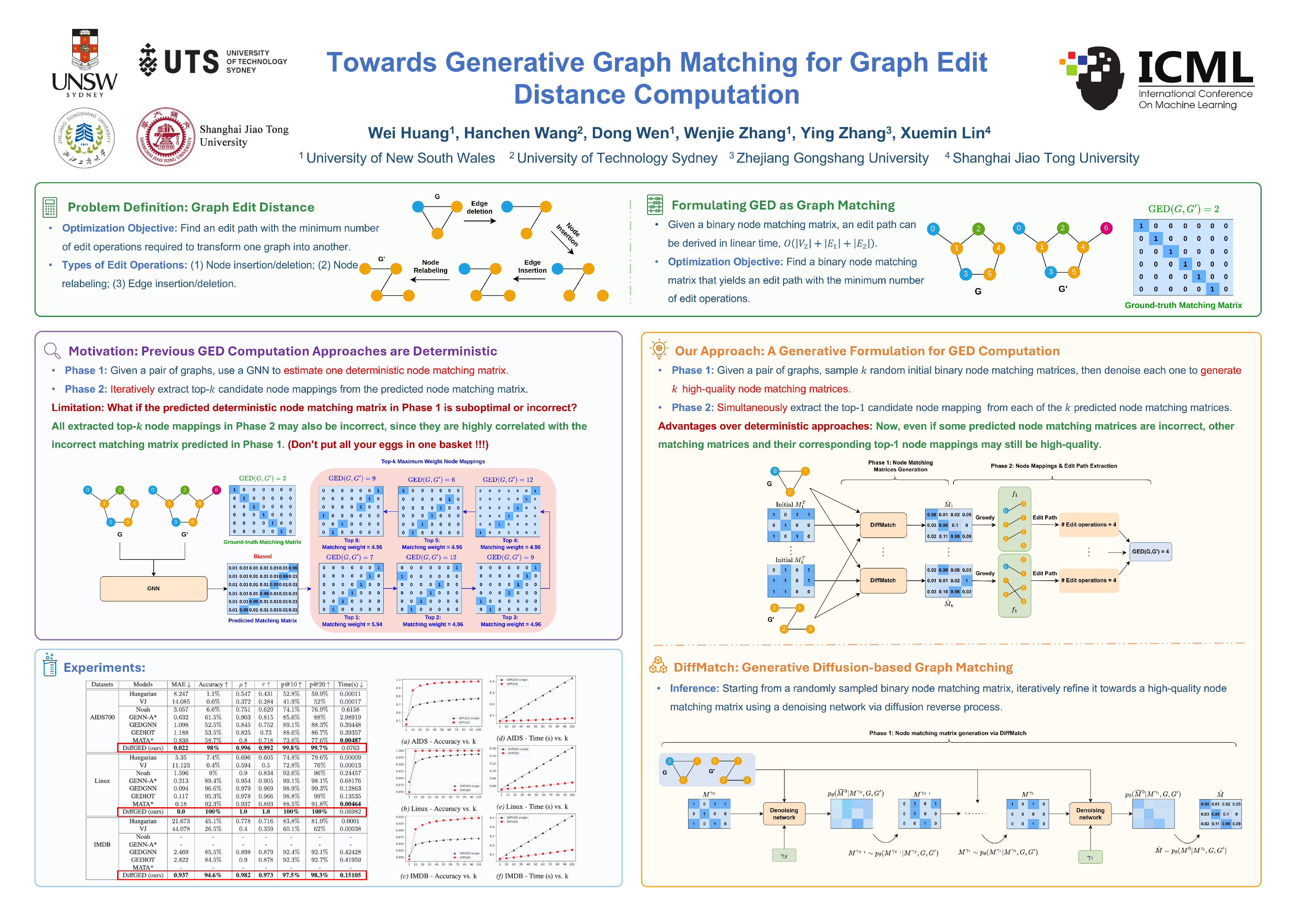
Graph Edit Distance (GED) is a way to measure how different two graphs are by finding the minimum number of edit operations needed to transform one graph into another. It is widely used in applications such as pattern recognition and graph similarity search, but it is also computationally very difficult to solve exactly. Existing learning-based methods approximate GED by predicting a single distribution and then extracting multiple candidate edit paths from it to find the one with the minimum number of edit operations. However, this is essentially a “putting all eggs in one bucket” strategy. What if the single predicted distribution fails? The candidate edit paths derived from it may all suffer from poor quality, making it difficult to discover a good solution. In this paper, we propose DiffGED, a new generative approach for GED computation. Instead of relying on a single predicted distribution, DiffGED generates multiple diverse distributions using a diffusion-based generative model. This allows candidate edit paths to be extracted from different distributions, increasing the chance of obtaining high-quality edit paths even when some predicted distributions are inaccurate. Experiments on real-world datasets show that DiffGED produces high-quality solutions that are close to exact results, while being faster than existing methods.