
Beyond Temperature: Hyperfitting as a Late-Stage Geometric Expansion
Abstract
Lay Summary
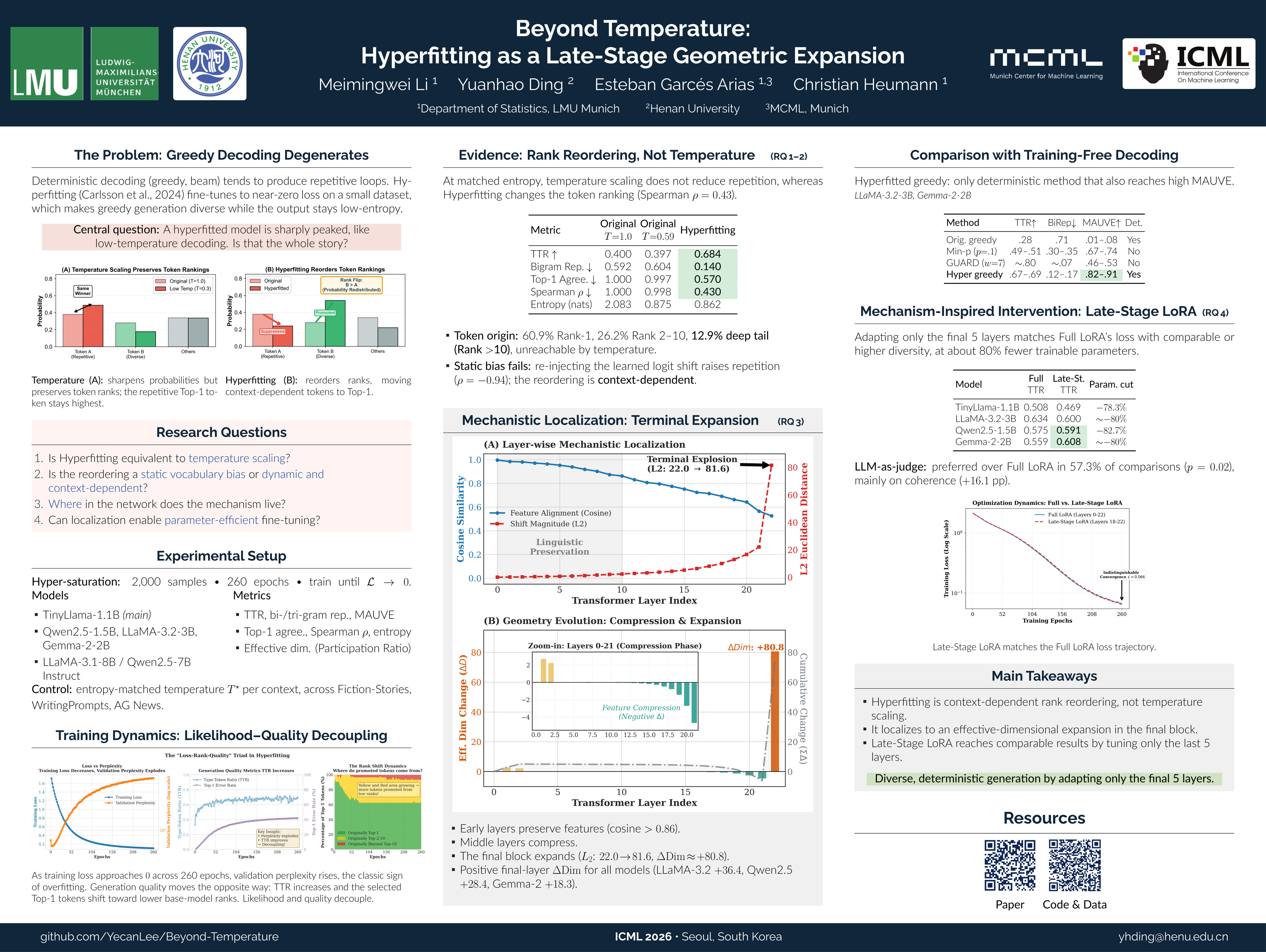
AI text generators like chatbots often get stuck repeating themselves when they always pick the word they judge most likely. A surprising fix was recently found: training a model over and over on a tiny set of examples until it memorizes them. This kind of over-memorization is usually a mistake, yet it makes the text more varied and natural. We show why: rather than simply making the model more confident in its existing favorite word, the technique changes its mind about which word fits best, favoring fresh choices over repetitive ones. And it does this almost entirely in the network's final stage. So adapting just those last few layers reproduces the benefit while training about 80% fewer parameters, making fluent text generation cheaper and more accessible.