
Native Parallel Reasoner: Reasoning in Parallelism via Self-Distilled Reinforcement Learning
Tong Wu ⋅ Michael Liu ⋅ Jun Bai ⋅ Zixia Jia ⋅ Shuyi Zhang ⋅ Ziyong Lin ⋅ Yanting Wang ⋅ Song-Chun Zhu ⋅ Zilong Zheng
Abstract
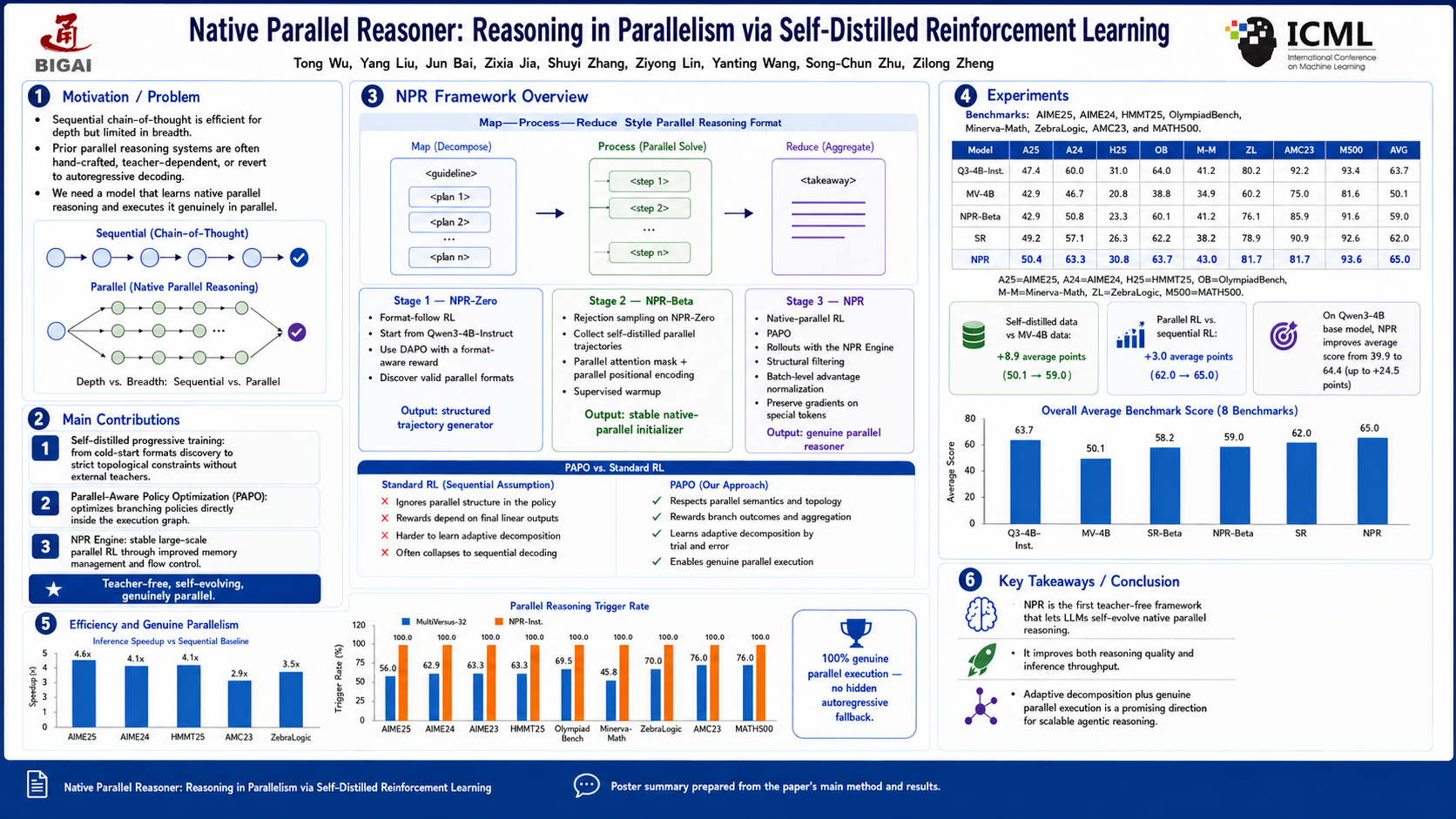
We introduce **Native Parallel Reasoner (NPR)**, a teacher-free framework that enables Large Language Models (LLMs) to self-evolve genuine parallel reasoning capabilities. NPR transforms the model from sequential emulation to native parallel cognition through three key innovations: (1) a **self-distilled** progressive training paradigm that transitions from cold-start format discovery to strict topological constraints without external supervision; (2) a novel **Parallel-Aware Policy Optimization (PAPO)** algorithm that optimizes branching policies directly within the execution graph, allowing the model to learn adaptive decomposition via trial and error; and (3) a robust **NPR Engine** that refactors memory management and flow control of SGLang to enable stable, large-scale parallel RL training. Across eight reasoning benchmarks, NPR trained on Qwen3-4B achieves performance gains of up to 24.5\% and inference speedups up to 4.6$\times$. Unlike prior baselines that often fall back to autoregressive decoding, NPR demonstrates 100\% genuine parallel execution, establishing a new standard for self-evolving, efficient, and scalable agentic reasoning.
Lay Summary
Large Language Models (LLMs) today typically reason step by step, one thought at a time, but humans often tackle problems by exploring multiple paths simultaneously. We introduce Native Parallel Reasoner (NPR), a framework that enables LLMs to self-evolve genuine parallel reasoning capabilities without any external supervision. NPR transforms models from sequential thinking to native parallel cognition through three innovations. First, a self-distilled progressive training paradigm guides the model from discovering its own reasoning format to operating under strict structural constraints, all without a teacher. Second, a novel Parallel-Aware Policy Optimization (PAPO) algorithm lets the model learn, through trial and error, how to adaptively break problems into branches it can explore at the same time. Third, a robust NPR Engine ensures this process runs stably at large scale. Tested across eight reasoning benchmarks, NPR, trained on a 4-billion-parameter model, achieves performance gains of up to 24.5\% and inference speedups of up to 4.6$\times$. Critically, unlike prior approaches that often fall back to thinking sequentially, NPR demonstrates 100\% genuine parallel execution, establishing a new standard for efficient and scalable reasoning.
Video
Chat is not available.
Successful Page Load