
Collaborative and Efficient Fine-tuning: Leveraging Task Similarity
Abstract
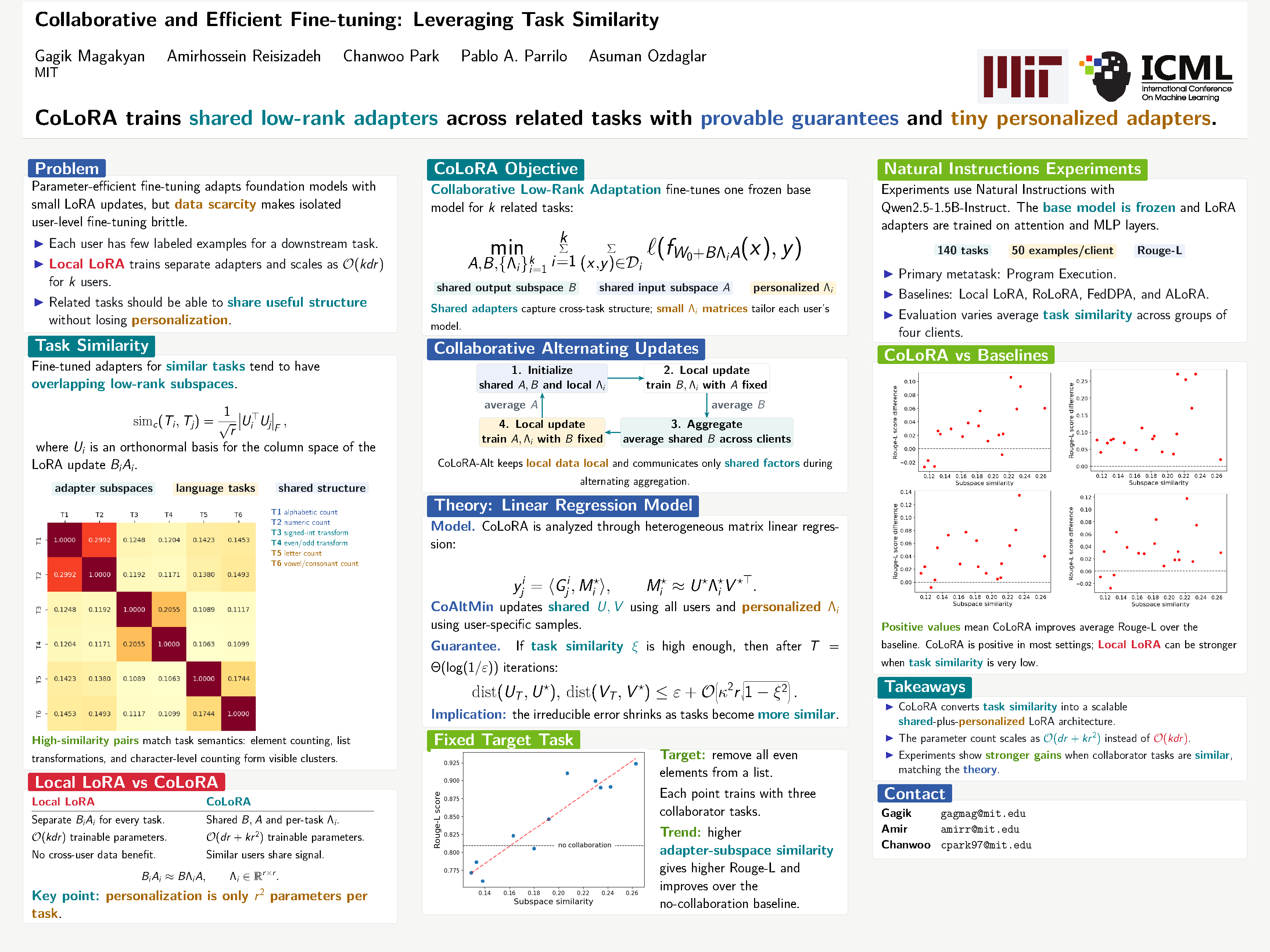
Adaptability has been regarded as a central feature in the foundation models, enabling them to effectively acclimate to unseen downstream tasks. Parameter-efficient fine-tuning methods such as celebrated LoRA facilitate efficient adaptation of large foundation models using labeled, high-quality and generally scarce task data. To mitigate data scarcity in fine-tuning of foundation models, we propose to leverage task similarity across downstream users. Intuitively, users with similar tasks must be able to assist each other in boosting the effective fine-tuning data size. We propose Collaborative Low-Rank Adaptation, or CoLoRA, which exploits task similarity to collaboratively and efficiently fine-tune personalized foundation models. The main idea in CoLoRA is to train one shared adapter capturing underlying task similarities across all tasks, and personalized adapters tailored to user-specific tasks. We theoretically study CoLoRA on heterogeneous linear regression and provide provable guarantees for ground truth recovery. We also conduct several natural language experiments with varying task similarity, which further demonstrate that when trained together with similar tasks, individual performances are significantly boosted.
Lay Summary
Training a powerful AI model on your own data works well — but only if you have enough data. In practice, individual users often have very limited labeled examples for their specific task, making it hard to get good performance. This is the data scarcity problem. We propose CoLoRA (Collaborative Low-Rank Adaptation), a method that lets multiple users with similar tasks pool their data implicitly by sharing part of their model. The key insight is that similar tasks — say, summarizing text in different languages, or counting different kinds of items in a list — tend to produce AI model updates that share common structure. CoLoRA trains one shared component capturing what all tasks have in common, plus small private components tailored to each individual user, without ever requiring users to share their raw data. We prove mathematically that this approach recovers the correct model given enough data, and we show experimentally that users with similar tasks consistently outperform those who train alone on their limited data. Crucially, CoLoRA adds only a tiny number of extra parameters per new user, making it practical to scale to thousands of participants. This opens the door to more effective and privacy-friendly collaborative AI fine-tuning.