
Adaptive Volumetric Mechanical Property Fields Invariant to Resolution
Abstract
Lay Summary
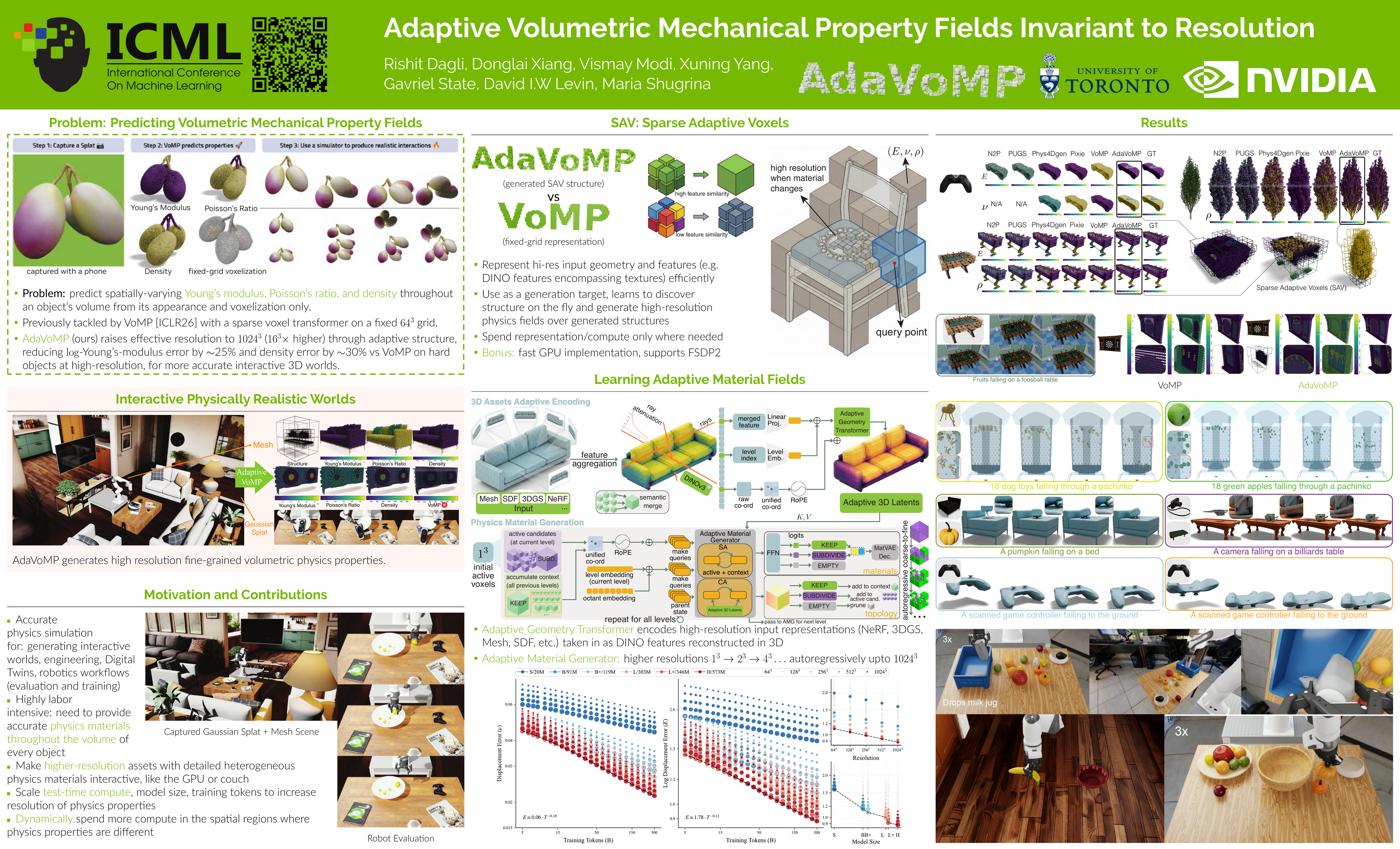
Most 3D objects used in digital worlds describe only how things look, not how they physically behave. For realistic robot training, games, and simulations, we also need to know properties such as how stiff, compressible, or heavy each part of an object is, including inside the object rather than just on its surface. Adding this information by hand is slow, difficult, and often impossible for large collections of objects. We introduce AdaVoMP, a machine learning method that automatically predicts these physical material properties for complex 3D objects. Instead of treating every part of an object at the same level of detail, our method uses a flexible 3D grid that spends more detail near important boundaries and complex regions, while using less detail in simple uniform areas. This makes it possible to predict material fields at much higher resolution than previous methods while staying efficient. Our results show that AdaVoMP produces more accurate material predictions than prior approaches and can turn high-resolution 3D assets into objects that are ready for realistic physics simulation. This helps move toward scalable creation of interactive digital worlds for robotics and physical AI.