
TimeOmni-VL: Unified Models for Time Series Understanding and Generation
Abstract
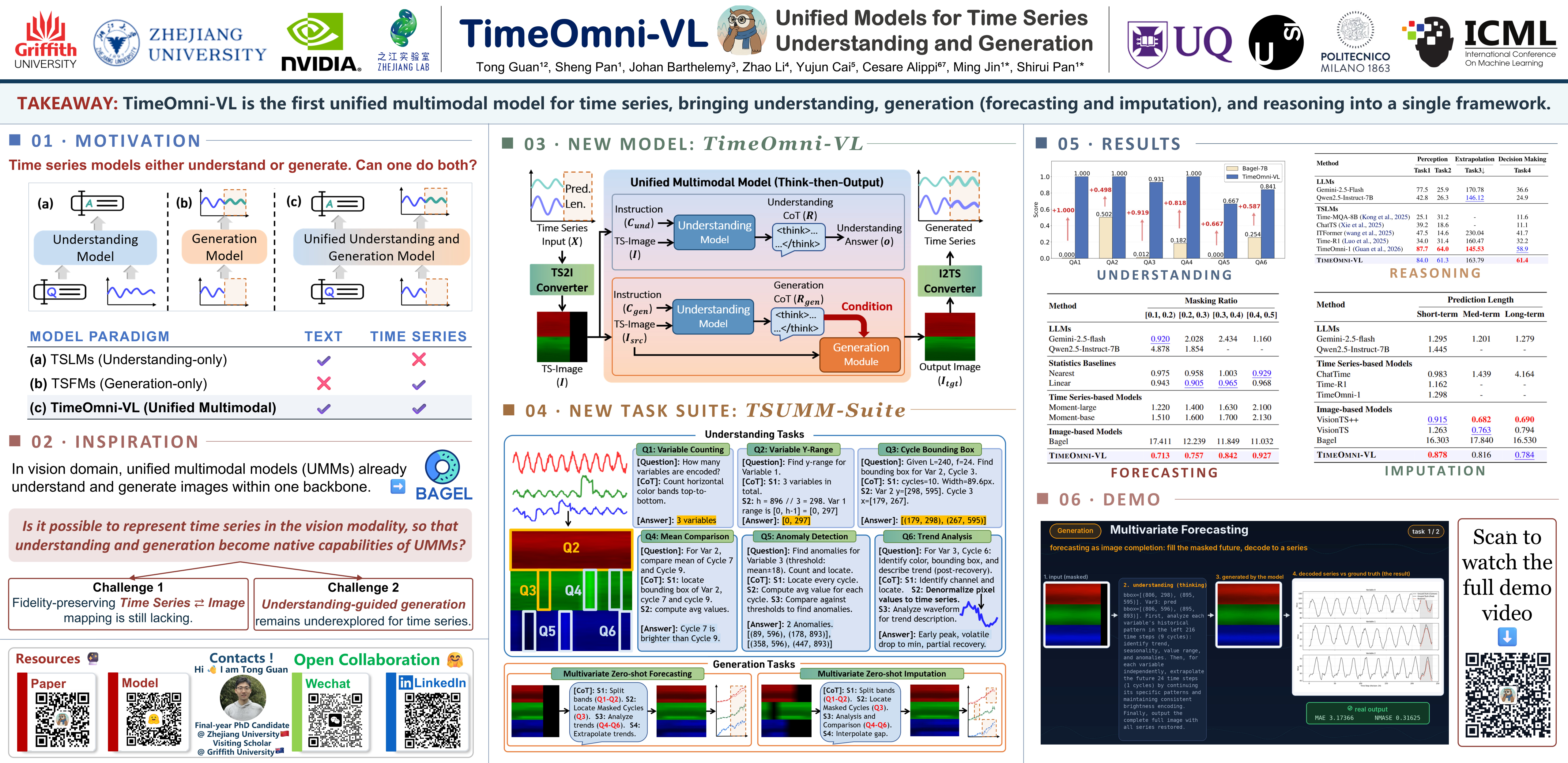
Recent time series modeling faces a sharp divide between numerical generation and semantic understanding, with research showing that generation models often rely on superficial pattern matching, while understanding-oriented models struggle with high-fidelity numerical output. Although unified multimodal models (UMMs) have bridged this gap in vision, their potential for time series remains untapped. We propose TimeOmni-VL, the first vision-centric framework that unifies time series understanding and generation through two key innovations: (1) Fidelity-preserving bidirectional mapping between time series and images (Bi-TSI), which advances Time Series-to-Image (TS2I) and Image-to-Time Series (I2TS) conversions to ensure near-lossless transformations. (2) Understanding-guided generation. We introduce TSUMM-Suite, a novel dataset consisting of six understanding tasks rooted in time series analytics and coupled with two generation tasks. With a calibrated Chain-of-Thought (CoT), TimeOmni-VL is the first to leverage time series understanding as an explicit control signal for high-fidelity generation. Experiments confirm that this unified approach significantly improves semantic understanding and numerical precision, establishing a new frontier for multimodal time series modeling.
Lay Summary
Time series data record how measurements change over time, such as changes in a patient’s condition or readings from a machine sensor. Today’s time series AI models often split into two groups: some predict or fill in values accurately, while others explain patterns such as trends and repeated cycles. It is still difficult for one model to do both well. TimeOmni-VL tackles this problem by turning time series into images, so a visual AI model can understand and generate temporal data in one system. To make this work, we design a two-way conversion between time series and images that preserves numerical information as faithfully as possible. We also build TSUMM-Suite, a dataset that teaches the model to locate variables, compare cycles, detect unusual patterns, and describe trends before forecasting or filling in missing values. Rather than generating outputs blindly, TimeOmni-VL first analyzes the structure of the time series image and then uses this understanding to guide generation. Experiments show strong results on both time series understanding and generation, suggesting a new route toward AI systems that can explain temporal patterns while producing accurate numerical outputs.