
$\textit{S}$-SPPO: Semantic-Calibrated Self-Play Preference Optimization
Abstract
Lay Summary
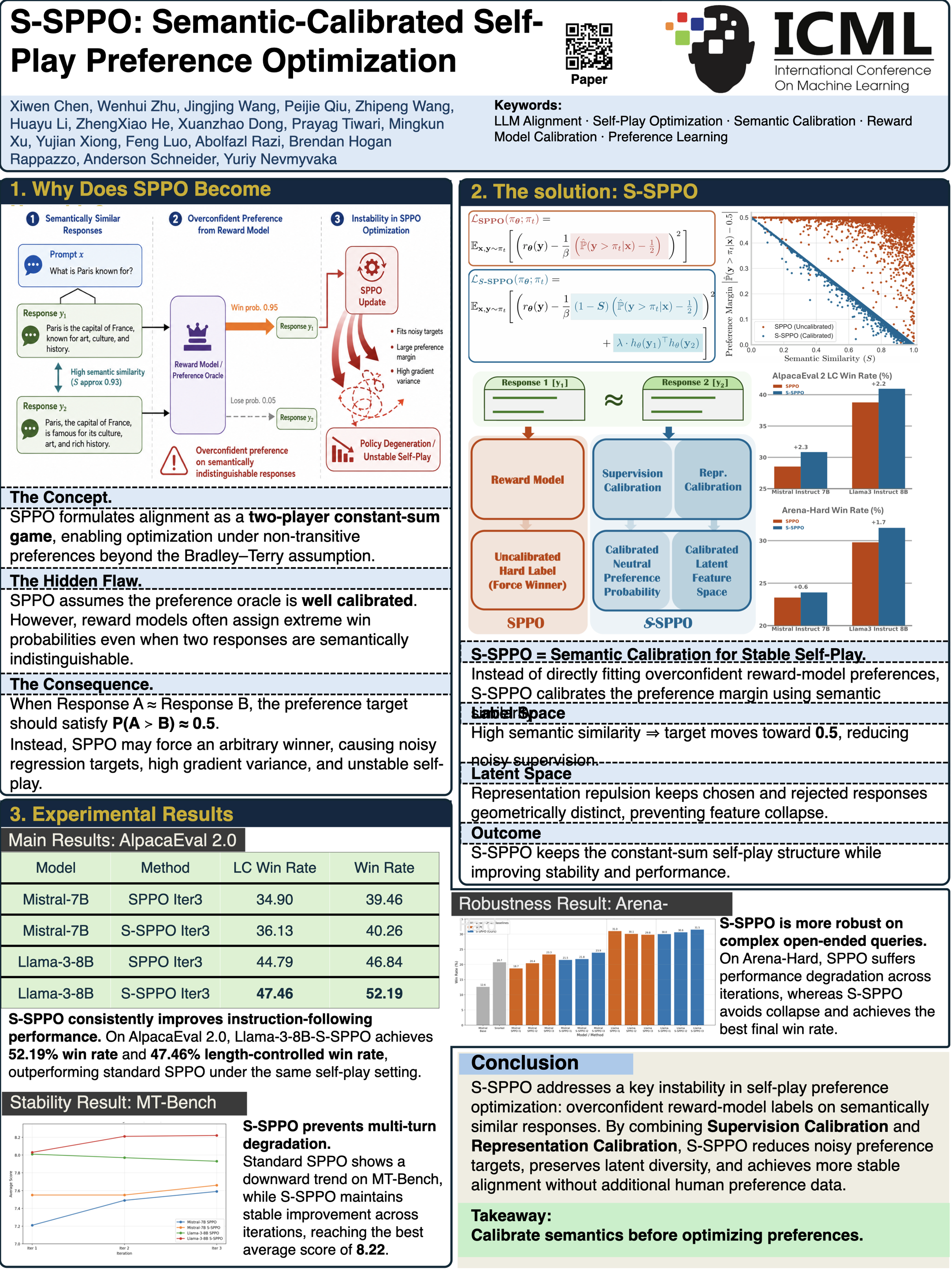
Recently, a promising way to train large language models is through "self-play" (SPPO). Inspired by game theory, this method treats learning like a competitive match: the model plays against itself by generating multiple answers, while an automatic "judge" scores them to help the model find an optimal balance, or "equilibrium". However, this game often breaks down because the judge makes a critical mistake: it confidently picks an arbitrary winner even when two responses mean the exact same thing. To solve this, we introduced S-SPPO, a training method that acts as a fairer referee by recognizing true similarity and forcing a tie for identical-meaning answers. It also ensures the large language model maintains diverse conversational abilities so it does not collapse into repeating the same outputs. This stabilizes the self-play learning process, allowing models to achieve record-breaking benchmark performance autonomously without relying on expensive human-labeled data.