
Physics-Informed Diffusion Models in Spectral Space
Abstract
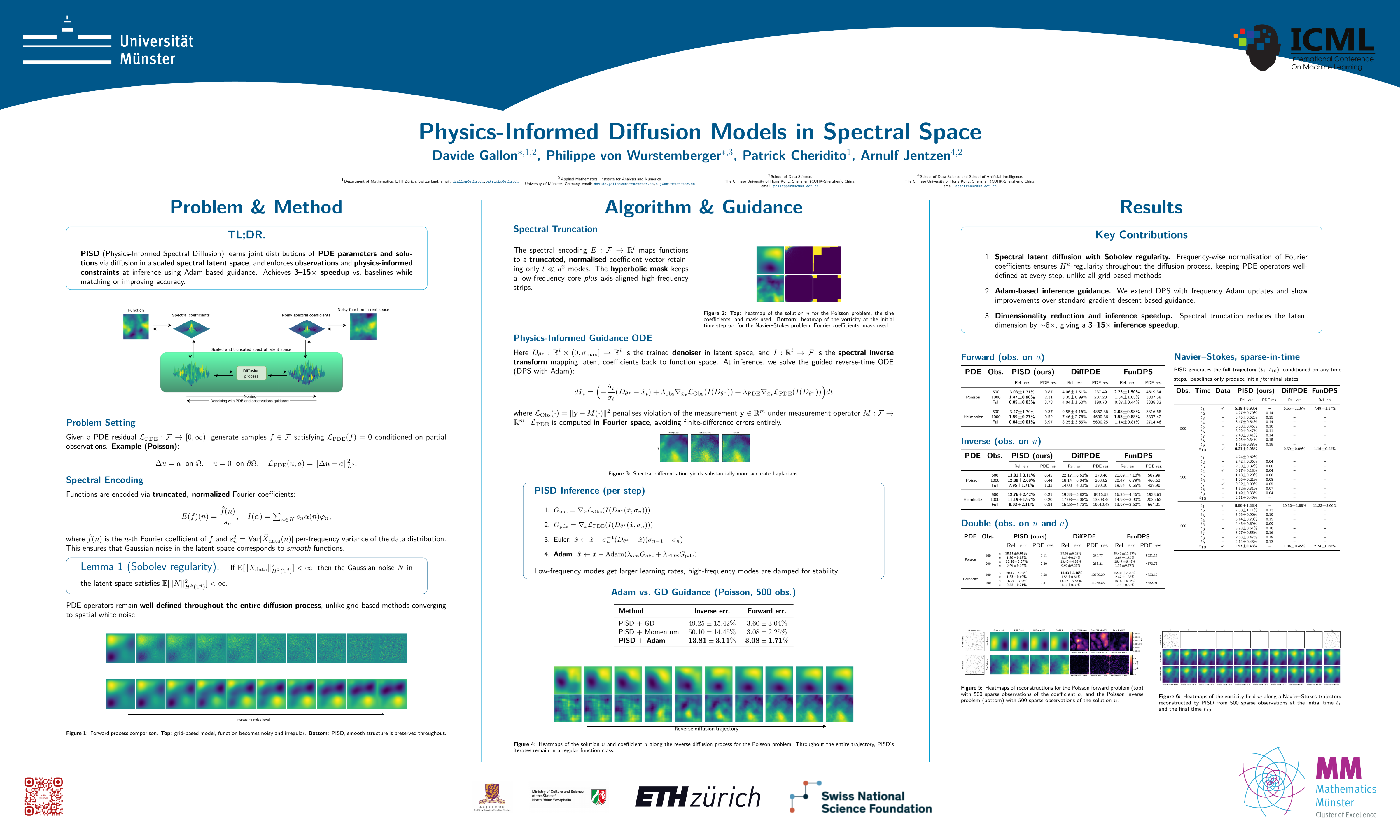
We propose physics-informed spectral diffusion (PISD), a methodology that combines generative latent diffusion models with physics-informed machine learning to generate solutions of partial differential equations (PDEs) conditioned on partial observations, which includes, in particular, forward and inverse PDE problems. We learn the joint distribution of PDE parameters and solutions via a diffusion process in a latent space of scaled spectral representations, where Gaussian noise corresponds to functions with controlled regularity. This spectral formulation enables significant dimensionality reduction compared to grid-based diffusion models and ensures that the induced process in function space remains within a class of functions for which the PDE operators are well defined. Building on diffusion posterior sampling, we enforce physics-informed constraints and measurement conditions during inference, applying Adam-based updates at each diffusion step. We evaluate the proposed approach on Poisson, Helmholtz, and incompressible Navier-Stokes equations, demonstrating improved accuracy and computational efficiency compared with existing diffusion-based PDE solvers, which are state of the art for sparse observations. Code is available at https://github.com/deeplearningmethods/PISD.
Lay Summary
Partial differential equations are mathematical tools used across science and engineering to describe how physical quantities, such as temperature, pressure, or velocity, change over space and time. In many applications, one needs to reconstruct these quantities from partial measurements, or to infer the hidden properties of a system from observations of its behavior. These problems are challenging, and AI-based methods are emerging as a promising tool to tackle them. We introduce physics-informed spectral diffusion (PISD), a method that combines generative AI with physical knowledge. Instead of representing physical quantities pixel by pixel, our approach works in a space of functions that is naturally suited to smooth physical phenomena. This makes the AI faster while also helping it produce results more consistent with the governing equations. Tested on three classical physics problems, PISD reconstructs solutions faster than existing methods, with comparable or better accuracy. This contributes to bringing AI-driven physical simulation closer to practical use in real-world scientific and engineering applications.