
Decoupling Regularization and Privacy in Differentially Private Ridge Regression and ERM
Abstract
Lay Summary
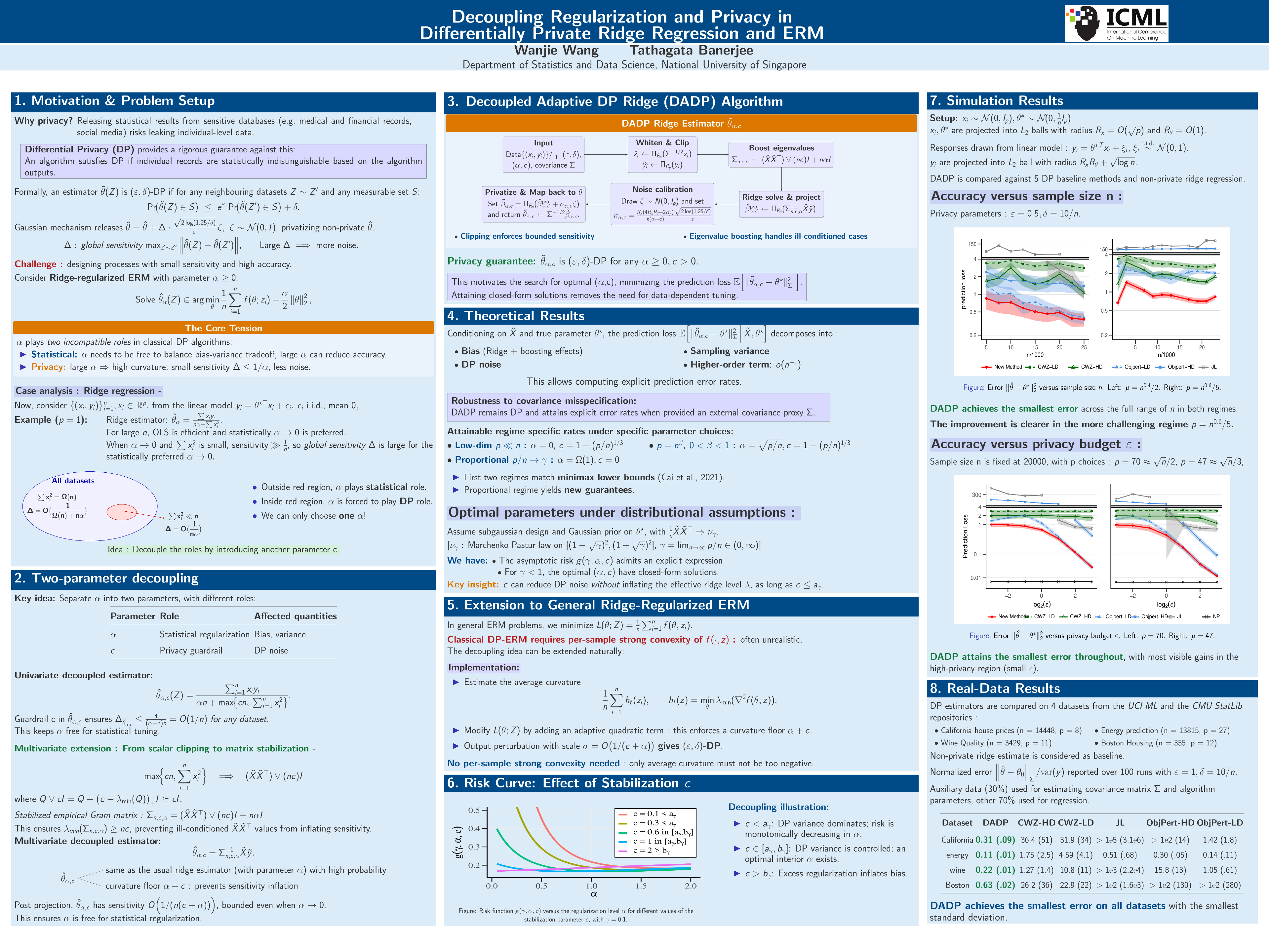
Modern data analysis often relies on sensitive individual-level data, making privacy protection an important requirement when releasing statistical models. Differential privacy addresses this by adding a random noise to model outputs, where the noise is calibrated by global sensitivity. In ridge regression, this creates a tuning challenge: the usual ridge parameter must both control statistical regularization and reduce the global sensitivity that determines noise calibration. These two roles can conflict, since stronger regularization improves privacy stability but increases statistical bias. We propose a two-parameter framework that separates these roles. One parameter controls statistical regularization, while the other acts as a privacy guardrail by stabilizing ill-conditioned datasets and reducing sensitivity. For ridge regression, this guardrail boosts the smallest eigenvalue of the empirical Gram matrix. We derive an explicit decomposition of the error into statistical bias, sampling variance, and privacy-induced variance, which leads to theory-guided parameter choices. We also extend the same idea to ridge-regularized ERM. Simulations and real-data experiments show that this decoupling improves accuracy over standard differentially private regression methods while maintaining rigorous privacy guarantees.